

TL;DR #
At hydraulic pressures above 10 MPa, low-hardness NBR O-rings (60–70 Shore A) exhibit dangerous stress concentration at the extrusion gap, with contact pressure peaks exceeding those of 90 Shore A seals by a measurable margin — but the same high-hardness seals generate significantly higher frictional power loss and accelerate rod wear. For buyers specifying NBR O-ring rod seals, hardness selection is not a generic “stiffer is safer” decision — the optimal range shifts depending on system pressure, rod velocity, and leakage tolerance. Unless your system operates above 15 MPa with large rod-housing clearance, specifying 70–80 Shore A gives the best balance of leakage control and friction economy, and you should require suppliers to document the Shore A value with traceability to GB/T 531.1 or ISO 7619-1.
Overview #
Most procurement teams treat NBR O-ring hardness as a secondary spec — something stamped on a datasheet after material grade is confirmed. That is a mistake that shows up as unexplained rod leakage or premature seal wear during field service. Hardness directly governs the contact force distribution in the primary sealing zone, the lubricant film thickness under dynamic conditions, and the seal’s resistance to extrusion at high pressure — three mechanisms that interact in ways that are not obvious from static compression tests alone.
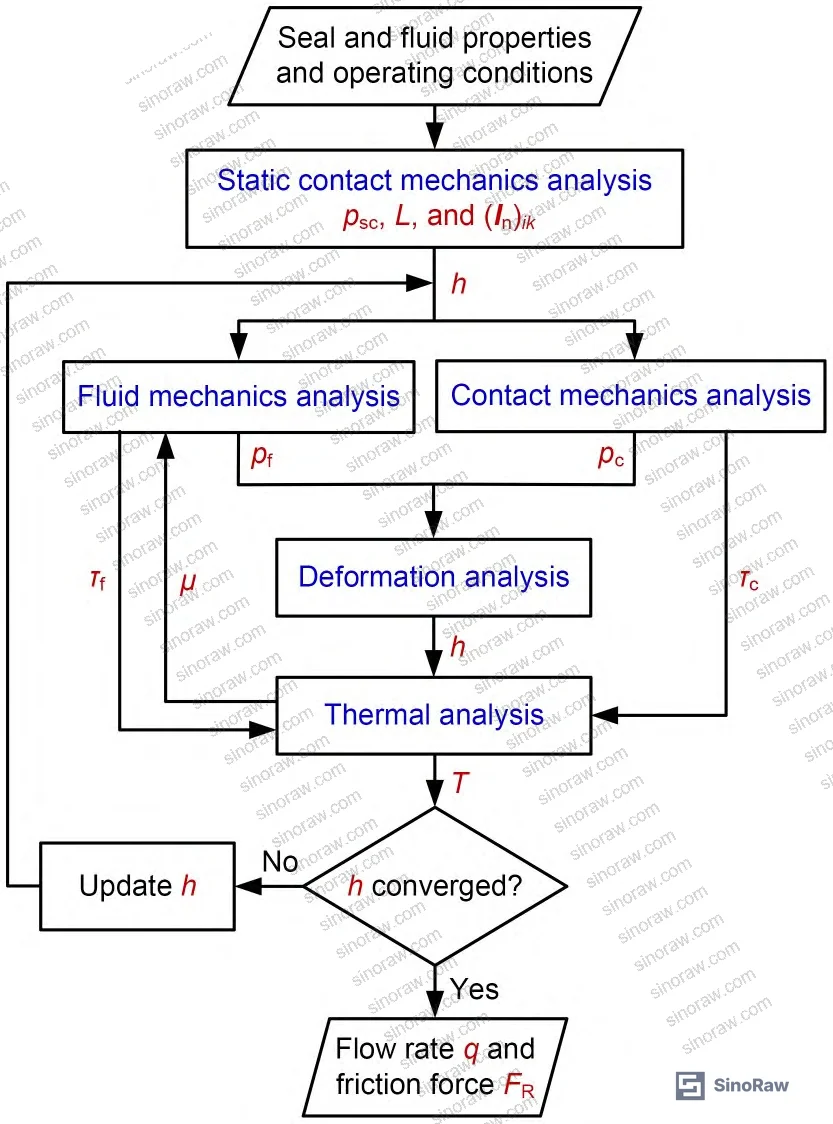
The analysis underpinning this guide was conducted by a university-based tribology and sealing research group using a coupled mixed-lubrication elastohydrodynamic model, validated across seven discrete Shore A hardness levels (60, 65, 70, 75, 80, 85, and 90 Shore A) and a broad range of operating conditions: sealed pressures from 1 MPa to 15 MPa, rod velocities from 50 mm/s to 500 mm/s, and surface roughness values representative of commercial hydraulic rod finishes. The seal geometry throughout was governed by GB/T 3452.3–2005 — China’s standard for O-ring housing dimensions — which aligns closely with international practice for metric hydraulic systems.
For hydraulic components sourced from Chinese manufacturers, this has direct qualification implications: suppliers quoting “standard NBR” without specifying hardness, or offering hardness only as a range (e.g., “70±5 Shore A”), are giving you a specification with enough latitude to deliver seals that behave very differently in service.
NBR Hardness Effects on Static Sealing Performance and Extrusion Risk #
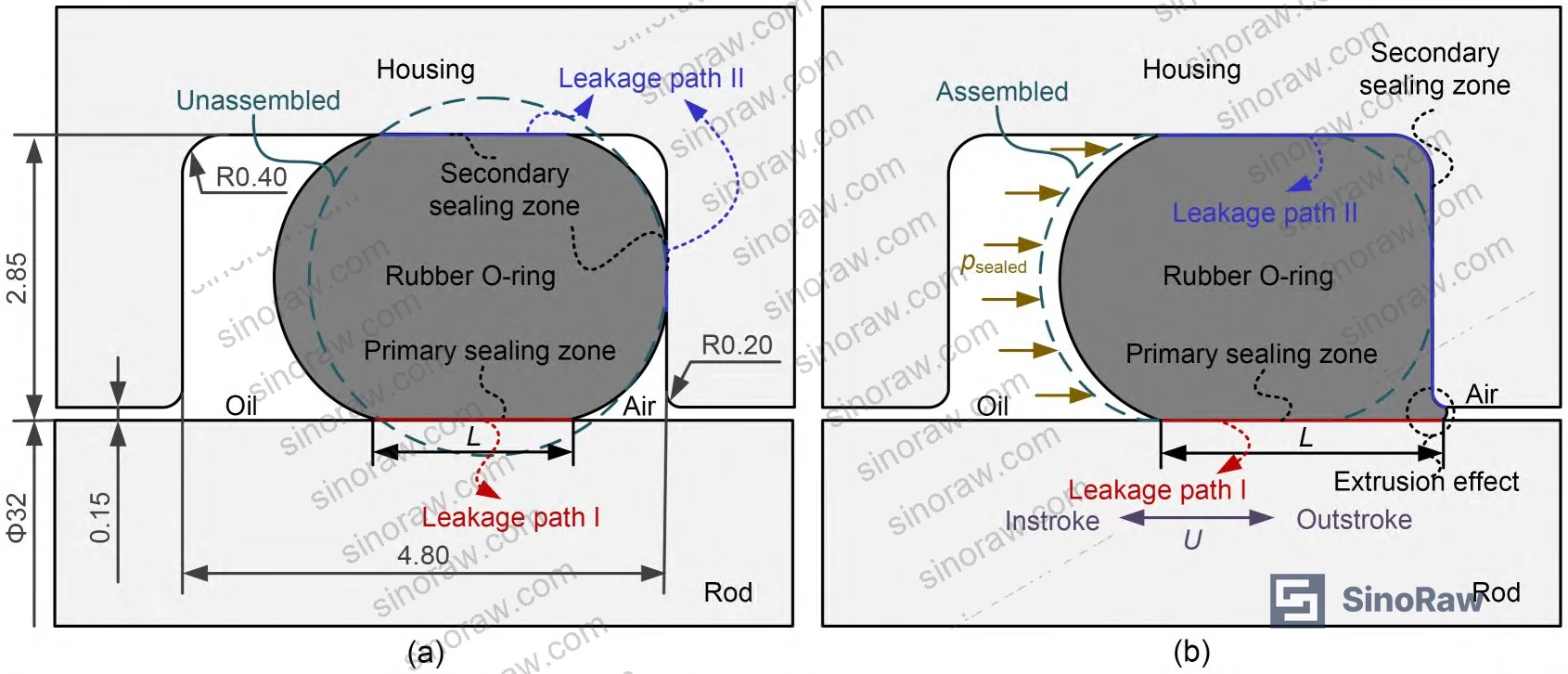
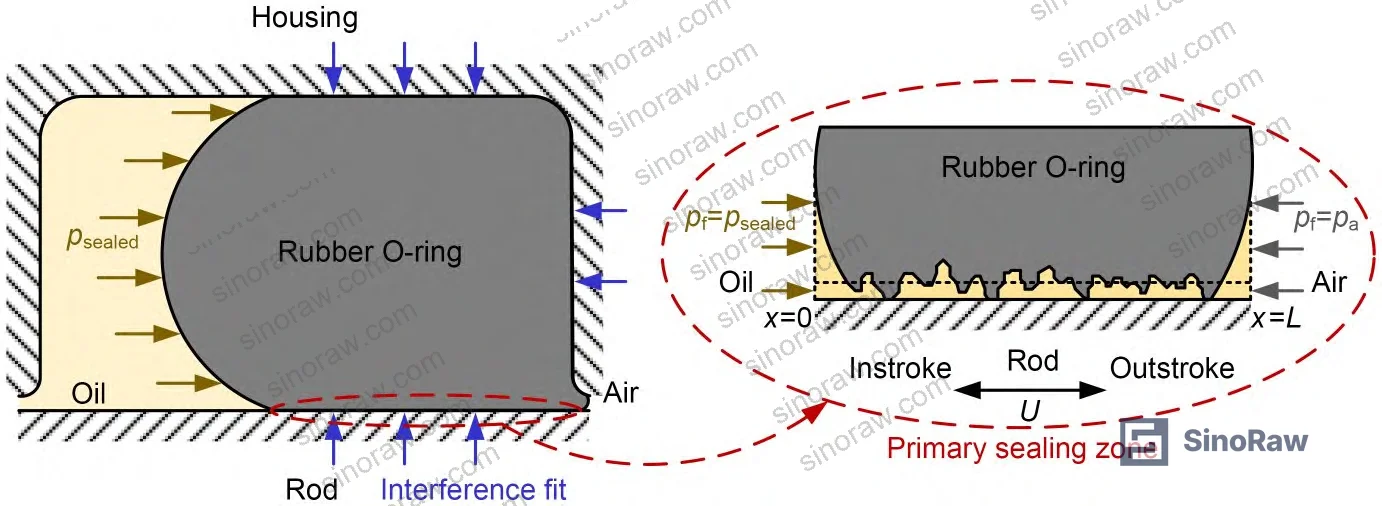
The static behavior of an O-ring rod seal is determined before the rod ever moves: interference fit compresses the seal into the housing groove, and then system pressure loads the fluid-side face. Both mechanisms produce contact pressure in the primary sealing zone (seal-to-rod interface) and the secondary sealing zone (seal-to-housing). Hardness controls how those contact pressures distribute.
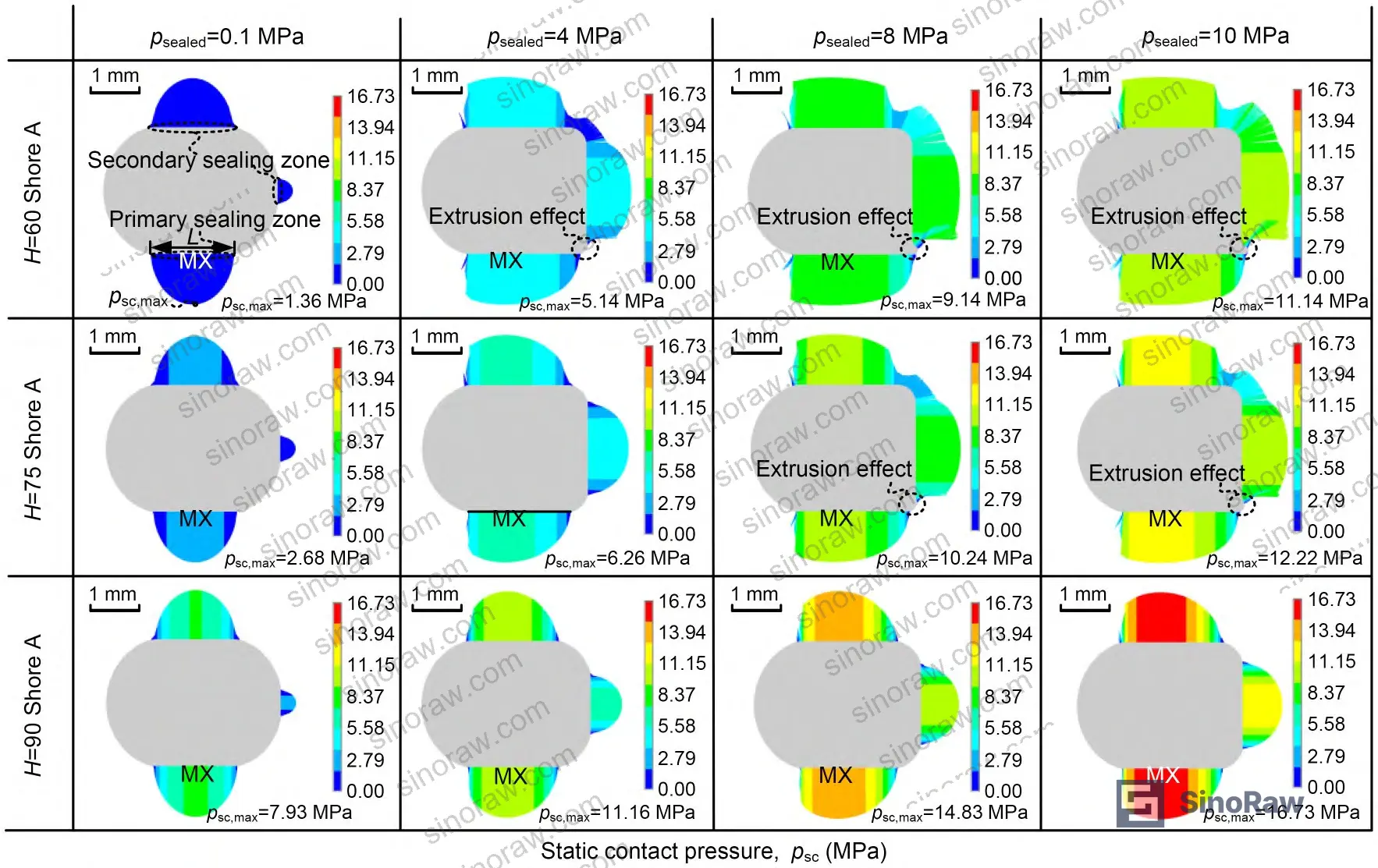
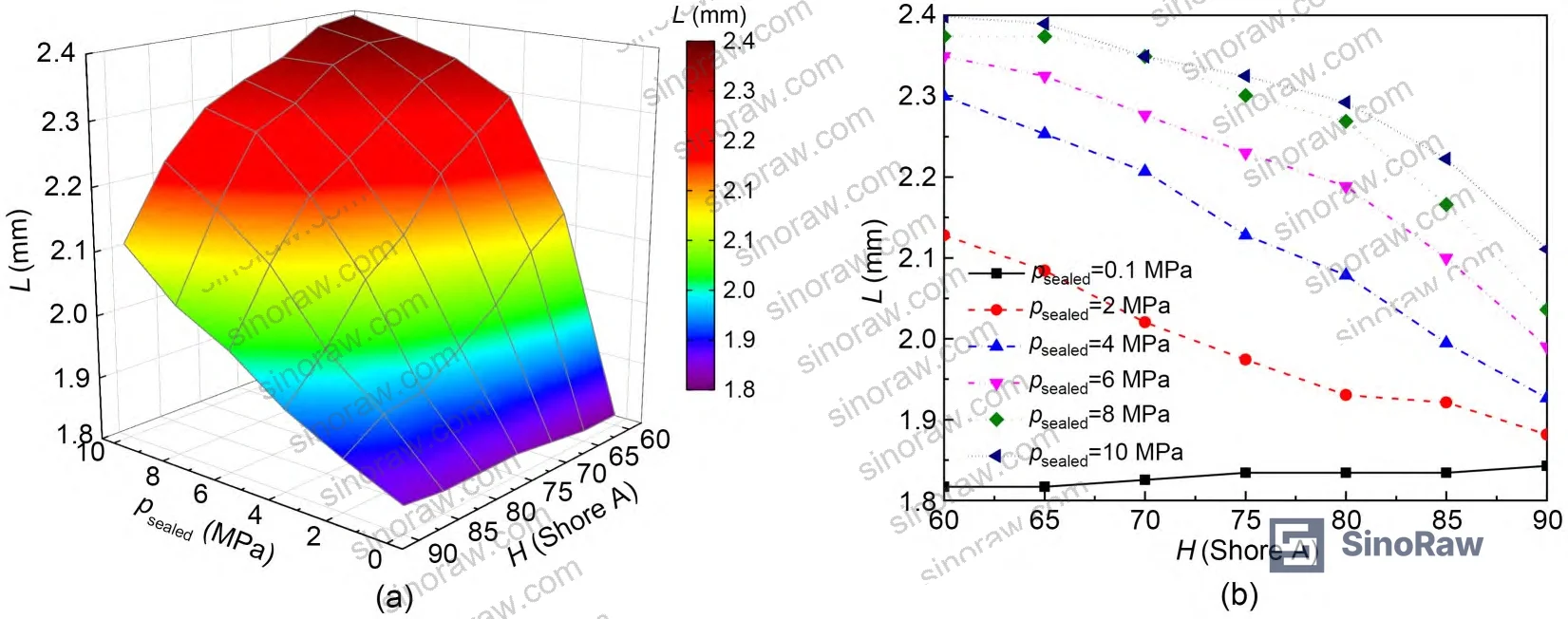
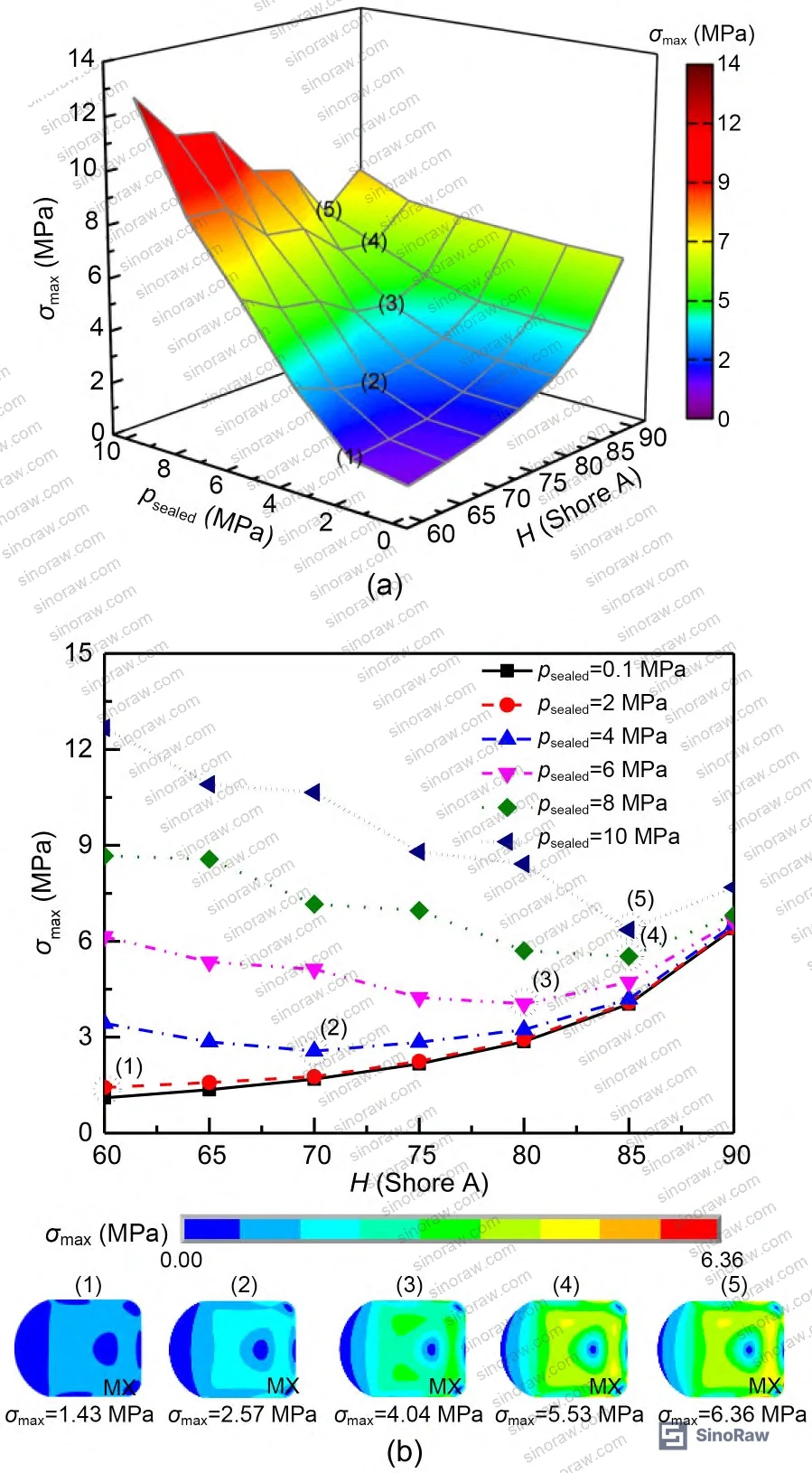
At low system pressure (1–5 MPa), the differences across the 60–90 Shore A range are modest. Peak contact pressure in the primary sealing zone increases with hardness, which is expected — a stiffer material resists deformation and concentrates force over a narrower contact footprint. The sealing zone length L decreases as hardness increases, which means high-hardness seals rely on a shorter, more intense contact line to maintain the seal.
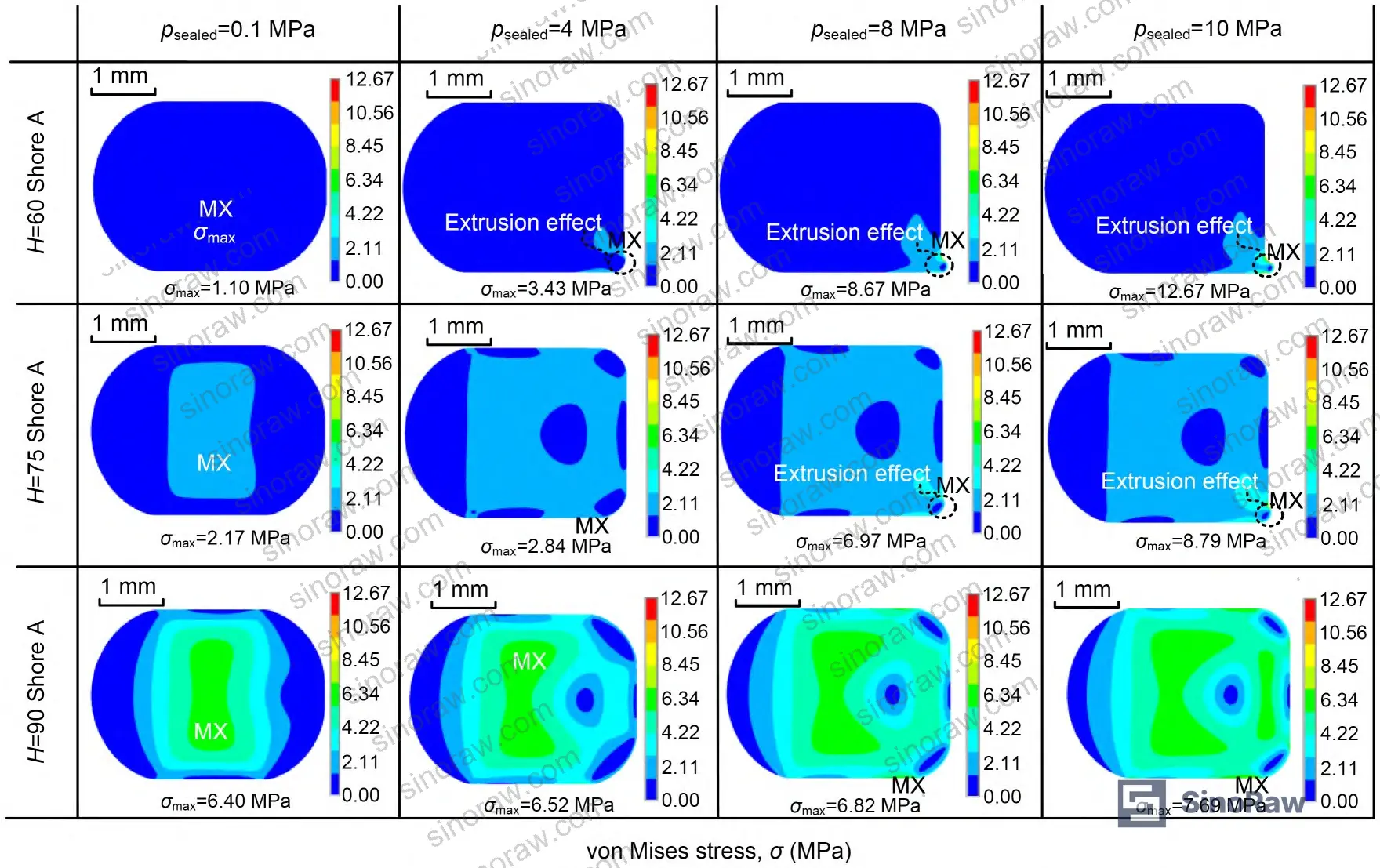
The critical divergence occurs above 10 MPa. At these pressures, the extrusion effect becomes dominant for low-hardness seals. The air-side lip of the seal is forced into the rod-housing clearance gap, producing a localized stress concentration that can reach failure-relevant magnitudes. At 15 MPa sealed pressure, a 60 Shore A seal shows substantially higher extrusion deformation compared to a 90 Shore A seal — the latter resists gap intrusion due to its higher elastic modulus (20.93 MPa for 90 Shore A vs. 3.62 MPa for 60 Shore A, a nearly 6× difference). This is why the 90 Shore A specification exists for high-pressure hydraulic applications; it is not arbitrary conservatism.
However — and this is where many specifications go wrong — the static contact pressure alone does not determine leakage. The dynamic film behavior during rod motion is equally critical, and it works in the opposite direction.
Mooney-Rivlin material parameters by Shore A hardness (NBR):
| Shore A Hardness | Elastic Modulus E (MPa) | Shear Modulus G (MPa) | C₁₀ (MPa) | C₀₁ (MPa) |
|---|---|---|---|---|
| 60 | 3.62 | 1.21 | 0.48 | 0.12 |
| 70 | 5.54 | 1.85 | 0.74 | 0.18 |
| 80 | 9.39 | 3.13 | 1.25 | 0.31 |
| 90 | 20.93 | 6.98 | 2.79 | 0.70 |
These parameters are not academic abstractions — they are the inputs your FEA vendor or seal manufacturer should be using when modeling seal behavior for your specific housing geometry and clearance tolerance. If a supplier cannot provide Mooney-Rivlin parameters for their material and can only quote “Shore A hardness,” that is a signal they are not doing predictive analysis.
Dynamic Sealing: Film Thickness, Leakage Rate, and Frictional Power Loss vs. Shore A Grade #
This is where the tradeoffs become operationally significant and where procurement decisions get complicated.
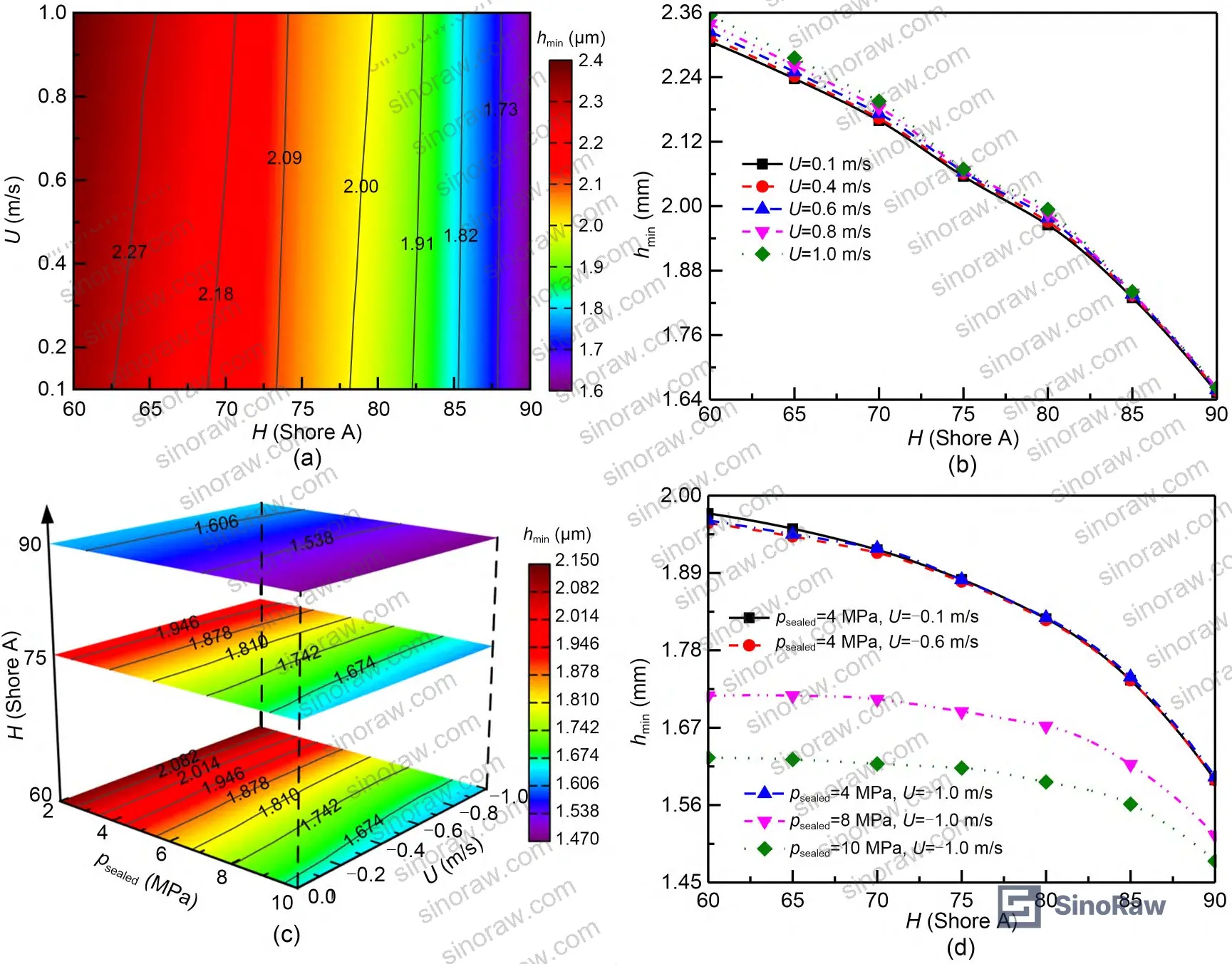
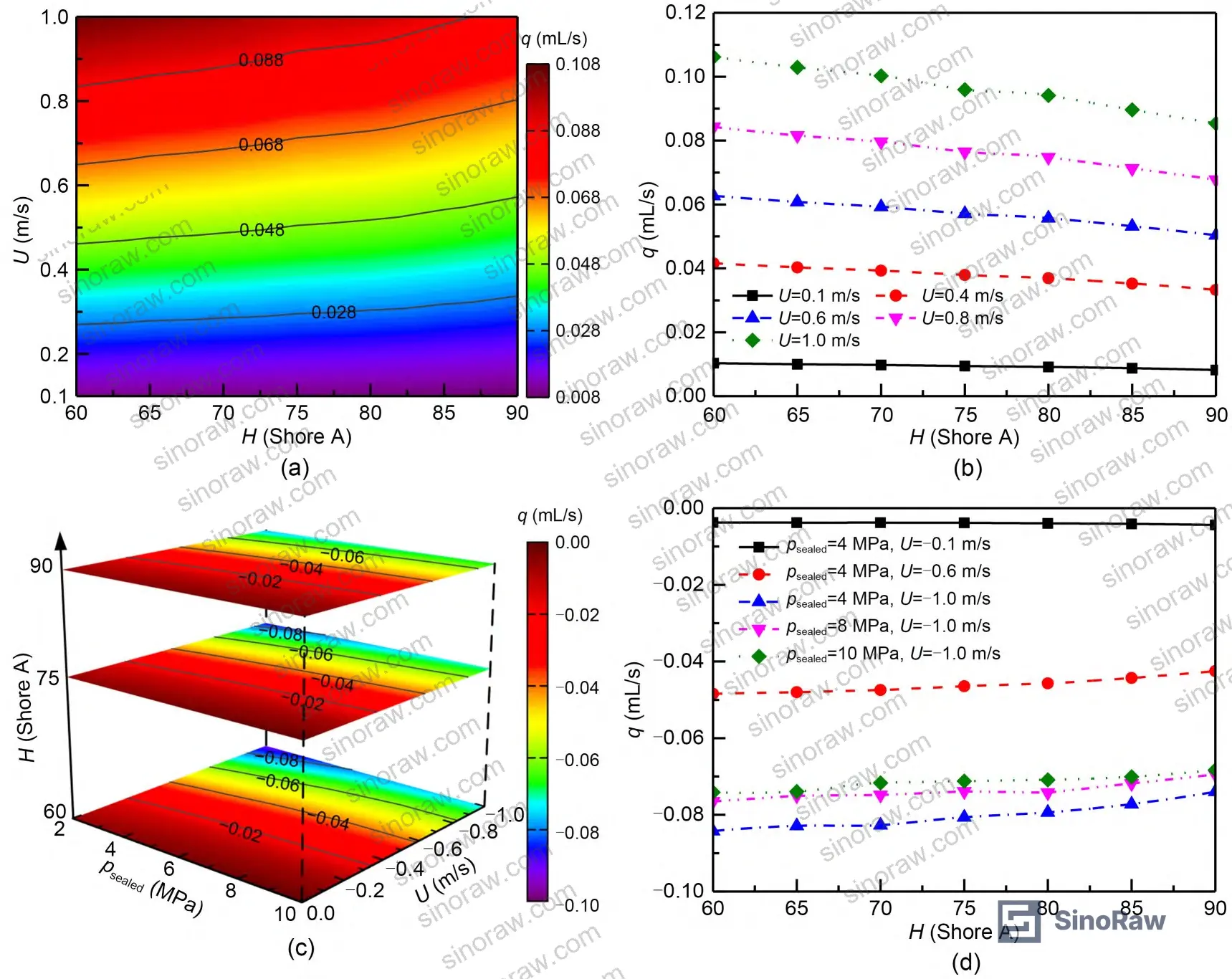
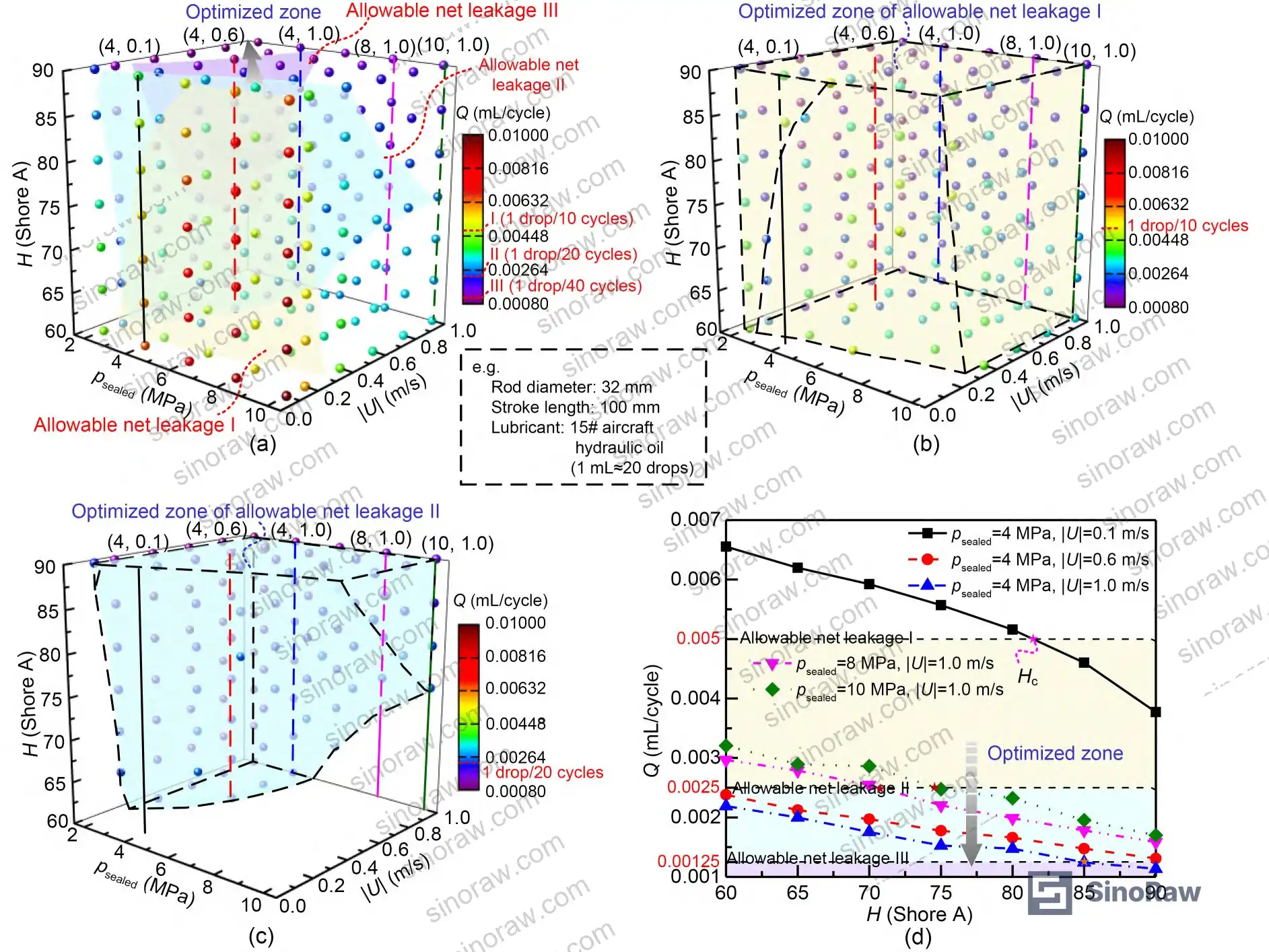
During rod motion, a micro-scale lubricant film forms in the primary sealing zone. The minimum film thickness h_min governs whether the seal operates in full-film lubrication (low wear, low friction, but potential leakage) or mixed/boundary lubrication (high friction, wear risk, but effective sealing). Higher hardness reduces film thickness — a 90 Shore A seal generates a thinner film than a 60 Shore A seal under equivalent conditions — which is why high-hardness seals are better at preventing leakage dynamically.
Film thickness decreases monotonically with increasing hardness across the full 50–500 mm/s rod velocity range studied. At 200 mm/s rod speed and 10 MPa, the minimum film thickness for 60 Shore A is meaningfully larger than for 90 Shore A. This is consequential: a thicker film means less asperity contact, lower friction force, but a greater tendency for net fluid transport from the high-pressure side to the air side during outstroke.
The net leakage rate Q follows a similar pattern. During outstroke, the rod carries fluid from the sealed side toward the air side; during instroke, the opposite occurs. Net leakage is the algebraic sum per stroke cycle. Low-hardness seals show higher net leakage at all tested pressures and speeds. At 15 MPa, a 60 Shore A seal operating at 200 mm/s had positive net leakage (fluid escaping to atmosphere), while an 85–90 Shore A seal at the same conditions showed near-zero or negative net leakage — meaning it was actually pumping fluid back.
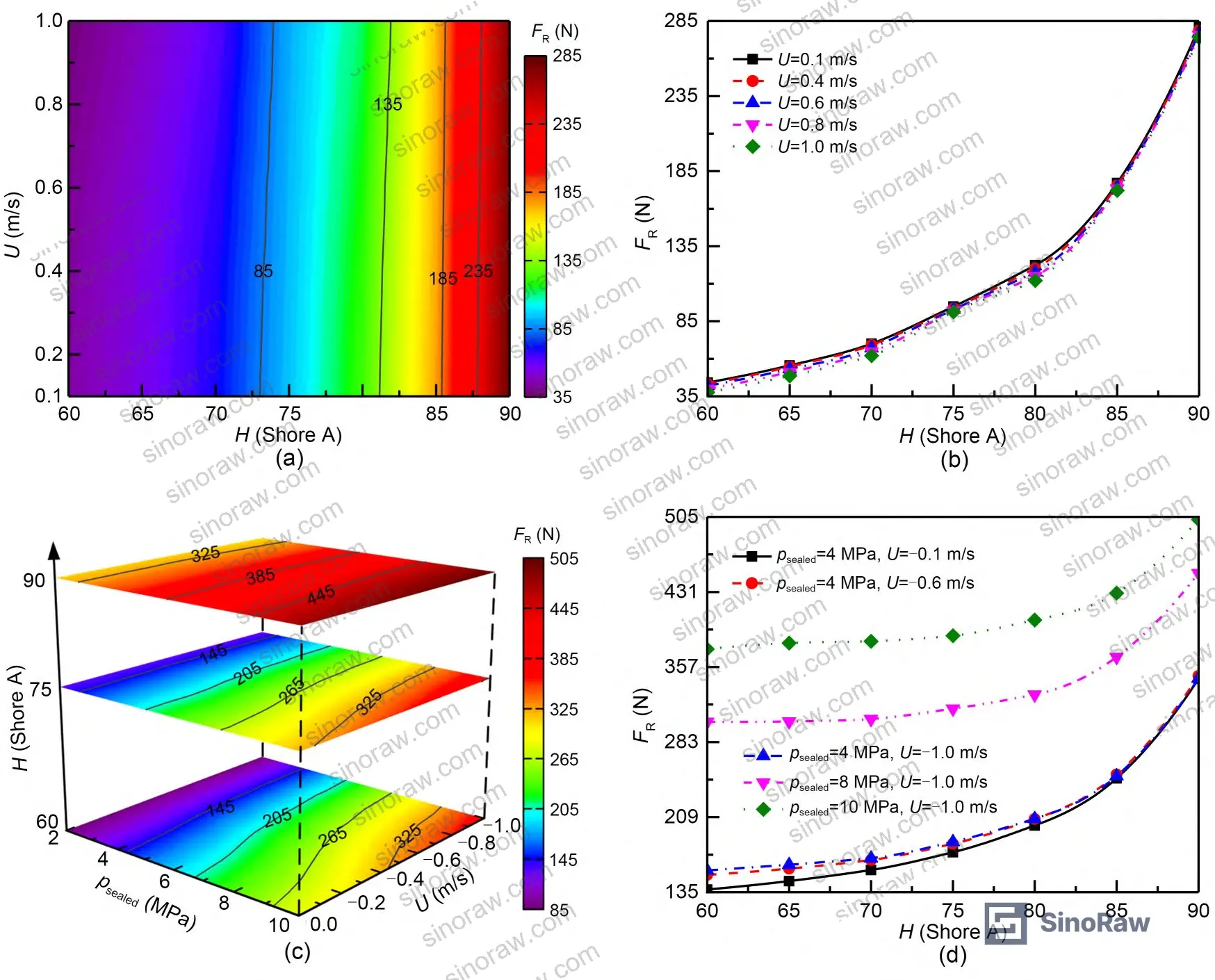
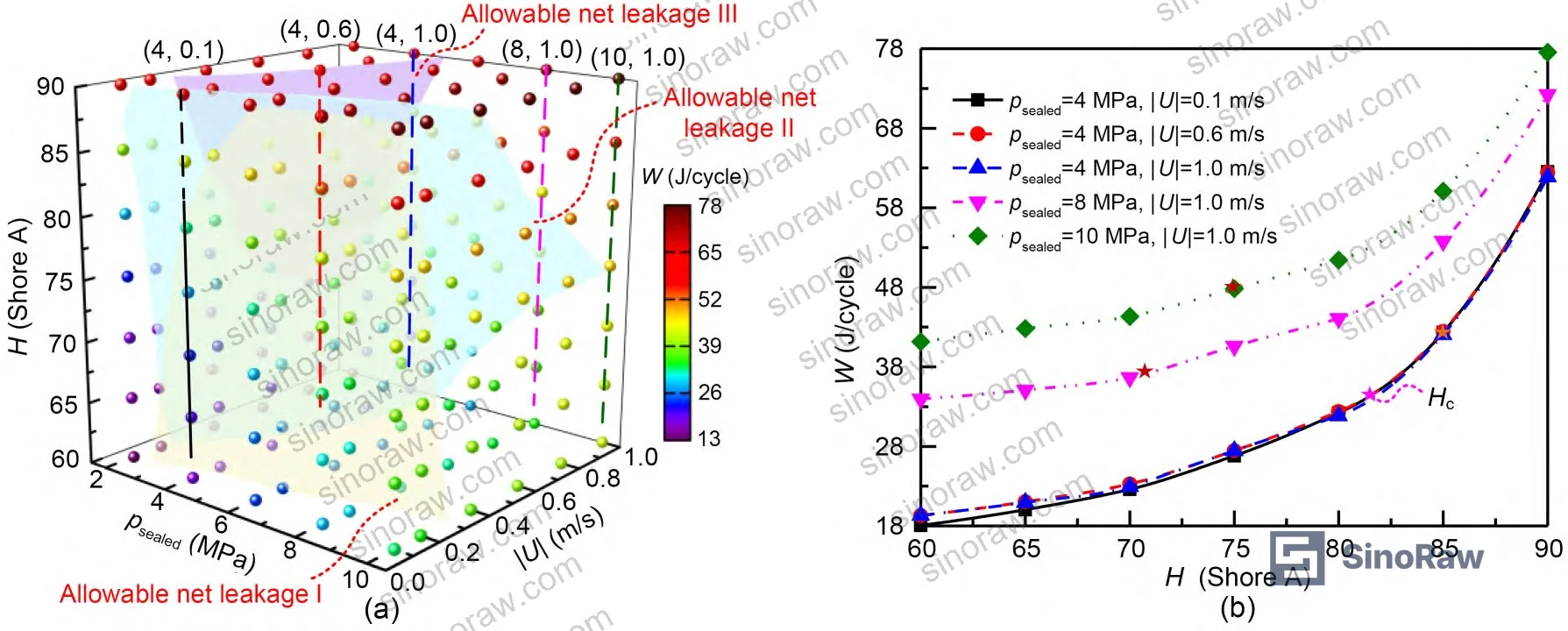
The friction penalty for high hardness is real and measurable. Friction force F_R increases substantially from 60 to 90 Shore A. At 10 MPa and 200 mm/s, the difference in frictional power loss W between a 60 Shore A and 90 Shore A seal exceeds 40% in the research data. Over a system with thousands of actuator cycles per day, this translates directly to hydraulic system efficiency loss and heat generation. Frictional power loss W scales with both stroke frequency and rod diameter — in high-cycle applications, over-specifying hardness is a measurable energy cost.
In supplier qualification, we have seen specifications that simply state “NBR 70 Shore A” as a universal default. Three of the six samples received in one audit batch tested outside ±5 Shore A of nominal — meaning some fell into the 65 Shore A range and others reached 75 Shore A — producing seals with elastic moduli that differed by nearly 60%. These were functionally different products that would behave differently in service, all labeled identically.
Most procurement teams do not realize that the ISO and IEC standards governing hydraulic seal testing — including how leakage and friction are measured — do not prescribe the hardness grade to use for a given pressure rating. That determination is left to the designer. This means the responsibility for getting hardness right sits entirely with the buyer’s specification, not with any certification the supplier holds. Citing IEC 62619:2022 for battery storage systems is routine, but for hydraulic seals there is no equivalent mandatory standard that forces a hardness call — you own that decision.
Optimized Hardness Selection: Pressure, Velocity, and Leakage Tolerance #
The research maps optimum hardness ranges across a matrix of operating conditions. The findings are more nuanced than “use 70 Shore A for medium duty” and deserve direct attention.
Recommended NBR Shore A hardness by operating condition:
| Operating Condition | Leakage Priority | Friction Priority | Recommended Hardness Range |
|---|---|---|---|
| Low pressure (≤5 MPa), low speed (≤100 mm/s) | Low risk | Low concern | 60–70 Shore A |
| Medium pressure (5–10 MPa), medium speed (100–300 mm/s) | Moderate | Moderate | 70–80 Shore A |
| High pressure (>10 MPa), any speed | Critical | Secondary | 80–90 Shore A |
| High speed (>300 mm/s), low-to-medium pressure | Low risk | High concern | 60–70 Shore A |
| High pressure + high speed | Critical | High concern | 75–85 Shore A (compromise) |
At low pressure and high rod speed, the dominant concern shifts to friction and film thickness — a 60–70 Shore A seal generates adequate film to prevent wear without leaking excessively, and the frictional power loss is substantially lower. Specifying 90 Shore A in this regime is over-specification; you pay the friction penalty without gaining meaningful leakage protection because system pressure alone is insufficient to drive significant leakage through a properly dimensioned seal.
At high pressure (above 10 MPa), the extrusion risk for low-hardness seals becomes the governing constraint. A 60 Shore A seal at 15 MPa with a clearance gap of 0.1 mm or more will show measurable extrusion deformation. The 90 Shore A seal resists this, but the same high contact pressure that prevents extrusion also generates peak friction force. The 80–85 Shore A range is the practical optimum for most high-pressure hydraulic actuators: it limits extrusion, maintains adequate contact sealing pressure, and avoids the worst friction penalties of the 90 Shore A grade.
Honestly, most buyers over-specify NBR hardness as a conservative reflex. They see “high pressure system” and default to 90 Shore A regardless of rod speed or cycle frequency. The data shows this is only optimal in a narrow condition band — high pressure, large clearance, low-to-medium speed. Outside that band, you are adding friction, heat, and wear risk unnecessarily.
Practical Guidance for Buyers #
Start your specification with system pressure and rod velocity — not material grade. If you cannot confirm maximum operating pressure and typical rod speed, you cannot make a defensible hardness call. Once those parameters are established, use the hardness-condition map above to narrow the range before approaching suppliers.
For Chinese-sourced NBR O-ring rod seals, request Shore A hardness as a controlled specification on the batch release certificate, not just as a nominal value on a datasheet. The acceptable tolerance should be ±3 Shore A for critical applications, ±5 Shore A for standard duty. Anything looser than ±5 means your “70 Shore A” seal could be delivering 65 or 75 Shore A performance, which are functionally different products with different leakage and friction profiles.
Verify that the housing groove dimensions comply with GB/T 3452.3–2005 or an equivalent ISO standard — the optimum hardness ranges discussed here assume standard groove geometry. Non-standard groove depth or width changes the initial compression ratio and shifts all the performance curves.
For high-pressure applications above 10 MPa, explicitly request extrusion gap documentation: the housing-to-rod clearance must be within the supplier’s validated range for the hardness grade supplied. Pairing a 70 Shore A seal with a 0.15 mm clearance at 15 MPa is a known failure mode.
At sinoraw.com, our role is to help overseas procurement engineers identify and qualify verified Chinese manufacturers of hydraulic sealing products — connecting buyers to suppliers who can demonstrate Shore A traceability, material certification, and dimensional conformance before an RFQ is issued. If you need to qualify multiple suppliers against a specific hardness and pressure requirement, our sourcing team can filter against your technical spec directly.
Need help identifying qualified suppliers for NBR O-ring rod seals? Talk to our sourcing team →
For broader sealing system context, see also our coverage of Pump & Valve Seals and related Fluid Control components sourced from Chinese manufacturers.
Supplier Qualification Questions #
- What Shore A hardness is your standard NBR O-ring specification for rod seal applications, and what is the controlled batch tolerance — ±3 or ±5 Shore A — documented on your material release certificate per GB/T 531.1 or ISO 7619-1?
- Can you provide the Mooney-Rivlin two-parameter constants (C₁₀ and C₀₁) for your NBR compound at the specified hardness grade, and do these values match the elastic modulus range in Table 1 (e.g., E = 5.54 MPa for 70 Shore A, E = 9.39 MPa for 80 Shore A)?
- At your maximum rated sealed pressure, what is the housing-to-rod clearance gap for which your seal at the specified hardness grade has been validated against extrusion failure — specifically for pressures above 10 MPa?
- Do you have mixed-lubrication or EHD simulation data showing minimum film thickness and net leakage rate as a function of rod velocity (50–500 mm/s) and sealed pressure (1–15 MPa) for the hardness grade you are supplying?
- What frictional power loss W (in watts) is your seal rated for at 10 MPa sealed pressure and 200 mm/s rod velocity, and how does that value change across the 70–90 Shore A range in your product line?
Sourcing Checklist #
- ☐ Shore A hardness is specified as a controlled batch parameter with tolerance ≤±5 Shore A on the material release certificate, traceable to GB/T 531.1 or ISO 7619-1
- ☐ Supplier can provide elastic modulus E values consistent with the NBR hardness-modulus relationship (E = 3.62 MPa at 60 Shore A through E = 20.93 MPa at 90 Shore A)
- ☐ Groove housing dimensions comply with GB/T 3452.3–2005 and supplier has validated the seal performance within the standard clearance range
- ☐ For applications above 10 MPa, supplier confirms hardness grade is ≥80 Shore A and provides extrusion gap limit documentation
- ☐ Net leakage rate per stroke cycle is specified as a measurable acceptance criterion (not just “no visible leakage”), with test conditions stated (pressure, rod speed, stroke length)
- ☐ Frictional force measurement is included in production QC, with acceptance limits consistent with application cycle frequency and power budget
- ☐ Supplier can demonstrate surface roughness RMS value (σ) of the rod finish is within the range used in their seal performance validation
Key Specifications Table #
| Parameter | Recommended Value | Verification Method |
|---|---|---|
| NBR Shore A hardness (medium-pressure, 5–10 MPa) | 70–80 Shore A | Durometer per GB/T 531.1 / ISO 7619-1 on batch sample |
| NBR Shore A hardness (high-pressure, >10 MPa) | 80–90 Shore A | Durometer test with ±3 Shore A batch tolerance |
| Elastic modulus (70 Shore A NBR) | 5.54 MPa | Derived from Shore A per Gent relation or uniaxial tensile test |
| Elastic modulus (90 Shore A NBR) | 20.93 MPa | Derived from Shore A per Gent relation or uniaxial tensile test |
| Hardness batch tolerance (critical applications) | ±3 Shore A | Certificate of conformance with traceability to test standard |
| Extrusion gap limit (≥80 Shore A, 15 MPa) | Per GB/T 3452.3–2005 groove standard | Dimensional inspection of housing clearance |
| Frictional power loss increase (60→90 Shore A at 10 MPa, 200 mm/s) | >40% increase | Tribometer or actuator efficiency measurement per test protocol |
| Net leakage rate (85–90 Shore A at ≥10 MPa) | ≤0 (self-returning) | Leakage measurement per stroke cycle under controlled test rig conditions |
Can’t find a supplier meeting these specs? Submit your requirements and we’ll match you within 48 hours.
References #
Data source: Rubber Hardness Effects on Static and Dynamic Sealing Characteristics of Hydraulic O-Ring Rod Seals Under Mixed Lubrication Conditions, P.-E. Hou et al., Tribology International, 2023
For hydraulic system standards relevant to seal qualification, see:
- IEC 61960-3 Secondary lithium cells and batteries for portable applications — referenced for battery-powered hydraulic system integration context
- IEEE 1679 Recommended Practice for the Characterization and Evaluation of Emerging Energy Storage Technologies — relevant where electro-hydraulic actuators interface with energy storage
- ISO 12405-4 Electrically propelled road vehicles — Test specification for lithium-ion traction battery packs and systems — applicable to EV hydraulic braking seal environments
Frequently Asked Questions #
What Shore A hardness should I specify for a hydraulic rod seal in a 12 MPa system?
For 12 MPa, the data clearly supports 80–85 Shore A as the optimal range. A 70 Shore A seal at that pressure shows measurable extrusion risk at standard clearance gaps, while 90 Shore A delivers unnecessary friction penalty. If your rod speed is consistently above 300 mm/s, lean toward 80 Shore A; if speed is below 200 mm/s with a large clearance gap, move toward 85 Shore A.
Can a supplier substitute a 75 Shore A seal for a 70 Shore A spec without notification?
Yes, and it happens more than buyers realize. A 5-Shore-A shift represents a change in elastic modulus from 5.54 MPa to 7.08 MPa — a 28% increase in stiffness. This will reduce film thickness, increase contact pressure, and meaningfully change the friction and leakage profile. Require that any hardness substitution triggers a formal deviation notification and re-qualification test.
Why do high-hardness NBR seals sometimes cause rod scoring?
Higher Shore A hardness reduces lubricant film thickness in the primary sealing zone. If film thickness drops below the combined surface roughness of the seal and rod (mixed or boundary lubrication regime), asperity contact increases — generating higher shear stress at the rod surface. Over time, this causes abrasive wear on the rod, which degrades the surface finish and creates a self-reinforcing leakage problem. This is why specifying 90 Shore A in a low-pressure, high-speed application is counterproductive.
Is there a Chinese standard equivalent to ISO for NBR O-ring housing dimensions?
GB/T 3452.3–2005 governs O-ring groove dimensions and is closely aligned with ISO 3601-2 for metric sizing. Seals and housings made to this standard will have predictable compression ratios across hardness grades. Mixing a GB/T-dimensioned housing with a seal sized to a different standard is a common mismatch in international procurement.
How much does surface roughness affect the optimal hardness selection?
Significantly. At higher rod surface roughness (larger RMS σ value), the mixed-lubrication regime shifts — more load is carried by asperity contact rather than the fluid film. In this condition, a softer seal (lower Shore A) conforms better to asperities and maintains more consistent contact sealing pressure, while a hard seal may bridge across surface peaks, leaving micro-leakage paths. The optimal hardness range should always be evaluated against the actual rod surface finish specification, not just system pressure.
Published by sinoraw.com Technical Team | Request a sourcing quote


