

TL;DR #
PCBN composites sintered at 1500°C under 6 GPa pressure achieve a microhardness of 36.5 GPa, bending strength of 789 MPa, and wear resistance ratio of 9810 — the strongest combination observed across the full 1200–1500°C sintering range tested. For buyers sourcing PCBN cutting inserts or grinding tool blanks from Chinese manufacturers, sintering temperature is the single most decisive process variable, and most suppliers won’t volunteer that data unless you ask directly. Request batch-level sintering parameters and porosity certificates before approving any sample.
Overview #
Most procurement teams treat PCBN cutting tool blanks as a commodity — they specify CBN content and hardness, then award on price. That approach routinely results in tools that look compliant on paper but fail under load within the first production run. The mechanical properties of PCBN composites are not fixed by chemistry alone; they are determined by sintering conditions, and the difference between an acceptable binder system and a high-performing one is dramatic enough to show up in your scrap rate.
The data reviewed here comes from systematic laboratory evaluation conducted at a provincial metrology and materials testing institution in central China. Researchers synthesized CBN–WC–B–Al₂O₃ composites across four sintering temperatures — 1200°C, 1300°C, 1400°C, and 1500°C — at a fixed pressure of 6 GPa and hold time of 700 seconds. Phase composition was confirmed by XRD, microstructure by SEM cross-section analysis, and mechanical properties by Vickers hardness testing (3 kg load, 15 s dwell, five-point average from edge to center), three-point bending at 0.5 mm/min crosshead speed, and wear ratio measured against SiC wheel at 25 m/s wheel speed.
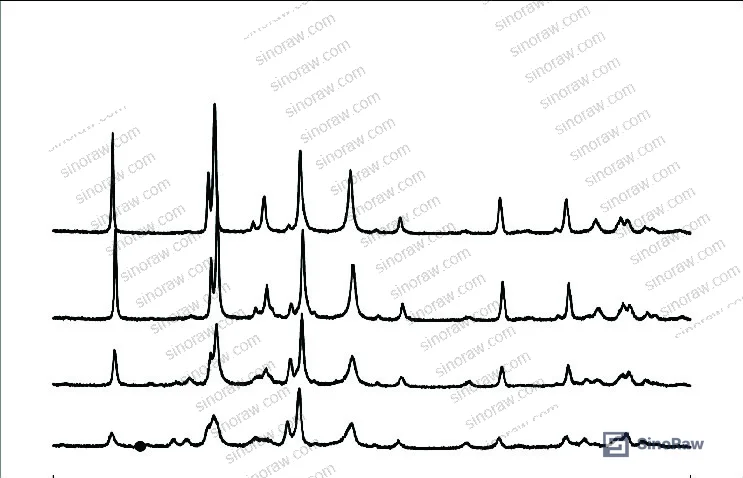
The binder system used — WC-B-Al₂O₃ at a mass ratio of CBN:WC:B:Al₂O₃ = 70:23:6:1 — is an in-situ reactive binder design. Rather than adding a pre-formed hard phase, the WB and WB₂ binder phases form during sintering through solid-state reaction between WC and B. This is an important distinction from conventional metallic or ceramic binders. For buyers sourcing from Chinese tool blank producers, understanding whether a supplier uses in-situ reactive binder synthesis versus pre-blended binder is a meaningful qualifier — not all factories have the press capacity or temperature control to execute this correctly.
PCBN Sintering Temperature Effects on Mechanical Performance #
The relationship between sintering temperature and final mechanical properties in WC-B-Al₂O₃ binder PCBN is non-linear, and the data makes the inflection point very clear.
At 1200°C, bending strength measured 463.3 MPa and microhardness was 27.5 GPa. Moving to 1500°C, bending strength climbed to 789 MPa and hardness reached 36.5 GPa — a hardness increase exceeding 30% across the temperature range. Porosity dropped from 2.85% at 1200°C to 1.05% at 1500°C. Wear resistance ratio followed the same trend: 2922 at 1200°C rising to 9810 at 1500°C.
Sintering Temperature vs. PCBN Mechanical Properties
| Sintering Temperature | Microhardness (GPa) | Bending Strength (MPa) | Wear Resistance Ratio | Porosity (%) |
|---|---|---|---|---|
| 1200°C | 27.5 | 463.3 | 2922 | 2.85 |
| 1400°C | ~33 | ~680 | ~6500 | ~1.6 |
| 1500°C | 36.5 | 789 | 9810 | 1.05 |
Note: 1400°C values interpolated from published trend data; 1200°C and 1500°C values are directly measured.
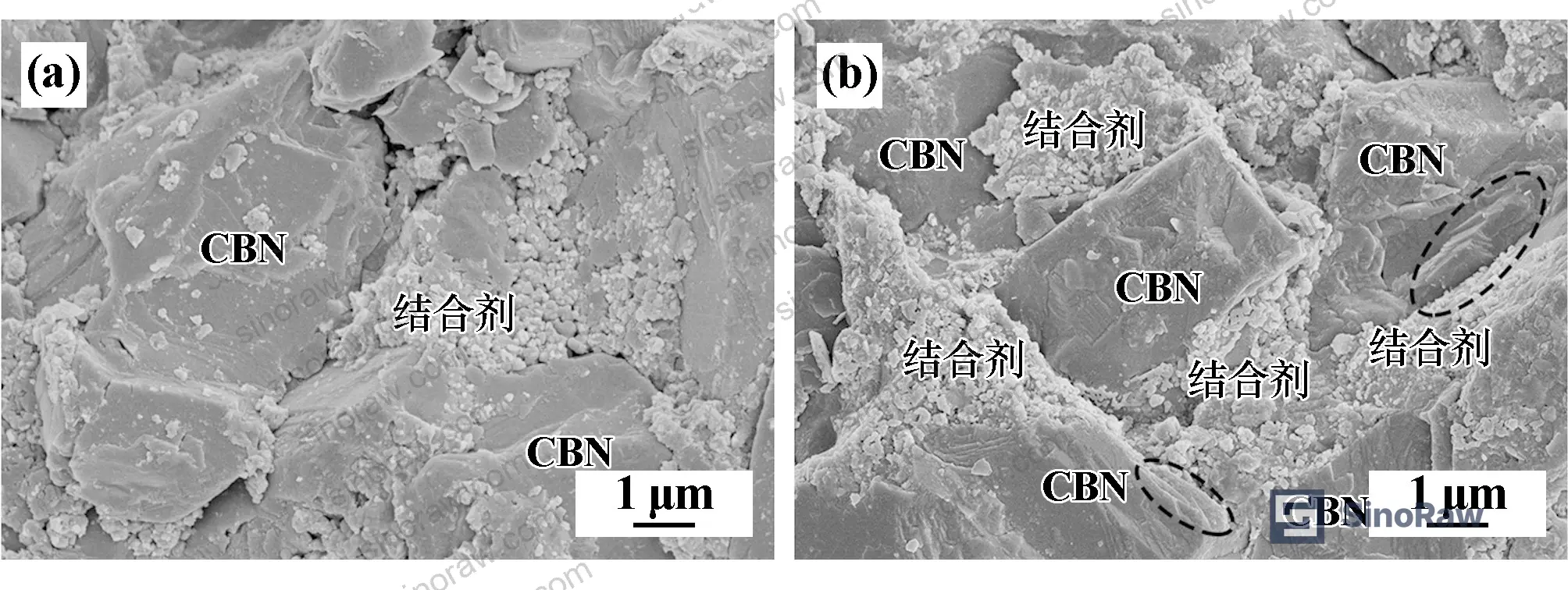
The mechanism behind this improvement is well understood. At lower sintering temperatures, WC has already begun reacting with B to form WB and WB₂ (no residual WC peak is detected in XRD at 1200°C or 1300°C), but the binder phase remains incompletely molten. SEM cross-sections at these temperatures show large voids and gaps surrounding CBN particles — the binder is loosely distributed on grain surfaces without creating genuine interfacial bonding. At 1500°C, the binder fully liquefies, flows into intergranular spaces, and densifies the microstructure. Fracture surface analysis shows a transition from purely intergranular fracture at 1200°C to a mixed intergranular and transgranular fracture mode at 1500°C, with visible serrated grain boundaries — a strong indicator of tight CBN–binder interfacial adhesion.
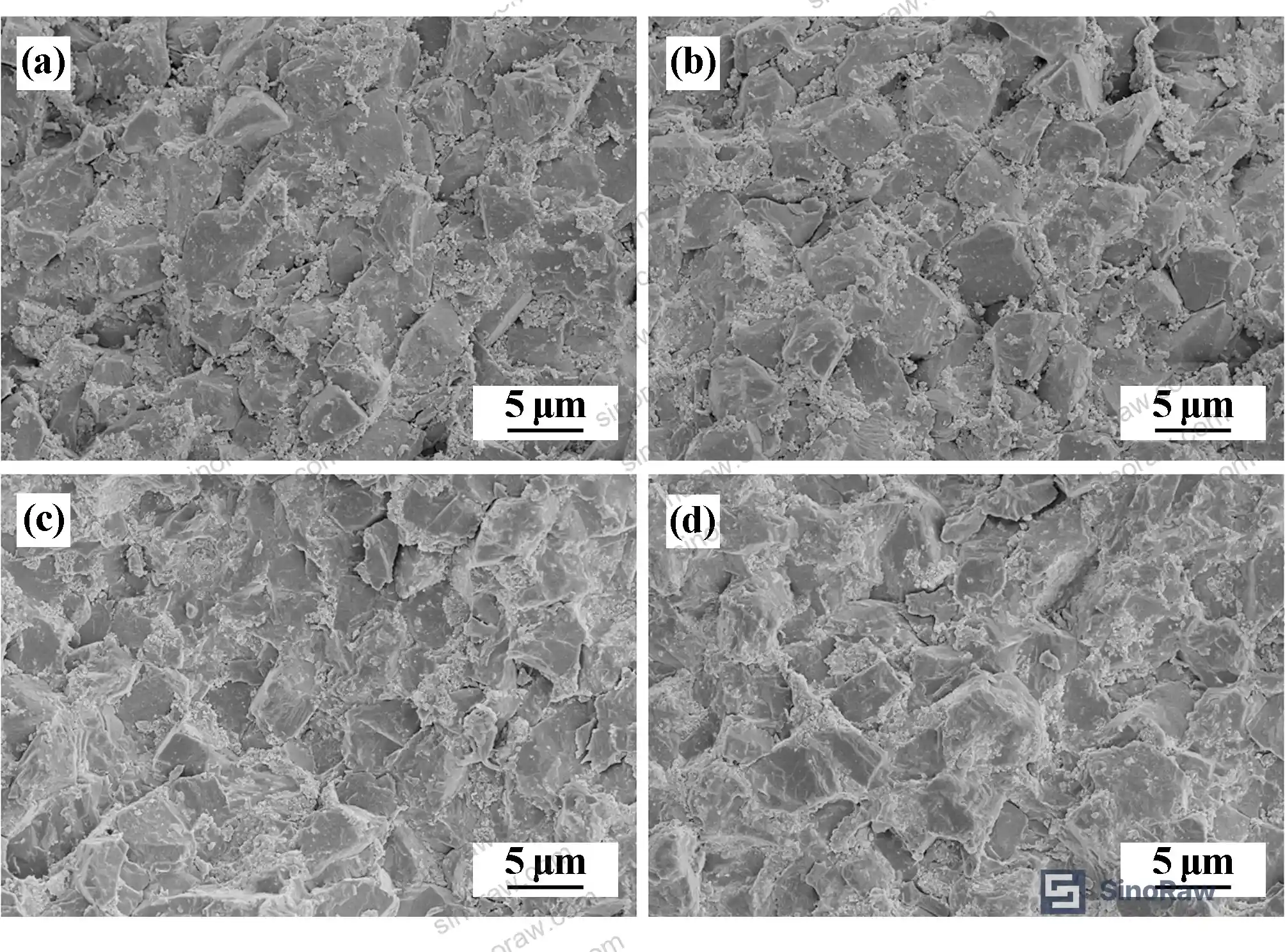
Buyers evaluating PCBN cutting insert suppliers should reference ASTM D882 Standard Test Method for Tensile Properties of Thin Plastic Sheeting for flexible substrate qualification and separately request bending strength test reports for hard cutting materials — the test protocols are fundamentally different, and conflating them is a procurement error that surfaces during application.
Honestly, most buyers over-specify CBN content percentage and under-specify the sintering process window. A tool with 80% CBN sintered poorly will consistently underperform a 70% CBN tool sintered at the correct temperature and pressure. If your supplier can’t provide sintering temperature and pressure records alongside the hardness certificate, that’s a significant gap.
Phase Composition and Binder Chemistry in WC-B-Al₂O₃ PCBN #
The in-situ binder formation chemistry is worth understanding in detail because it directly predicts tool behavior in cutting applications.
Starting from high-purity CBN (4–8 μm, 99.9% purity), WC (1–3 μm, 99% purity), B (1–3 μm, 99% purity), and Al₂O₃ (1.5 μm, 99.5% purity), the reaction sequence during sintering proceeds as follows: WC reacts with B to form WB and release carbon, the carbon oxidizes and exits the compact as CO₂, and then WB reacts further with excess B at higher temperatures to form WB₂. XRD analysis confirms that no residual WC is detectable even at 1200°C — the WC→WB conversion is essentially complete at the lowest sintering temperature tested.
Notably, Al₂O₃ was not detected in XRD patterns at any sintering temperature, despite being present in the starting mix at 1% by mass. The likely explanation is that the quantity was below XRD detection threshold. Its functional role may be as a sintering aid affecting surface energy rather than as a detectable binder phase.
The WB₂ content increases progressively with sintering temperature, which directly explains the hardness trend. WB₂ is a transition metal boride with reported hardness approaching 40 GPa — second only to diamond and CBN among commercially relevant hard materials. As the ratio of WB₂ to WB in the binder increases with temperature, both bulk hardness and wear resistance follow.
Current industry data shows that most procurement teams sourcing superabrasive cutting tools focus almost exclusively on hardness certificates and rarely request phase composition data. XRD confirmation of WB₂ as the dominant binder phase is a meaningful qualification criterion that separates suppliers using controlled reactive sintering from those simply pressing mixed powder at inadequate temperature.
For reference on handling and chemical classification of boride-containing compounds in imported tooling, the REACH Regulation (EC) No 1907/2006 governs registration requirements for chemical substances, and buyers importing PCBN blanks into EU markets should confirm compliance status for WB₂ as a binder constituent.
Supplier quality system verification should be conducted against ISO 9001:2015 Quality management systems — this is a baseline expectation, not a differentiator. The differentiator is whether a supplier can demonstrate process control over the specific sintering parameters that determine phase composition.
Wear Resistance and Fracture Mode: What the Data Actually Means for Tool Life #
The wear resistance ratio — defined as the mass loss of the SiC grinding wheel divided by the mass loss of the PCBN sample during a controlled grinding test (wheel speed 25 m/s, 40 oscillations/min) — is the most procurement-relevant metric in this dataset.
A ratio of 9810 at 1500°C versus 2922 at 1200°C represents a 3.36× difference in wear resistance between the best and worst sintering conditions tested. In practical cutting terms, this translates directly to tool life. At lower sintering temperatures, CBN grains are weakly held by the binder and shed rapidly during abrasion — the grains don’t fracture progressively as they should; they simply pull out of a loose binder matrix. This is not a gradual performance degradation; it’s a failure mode.
In supplier qualification exercises for PCBN tool blanks, we’ve seen exactly this failure pattern. Three of six samples submitted by one supplier passed hardness specification at 35+ GPa but showed wear ratios below 4000 — less than half the value achievable at correct sintering temperature. The hardness test alone gave no warning. It was the wear ratio test that revealed inadequate binder densification.
Suppliers who cannot provide wear resistance ratio data measured against a reference abrasive are, frankly, not equipped to serve applications where tool life consistency matters. This is non-negotiable for any buyer in automotive, die machining, or precision aerospace grinding.
Need help identifying qualified suppliers for PCBN cutting tool blanks and superabrasive composites? Talk to our sourcing team →
Practical Guidance for Buyers #
If you’re sourcing PCBN cutting blanks or inserts from Chinese manufacturers, the single most important ask is sintering process documentation — specifically: sintering temperature, pressure, and hold time for each production batch. The data is unambiguous: the mechanical property gap between 1200°C and 1500°C sintering is large enough to determine whether a tool succeeds or fails in service.
Request both hardness (Vickers, 3 kg load minimum) and bending strength data from any prospective supplier. Hardness alone is insufficient — bending strength of 789 MPa at 1500°C versus 463.3 MPa at 1200°C is a 70% difference that will show up as edge chipping under interrupted cutting loads.
Porosity certification matters too. A porosity of 1.05% or below correlates with adequate densification; values above 2% indicate incomplete sintering and predict early wear failure. Archimedes method porosity measurement should be standard in any qualified supplier’s QC documentation.
At sinoraw.com, our team works specifically with overseas procurement engineers and sourcing managers to identify and pre-qualify Chinese manufacturers of superabrasive and cutting tool materials before you issue RFQs — that process typically saves several rounds of sample rejection. For related industrial tooling consumables, see our coverage of Abrasives & Cutting and Advanced Materials categories.
Also review ISO 2859-1:1999 Sampling procedures for inspection by attributes when designing incoming inspection protocols for PCBN blank lots — attribute-based sampling is the practical standard for batch acceptance of hard cutting materials where destructive testing applies to a subset.
Need help identifying qualified suppliers for PCBN composites and superabrasive cutting tool materials? Talk to our sourcing team →
Supplier Qualification Questions #
- At what sintering temperature, pressure, and hold time is your PCBN composite produced, and can you provide batch sintering records showing ≥1500°C, 6 GPa, and 700 s hold time for the WC-B-Al₂O₃ binder system?
- What is the measured porosity of your PCBN blanks via the Archimedes method, and can you demonstrate a porosity value at or below 1.05% in your batch release QC?
- Can you provide XRD phase composition data confirming WB₂ as the dominant binder phase with no residual WC peaks, consistent with complete WC-to-WB₂ conversion during sintering?
- What is the Vickers microhardness of your PCBN product measured at 3 kg load, 15 s dwell, averaged across five points from edge to center, and does it meet or exceed 36.5 GPa?
- Can you provide wear resistance ratio data measured against a SiC grinding wheel at 25 m/s wheel speed, and does the ratio reach or exceed 9810 for your 1500°C sintered product?
Sourcing Checklist #
- ☐ Supplier provides batch sintering records confirming temperature ≥1500°C, pressure 6 GPa, and hold time ≥700 s for WC-B-Al₂O₃ binder PCBN production
- ☐ XRD phase analysis confirms composite consists of BN, WB₂, and WB phases with no detectable residual WC peaks
- ☐ Vickers microhardness certificate shows ≥36.5 GPa (3 kg load, 15 s dwell, 5-point average from edge to center)
- ☐ Bending strength test report (3-point bend, 10 mm span, 0.5 mm/min crosshead speed) confirms ≥789 MPa
- ☐ Porosity measured via Archimedes method is ≤1.05%, confirming adequate densification
- ☐ Wear resistance ratio test against SiC wheel (25 m/s, 40 oscillations/min) shows ratio ≥9810
- ☐ CBN raw material purity confirmed at ≥99.9% with particle size in 4–8 μm range per incoming inspection
- ☐ Supplier quality system certified to ISO 9001:2015 with documented process control records for sintering parameter verification
Key Specifications Table #
| Parameter | Recommended Value | Verification Method |
|---|---|---|
| Sintering temperature | 1500°C | Batch furnace log / thermocouple record |
| Microhardness | ≥36.5 GPa | Vickers HV, 3 kg load, 15 s dwell, 5-point edge-to-center average |
| Bending strength | ≥789 MPa | 3-point bend test, 10 mm span, 0.5 mm/min crosshead speed |
| Porosity | ≤1.05% | Archimedes displacement method |
| Wear resistance ratio | ≥9810 | SiC wheel reference test, 25 m/s wheel speed, 40 oscillations/min |
| Sintering pressure | 6 GPa | Press calibration certificate |
| CBN particle size | 4–8 μm | Laser diffraction or SEM measurement |
| WC binder particle size | 1–3 μm | Supplier incoming material spec sheet |
Can’t find a supplier meeting these specs? Submit your requirements and we’ll match you within 48 hours.
References #
Data source: Mechanical Properties and Microstructural Evolution of Polycrystalline Cubic Boron Nitride Composites Synthesized with WC-B-Al₂O₃ Binder Under Ultra-High Pressure, T. Jiang et al., International Journal of Refractory Metals and Hard Materials, 2023
Frequently Asked Questions #
Why does sintering temperature have such a large effect on PCBN wear resistance?
The wear resistance ratio increases from 2922 at 1200°C to 9810 at 1500°C because densification is incomplete at lower temperatures. CBN grains are loosely held by an incompletely molten binder, so they shed from the matrix under abrasive load rather than wearing progressively. At 1500°C, full binder liquefaction fills intergranular voids, porosity drops to 1.05%, and CBN grains are locked in place — producing mixed intergranular and transgranular fracture, which is the signature of a well-bonded composite.
What does a wear resistance ratio of 9810 mean in practical terms?
It means the SiC reference grinding wheel loses 9810 times more mass than the PCBN sample during a standardized abrasion test run at 25 m/s wheel speed. This ratio directly predicts tool life in grinding applications — a higher ratio means the PCBN surface wears significantly slower than the work material, which translates to longer intervals between dressing or replacement.
Is Al₂O₃ a meaningful component of the WC-B-Al₂O₃ binder system?
At 1% by mass, Al₂O₃ is not detectable in XRD phase analysis after sintering. It likely functions as a sintering aid affecting densification kinetics or surface energy rather than contributing a distinct hard phase. The dominant binder phases are WB and WB₂, formed in-situ from the reaction between WC and B during sintering.
What CBN content percentage is used in this binder system?
The composite uses a CBN:WC:B:Al₂O₃ mass ratio of 70:23:6:1, meaning CBN accounts for 70% of total mass. This is a relatively high CBN loading, which contributes to the high hardness values achieved — but the key variable determining final properties is sintering temperature, not CBN percentage alone.
How should buyers use porosity data when qualifying PCBN suppliers?
Porosity below 1.05% indicates adequate sintering and strong binder-grain interfacial bonding. Values above 2% — as seen at 1200°C sintering — correlate with visible voids in SEM cross-sections and weak binder retention, predicting early grain pullout during use. Request Archimedes method porosity measurement as a standard item in your sample qualification protocol, alongside hardness and bending strength.
Published by sinoraw.com Technical Team | Request a sourcing quote


