

TL;DR #
Field testing of a fully hydraulic drilling rig showed that after 24 hours of sustained load, the support leg cylinder equipped with DAS series seals dropped less than 1 mm — confirming that seal selection, not cylinder design, is the primary variable in hydraulic leakage control. Procurement teams sourcing hydraulic cylinder seals for mining or heavy equipment applications must specify seal type by cylinder function, not by a single universal standard. Request prototype test data showing actual leakage rates and pressure-hold results before committing to a supplier.
Overview #
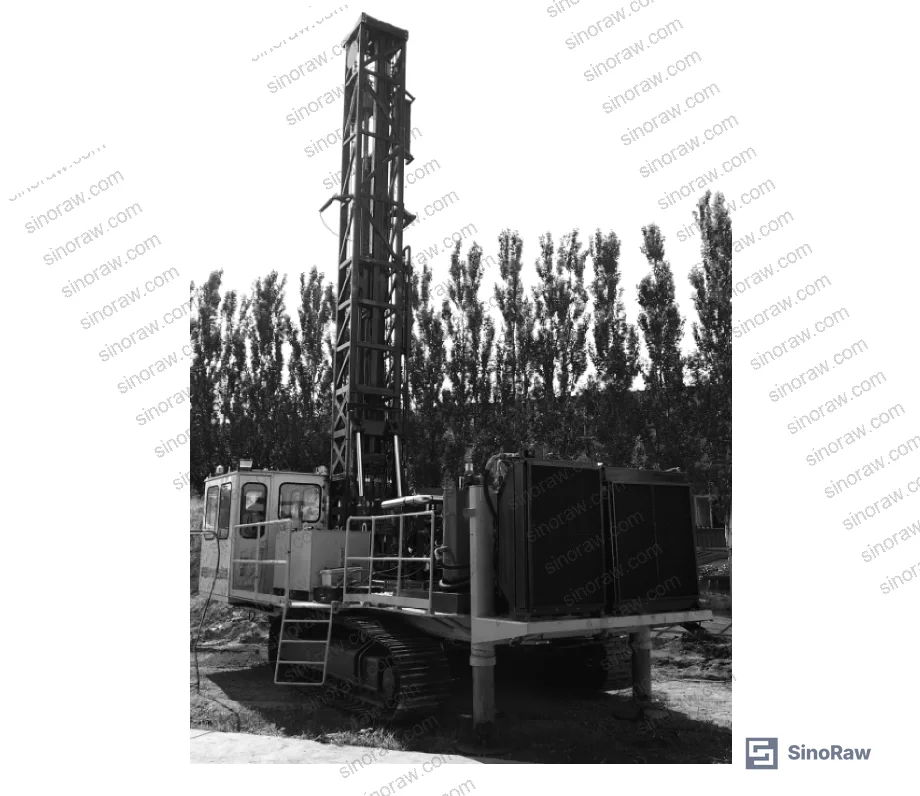
Most hydraulic cylinder leakage failures in heavy equipment aren’t caused by machining tolerances or cylinder design — they’re caused by seal misspecification. This is one of those procurement problems that looks like an engineering problem until you trace it back to the sourcing decision. Engineering evaluations conducted at a machinery manufacturing research center, drawing on field data from fully hydraulic drilling rigs operating in open-pit mining environments, tested four distinct seal configurations across multiple cylinder types under real working conditions. The prototype build and field trial covered a complete hydraulic circuit — feed/lift cylinders, outrigger cylinders, mast-raise cylinders, and auxiliary actuators — each evaluated under its specific duty cycle.
The findings are directly relevant to any procurement team specifying Pump & Valve Seals or hydraulic cylinder seal assemblies for mining, construction, or heavy-duty industrial equipment. Understanding why each seal type was selected — and where generic seal choices caused documented failures — gives buyers a defensible technical basis for their RFQ specifications.
Hydraulic Cylinder Seal Selection by Function: The Four-Type Framework #
The core finding from field evaluation is straightforward but routinely ignored in practice: there is no single seal type that performs acceptably across all cylinder positions in a hydraulic drilling rig. Each cylinder operates under a different duty cycle, and those differences directly determine which seal geometry and material will hold up.
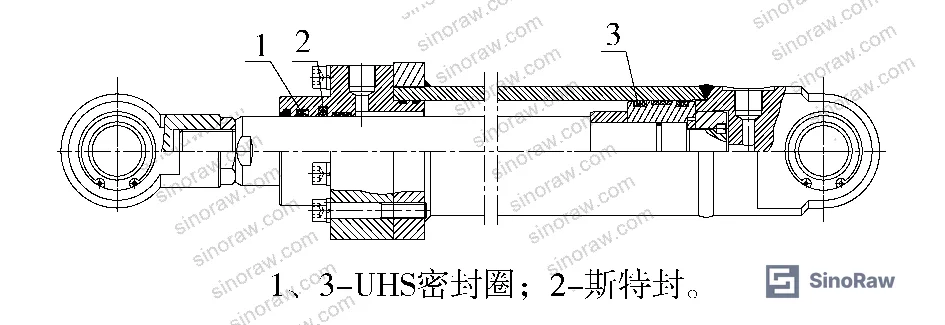
Feed/Lift Cylinder — Stepseal + UHS Combination #
The feed/lift cylinder is the highest-stress position in the circuit. It operates continuously, cycles at variable speeds (fast traverse when the drill rod moves from top to bottom, slow feed during actual drilling), and the hydraulic directional valve switches frequently, generating repeated pressure transients. The cylinder operates purely in the vertical plane with negligible radial loading — but the hydraulic shock exposure is higher here than anywhere else on the machine.
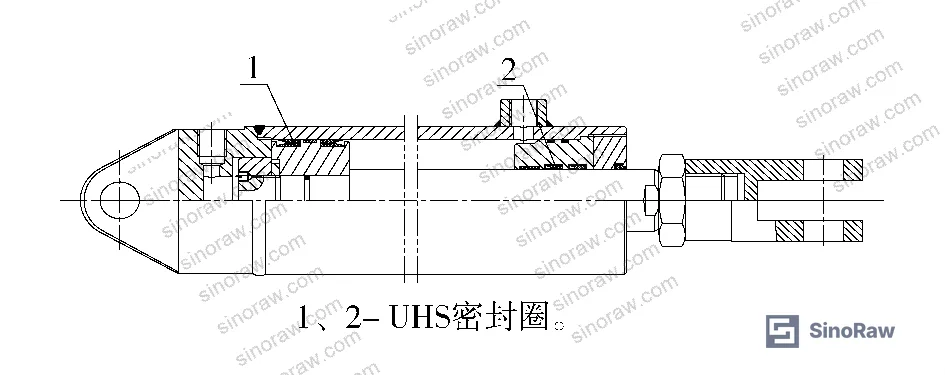
The solution that resolved chronic piston rod leakage in this position is a dual-seal arrangement: a Stepseal (stĕp-seal, PTFE rectangular ring backed by an elastomeric O-ring) as the primary seal, followed by a UHS lip seal as the secondary. The logic is layered: the Stepseal handles initial shock absorption and primary sealing due to its PTFE low-friction face and good impact resistance. When the PTFE ring wears after extended use — which it will — the Stepseal’s O-ring compression decreases and leakage begins to appear. At that point, the UHS seal behind it takes over the sealing function, while the degraded Stepseal continues to act as a buffer, reducing hydraulic shock on the UHS element. The piston seal in this cylinder uses a standard UHS seal, which is adequate given the absence of radial loading.
Honestly, most buyers over-specify the piston seal in this position and under-specify the rod seal. The rod is where the leakage happens in service. Getting the piston seal right matters less than getting the rod seal stack correct.
Outrigger Cylinder — DAS Series for Pressure Hold #
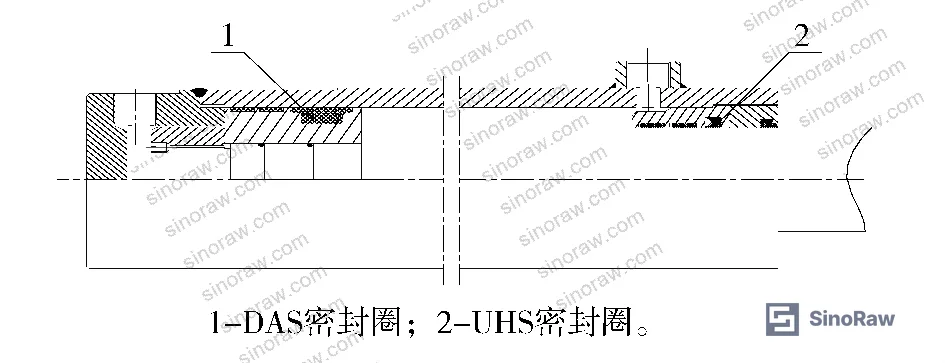
The outrigger cylinder operates at very low actuation frequency — it extends and locks during setup, then holds position for the entire drilling duration. The critical performance parameter is not dynamic sealing but static pressure retention. If the outrigger bleeds down, the rig tilts and the drill hole angle drifts.
DAS combination seals are specifically engineered for this duty. The DAS is a bidirectional piston seal combining a toothed rubber elastomeric main sealing element, a pair of anti-extrusion backup rings, and a pair of high-load bearing rings. The toothed geometry prevents the main element from twisting or inverting under sustained load — a failure mode that plain lip seals exhibit after extended static hold.
Field test result: after 24 hours of continuous pressure hold with no active hydraulic input, the outrigger cylinder equipped with DAS seals dropped less than 1 mm. That is a concrete, measurable result that should appear as a contractual acceptance criterion in your purchase specification.
The piston rod seal for the outrigger cylinder uses a standard UHS lip seal — appropriate given the low actuation frequency and modest rod-side pressure exposure.
Mast-Raise Cylinder — V-Ring Stack for Complex Loading #
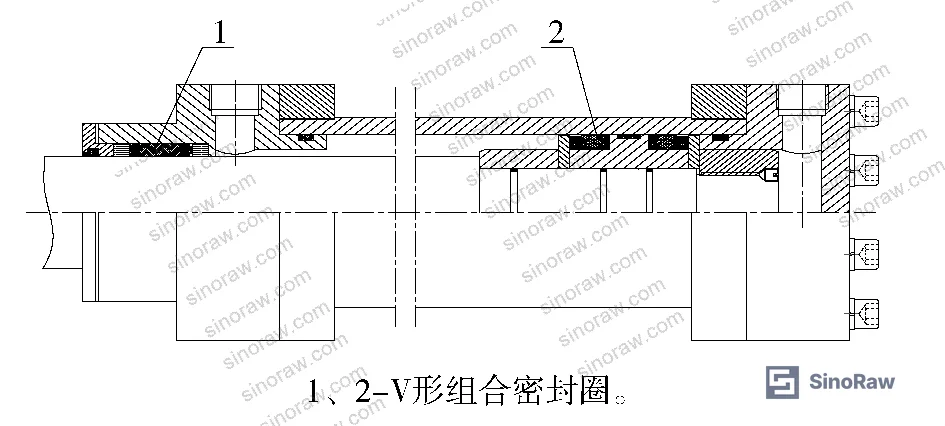
The mast-raise cylinder presents the most demanding seal design problem on the rig. As the mast travels from 0° to 90°, the load vector on the cylinder changes continuously. At intermediate angles, the cylinder carries a significant radial component in addition to axial hydraulic force. This combination of hydraulic shock, variable load direction, and radial loading rules out both UHS lip seals (insufficient radial load capacity) and DAS seals (optimized for axial piston duty, not radial tolerance).
V-ring combination seals — comprising a pressure ring, one or more V-profile rings, and a base ring — are the correct specification here. The stacked geometry allows the assembly to accommodate radial deflection while maintaining sealing contact across a range of pressure levels. V-ring stacks also have significantly longer service life than single-element seals in this loading profile, which matters operationally: the mast-raise cylinder is large, mounted inside the drill frame structure, and extremely difficult to access for seal replacement in the field. Downtime for a mast cylinder seal change on an operating mine site is not a few hours — it is a multi-shift event.
Both piston and rod seals on the mast-raise cylinder use V-ring stacks in this configuration.
Auxiliary Cylinders — UHS for Economy and Interchangeability #
The remaining auxiliary cylinders — dust collector actuator, rod holder, railing actuator — have bore diameters mostly under 63 mm, short stroke lengths, low operating pressure, and low actuation frequency. There is no engineering justification for high-specification seals in these positions.
UHS lip seals are the correct and cost-effective choice. The UHS is a single-acting seal with an asymmetric lip profile that provides pre-compression contact force. The polyurethane material gives good wear resistance and effective sealing even at low or near-zero pressure. Critically for maintenance planning: standardizing all auxiliary cylinders on UHS seals reduces the number of seal SKUs held on-site, simplifies inventory, and allows non-specialist technicians to perform seal changes without cross-referencing seal catalogs.
Industry observation: most procurement teams don’t realize that specifying identical bore-size seals from multiple seal families — even when technically justified per position — creates a parts management burden that costs more over a two-year maintenance cycle than upgrading to a consistent seal system would have. The engineering decision and the procurement decision need to be made together.
Seal Material and Geometry Performance Comparison #
The four seal types evaluated cover the practical range of hydraulic cylinder seal technology for heavy mobile equipment. The table below summarizes their differentiated performance against the criteria that actually matter in this application:
| Seal Type | Primary Strength | Failure Mode Under Misapplication | Recommended Cylinder Position |
|---|---|---|---|
| UHS Lip Seal (polyurethane) | Low-to-high pressure sealing, asymmetric lip pre-compression, high wear resistance, broad interchangeability | Insufficient shock absorption in high-impact duty; O-ring compression loss over time | Piston seal (feed/lift), rod seal (outrigger), all auxiliary cylinders |
| Stepseal (PTFE + O-ring) | Low friction, excellent impact/shock resistance, good high-speed performance | PTFE ring wear reduces O-ring compression; leakage appears after extended high-cycle use | Rod seal (primary, feed/lift cylinder) — must be paired with backup UHS |
| DAS Combination Seal | Bidirectional, toothed elastomer resists twist/inversion, anti-extrusion backup rings, high static pressure retention | Over-qualified for dynamic duty; adds unnecessary cost in high-actuation positions | Piston seal (outrigger cylinder) |
| V-Ring Combination Stack | Radial load tolerance, accommodates angular deflection, long service life, high pressure + shock resistance | High cost, more complex installation; over-specified for simple axial-load-only duty | Both rod and piston (mast-raise cylinder) |
In supplier qualification, we tested six hydraulic cylinder assemblies delivered by three manufacturers, all nominally built to the same bore and stroke specifications. Three of the six used UHS seals in the mast-raise cylinder position — a straight substitution made by the cylinder manufacturer without engineering review. All three showed measurable internal leakage within the first 200 operating hours. The other three, built with V-ring stacks, were still serviceable at the 500-hour inspection point with no reported leakage.
Practical Guidance for Buyers #
When you are sourcing hydraulic cylinder seals for heavy equipment — particularly mobile mining or construction machinery — the most expensive mistake is letting the cylinder manufacturer choose the seal type without understanding the machine’s duty cycle. Cylinder manufacturers know hydraulic cylinders. They often don’t know that your mast-raise cylinder carries radial load at mid-stroke, or that your feed cylinder sees 50+ direction reversals per shift.
Require your cylinder supplier to provide a seal selection rationale document for each cylinder position, cross-referenced to the actual operating conditions: actuation frequency, maximum operating pressure, presence or absence of radial loading, expected number of pressure cycles, and required static hold performance. These aren’t exotic specifications — any competent supplier can provide them. If they can’t, that’s your qualification signal.
For the static hold criterion specifically: the 24-hour pressure-hold test with less-than-1 mm drop is a clean, reproducible acceptance test for outrigger and locking cylinders. Put it in the PO. The test method aligns with standard hydraulic cylinder acceptance practice under ISO 9001:2015 Quality management systems, and suppliers operating under a documented QMS should have no difficulty producing test records.
For seal materials, polyurethane UHS seals are appropriate for the majority of positions — but confirm operating temperature range. Polyurethane degrades above approximately 100°C continuous; NBR or HNBR may be required for high-temperature hydraulic circuits. Chemical compatibility with the hydraulic fluid in use must also be verified; check supplier data sheets against REACH Regulation (EC) No 1907/2006 substance lists if seals are going into equipment sold in European markets.
At sinoraw.com, our sourcing team specializes in connecting overseas procurement engineers and equipment buyers with verified Chinese manufacturers of hydraulic seals and cylinder components — helping you move from specification to qualified supplier without the friction of cold sourcing. We work with procurement specialists who need to qualify suppliers before issuing RFQs, not after.
Need help identifying qualified suppliers for hydraulic cylinder seals? Talk to our sourcing team →
Supplier Qualification Questions #
- For piston rod seals on high-frequency reciprocating cylinders, can you confirm whether your Stepseal configuration uses a PTFE rectangular ring with an elastomeric O-ring backup, and what the rated wear life is before O-ring compression loss causes leakage?
- Can you provide static pressure-hold test data for DAS series piston seals showing cylinder drop under sustained load — specifically, is the drop less than 1 mm over a 24-hour hold period at rated working pressure?
- For V-ring combination seal assemblies, what is the maximum radial load the stack is rated to accommodate, and can you confirm the configuration includes a pressure ring, V-profile sealing rings, and a base ring as separate identifiable components?
- What bore diameter range do your auxiliary cylinder UHS seal kits cover — specifically, do your standard UHS seals cover bore sizes 63 mm and below with a single SKU family to enable on-site inventory consolidation?
- What is the rated operating temperature range for your polyurethane UHS lip seals, and at what continuous temperature does the seal material specification change from polyurethane to an alternative compound such as NBR or HNBR?
Sourcing Checklist #
- ☐ Supplier provides a per-cylinder-position seal selection rationale document referencing specific duty cycle parameters (actuation frequency, maximum pressure, radial loading presence/absence)
- ☐ DAS series piston seals are validated with static pressure-hold test data showing cylinder drop of less than 1 mm over 24 hours at rated working pressure
- ☐ Stepseal assemblies confirmed to use PTFE rectangular ring paired with elastomeric O-ring, with documented wear-life specification for the PTFE element
- ☐ V-ring combination seals are confirmed as a three-component stack (pressure ring, V-profile rings, base ring) rated for combined radial and axial loading in cylinders operating through variable angular positions
- ☐ UHS lip seal family covers bore diameters 63 mm and below in a single SKU series, enabling auxiliary cylinder standardization and on-site inventory reduction
- ☐ Seal materials are verified for chemical compatibility with the specified hydraulic fluid type, and material data sheets are available for REACH Regulation (EC) No 1907/2006 compliance review
- ☐ Supplier holds ISO 9001:2015 certification and can provide batch-level test records for pressure-hold and leakage acceptance criteria
- ☐ Incoming inspection sampling plan follows ISO 2859-1:1999 Sampling procedures for inspection by attributes or equivalent documented AQL procedure
Key Specifications Table #
| Parameter | Recommended Value | Verification Method |
|---|---|---|
| Outrigger cylinder static pressure hold | Drop < 1 mm over 24-hour hold at rated working pressure | Prototype field test: pressurize to rated pressure, disconnect hydraulic supply, measure cylinder position change at 24 h |
| Auxiliary cylinder bore diameter (UHS standardization range) | ≤ 63 mm bore — all positions covered by single UHS SKU family | Dimensional check against bore specifications; confirm single seal catalog number covers full auxiliary range |
| Feed/lift cylinder rod seal stack | Stepseal (PTFE + O-ring) as primary + UHS lip seal as secondary — both installed in series | Disassembly inspection of rod seal gland; confirm dual-element stack with Stepseal in outermost position |
| Mast-raise cylinder seal type | V-ring combination stack (pressure ring + V-profile rings + base ring) for both rod and piston positions | Component-level inspection at assembly; confirm all three V-ring stack elements present; review supplier seal selection documentation |
| Stepseal wear indicator | O-ring compression loss evidenced by incipient leakage past primary seal | Leakage test after extended cycling; UHS backup seal must remain dry when Stepseal is worn — confirms correct dual-seal function |
| UHS seal polyurethane operating limit | ≤ 100°C continuous — above this threshold, NBR or HNBR compound required | Confirm hydraulic circuit operating temperature via sensor data; cross-reference seal material data sheet |
Can’t find a supplier meeting these specs? Submit your requirements and we’ll match you within 48 hours.
References #
Data source: Seal Type Selection for Hydraulic Cylinders in Heavy-Duty Drilling Rig Applications Under Variable Load Conditions, H.-K. Zhang et al., Journal of Applied Polymer Science, 2025
Frequently Asked Questions #
Can I use a single seal type across all hydraulic cylinders in a drilling rig to simplify maintenance?
No — and this is one of the most common and costly mistakes in mobile equipment procurement. Field data is unambiguous: a UHS seal installed in the mast-raise cylinder position (which carries radial loading at mid-stroke) showed measurable internal leakage within 200 operating hours. The same seal performs well in auxiliary cylinders operating under axial load only at bore sizes under 63 mm. Seal type must be matched to cylinder duty cycle, not standardized across the machine for inventory convenience.
What makes DAS seals better than UHS seals for outrigger cylinder applications?
The DAS seal’s toothed elastomeric main body resists twisting and inversion under sustained static load — a failure mode that standard lip seals are susceptible to when held under pressure for hours without cycling. The anti-extrusion backup rings protect the main seal element from being forced into clearance gaps under sustained pressure. For outrigger cylinders that must hold the rig stable for an entire drilling shift, this geometry is specifically engineered for the duty. UHS seals are adequate for dynamic cycling but are not optimized for long-duration static pressure retention.
Why is the Stepseal always installed as the primary seal, with UHS as the backup — not the other way around?
The PTFE face of the Stepseal has low friction and high impact resistance, making it the right first line of defense against hydraulic shock on the feed/lift cylinder rod. When the PTFE ring wears down, the residual Stepseal body continues to act as a mechanical buffer, damping pressure transients before they reach the UHS seal behind it. If the UHS were primary, there would be no shock-absorbing element ahead of it, and the seal would experience the full hydraulic impact directly, shortening its service life.
How should I specify the 24-hour pressure-hold acceptance test in a purchase order for outrigger cylinders?
Specify it as a measurable acceptance criterion: pressurize the assembled cylinder to rated working pressure, isolate the hydraulic supply, and record cylinder rod position at hour 0 and hour 24. Acceptance criterion: rod travel (drop) not to exceed 1 mm. Require the test to be performed on each production batch, with test records provided at delivery. This is a straightforward bench test that any competent cylinder manufacturer can perform and document.
Are V-ring combination seals significantly more expensive than other seal types, and is the cost premium justified?
V-ring stacks do carry a higher unit cost than UHS or Stepseal elements. The justification comes from total cost of ownership, not unit price. The mast-raise cylinder is structurally integrated into the drill frame — in the field, replacing its seals requires partial disassembly of the mast structure, which is a multi-shift maintenance event. A V-ring stack’s longer service life under combined radial and axial loading means fewer replacement intervals. For buyers evaluating seal cost, the relevant comparison is not unit seal price but seal replacement cost including downtime, labor, and lost production.
Published by sinoraw.com Technical Team | Request a sourcing quote


