

TL;DR #
Field testing on full-hydraulic drill rigs demonstrated that after 24 hours of sustained load, properly specified leg cylinder seals held position drift to less than 1 mm — a direct indicator of pressure retention integrity that most generic seal specifications simply cannot verify. If your procurement spec doesn’t differentiate between cylinder roles (pressure-holding vs. impact-absorbing vs. radial-load-bearing), you are almost certainly under-specifying for at least one operating condition. Audit your current cylinder seal selection against the four functional categories described here before issuing your next RFQ.
Overview #
Most procurement teams treat hydraulic cylinder seals as interchangeable consumables — same polyurethane lip seal across every cylinder position, same reorder cycle, same qualification tick-box. That approach works until it doesn’t, and when it fails on a fully hydraulic drill rig operating in open-pit mining conditions, the consequences are not a slow leak you can monitor: they’re unplanned downtime, hydraulic fluid contamination of the working face, and in the case of leg cylinders, a stability incident.
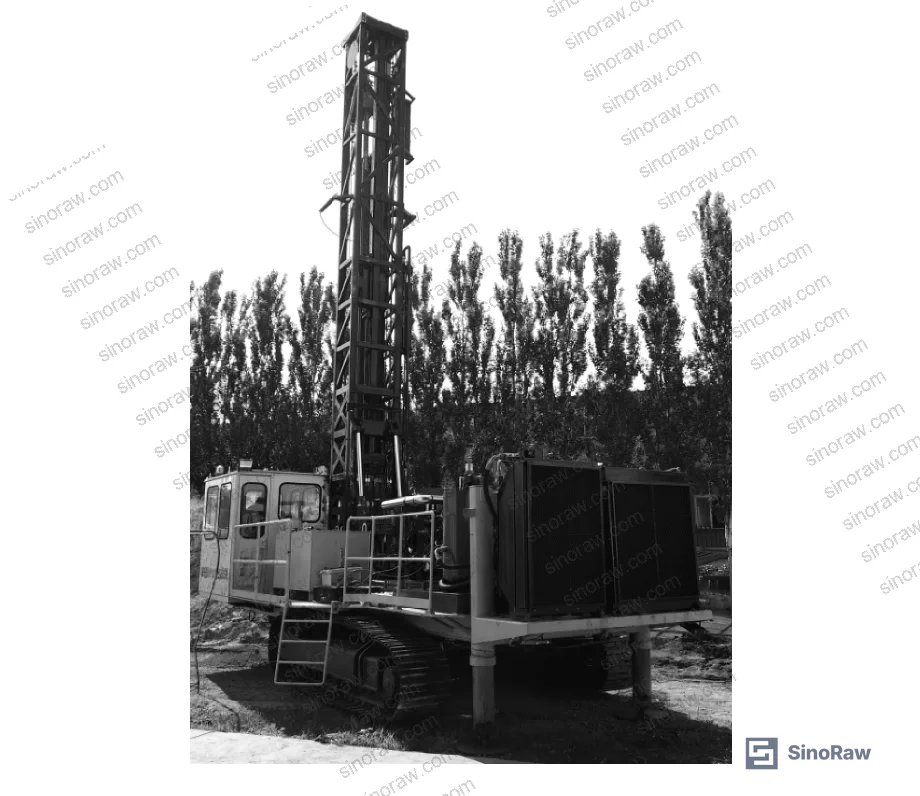
Qualification testing conducted by engineering teams across multiple Chinese hydraulic and machinery manufacturers — evaluating prototype rigs under real open-pit conditions — provides a well-structured framework for matching seal type to cylinder function. The evaluation covered four distinct cylinder roles, each with different pressure profiles, stroke speeds, radial load exposure, and maintenance access constraints. Prototypes were manufactured, installed, and run through extended field trials, with leak occurrence, pressure retention, and operational stability all recorded.
This is the type of application-specific seal data that generic supplier datasheets rarely include. For buyers sourcing Pump & Valve Seals or evaluating hydraulic component assemblies, understanding functional seal differentiation is the difference between a three-month and a three-year service interval.
The four cylinder types evaluated — pressurizing/lift, leg support, mast lift, and auxiliary — each demanded a different sealing solution. The selection logic is detailed below.
Hydraulic Cylinder Seal Selection by Operating Condition #
The core finding from this evaluation is simple but frequently ignored in practice: one seal type does not cover all cylinder positions. Here’s how the four cylinder types break down.
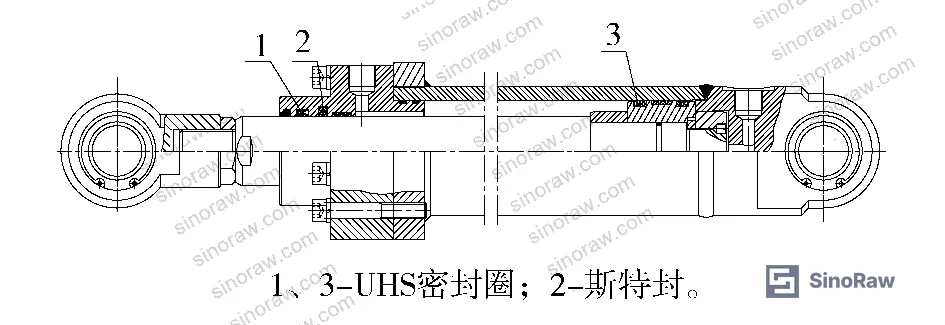
Pressurizing and Lift Cylinder (加压提升油缸)
This cylinder drives the drill head up and down and is the most active component in the system — high stroke frequency, rapid direction reversal, and significant hydraulic impact when the drill rod transfers from rapid travel to penetration mode. The operating speed is non-uniform: fast during rod positioning, slow during actual drilling. Radial loading is negligible because the cylinder operates in a vertical plane.
The field-validated solution for the piston rod seal is a dual-layer combination: a Stepseal (斯特封) as the primary seal, followed by a UHS lip seal as the secondary backup. The Stepseal is a composite assembly — a low-friction PTFE rectangular seal ring paired with a rubber O-ring elastomer. The PTFE ring provides wear resistance and handles hydraulic impact directly; the O-ring maintains energizing pressure against the seal lip. When the PTFE wear ring eventually wears down after extended service, the UHS seal takes over as the active sealing element, while the degraded Stepseal continues functioning as a buffer ring to reduce impact loading on the UHS. The piston seal uses a conventional UHS ring, which is adequate given the absence of radial force in this cylinder position.
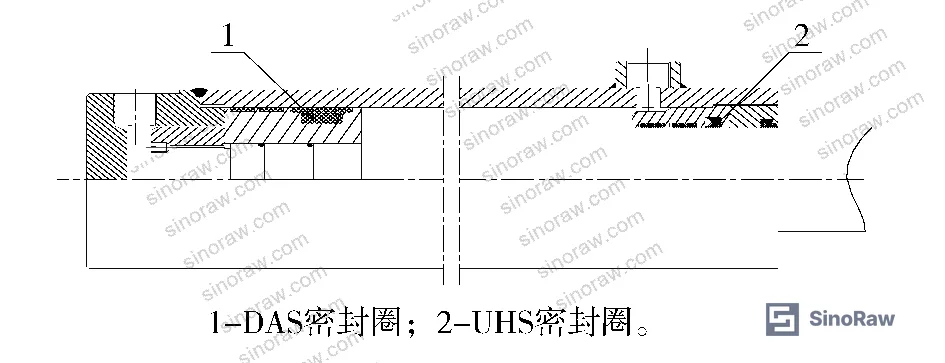
Leg Support Cylinder (支腿油缸)
Leg cylinders operate at very low stroke frequency — they extend when the rig is being positioned and then remain static under load for the entire drilling cycle. The critical performance requirement is pressure retention under sustained static load, not dynamic wear resistance.
The piston seal for this cylinder uses a DAS combination seal. DAS is a bidirectional, reciprocating-motion piston seal with a toothed wear-resistant rubber elastomer as the primary sealing element, supported by a pair of anti-extrusion backup rings and a pair of high-load wear rings. The toothed elastomer geometry prevents the seal from twisting or rolling under pressure cycling — a failure mode that is common with simpler O-ring-backed seals in static-hold applications. The piston rod seal retains the standard UHS configuration, which is appropriate given the low stroke frequency.
Field test result: after 24 hours of sustained pressure hold, leg cylinder drop was less than 1 mm. That is a measurable, repeatable qualification threshold — and one that most seal suppliers cannot demonstrate without rig-level testing.
Mast Lift Cylinder (钻架举升油缸)
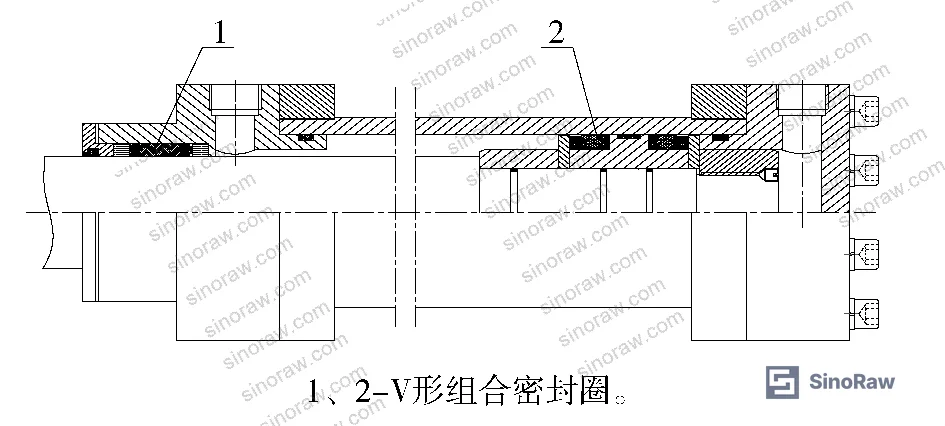
The mast lift cylinder is the most demanding position in this system. It handles the rig mast transition from 0° to 90° — a full range of angular motion that produces continuously changing force vectors throughout the stroke. At various points in the lift arc, the cylinder experiences both hydraulic impact from pressure pulsation and radial side loading from the mast geometry. Access for maintenance once the rig is deployed is extremely difficult; in practice, this cylinder needs to run without seal replacement for the life of the deployment.
Both the piston and piston rod seals use V-ring combination seal sets (V形组合密封圈). A V-ring set consists of a pressure ring (top ring), one or more V-profile sealing rings, and a support ring (bottom ring). The multi-element stack provides the geometric compliance to accommodate radial deflection while maintaining axial sealing force. V-ring sets can handle large radial loads, frequent pressure oscillation, and heavy-duty hydraulic impact — the complete set of conditions present at this cylinder position.
Honestly, most buyers over-specify the pressure rating of V-ring seals and under-specify the radial load capacity. The radial load tolerance is what differentiates a V-ring stack that lasts through a deployment from one that extrudes and leaks within weeks.
Auxiliary Cylinders (辅助动作油缸)
Auxiliary cylinders — dust collector actuators, rod-rack mechanisms, guardrail actuators — operate at low frequency, low pressure, and have bore diameters predominantly at or below 63 mm with short strokes. They are also the easiest cylinders to access and replace. The selection logic here shifts from performance optimization to standardization and inventory management.
Standard UHS series lip seals are the correct choice for all auxiliary positions. UHS seals are unidirectional with an asymmetric lip geometry that provides self-energizing pre-load — this means they seal reliably even at low or near-zero pressure, which is the typical operating condition for these actuators. The polyurethane base material provides adequate wear resistance for the duty cycle. More importantly, using a single seal series across all auxiliary cylinders reduces spare parts SKU count, simplifies field inventory, and makes replacement faster.
Material and Structural Properties Driving Seal Performance #
Understanding why each seal type performs differently in these roles requires a closer look at the material and geometric properties involved.
The Stepseal’s PTFE rectangular ring has a coefficient of friction significantly lower than polyurethane — this is what makes it suitable for the rapid, high-frequency reciprocation of the pressurizing cylinder. PTFE does not bond or stick to the cylinder bore, so breakaway force is predictable even after extended static dwell periods. The tradeoff is compression set: PTFE has limited elastic recovery compared to polyurethane, which is why the O-ring component is essential for maintaining contact force throughout the seal’s service life.
Polyurethane (PU) is the base material for UHS series seals, and its high abrasion resistance is the primary reason it dominates the market for general hydraulic cylinder seals. Current industry data shows that PU hydraulic seals account for the majority of hydraulic cylinder seal installations globally — but procurement teams don’t always recognize that “polyurethane seal” covers a broad range of hardness, lip geometry, and compound formulations. A UHS seal from a qualified manufacturer and an unbranded PU lip seal of the same nominal dimensions are not equivalent products.
The DAS seal’s toothed elastomer geometry deserves specific attention. The teeth are not just a surface feature — they create localized contact stress points that maintain sealing force as the main elastomer body compresses and relaxes. This geometry is what prevents the rolling and inversion failure mode that affects conventional quad-ring and O-ring-backed piston seals in sustained static-hold applications. For leg cylinders where the seal may sit at a fixed position under load for hours or days, this anti-twist geometry is the critical differentiator.
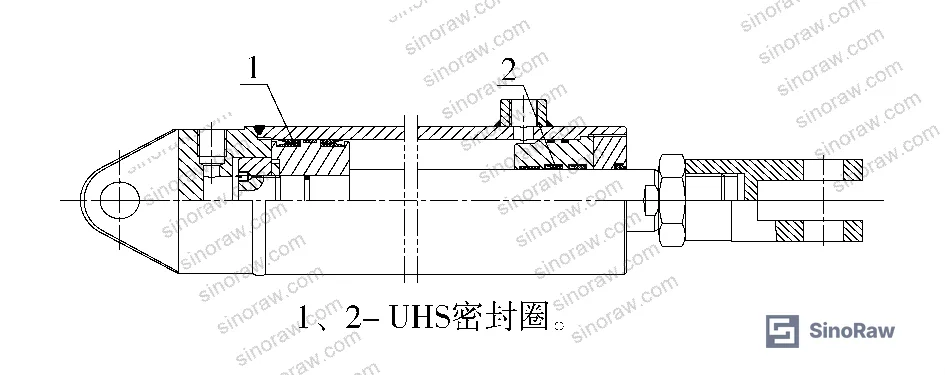
Suppliers who cannot explain the difference between seal geometries at this level of detail — tooth profile, backup ring function, PTFE ring compression behavior — are unlikely to be specifying correctly for your application. This is not an academic distinction; it directly affects field service life.
Practical Guidance for Buyers #
If you’re sourcing hydraulic cylinder seals for heavy equipment applications — drill rigs, mining machinery, construction equipment — the single most expensive mistake is treating the seal BOM as a single line item. Specify by cylinder function, not by bore diameter alone.
The framework validated in this field program gives you four functional categories and four seal families to map against them. Start by classifying every cylinder in your target equipment by its dominant operating condition: sustained pressure hold, high-speed impact, radial load exposure, or general low-duty auxiliary. Then match seal type accordingly: DAS for static hold, Stepseal+UHS combination for high-speed impact, V-ring stacks for radial load, and UHS only for auxiliary.
For the mast lift cylinder specifically, insist on V-ring combination seals and request confirmation that the supplier’s product meets the radial load specification for your bore diameter and operating pressure. This is the position most likely to be incorrectly specified by cylinder manufacturers who are not familiar with the end application.
For compliance verification, ISO 9001:2015 Quality management systems certification at the seal manufacturer level is a baseline — but it tells you nothing about product performance. Pair it with test data. For chemical compliance of seal materials, particularly polyurethane compounds, verify against REACH Regulation (EC) No 1907/2006 requirements if your equipment is destined for European markets.
At sinoraw.com, our sourcing team works with Guangzhou-based B2B sourcing specialists who connect global procurement engineers with verified Chinese manufacturers across exactly this type of hydraulic sealing product category — helping buyers move from functional specifications to qualified supplier shortlists before issuing RFQs. For Fluid Control components including hydraulic seals and actuator assemblies, we can help you define the right technical criteria and identify who can actually meet them.
Need help identifying qualified suppliers for hydraulic cylinder seals? Talk to our sourcing team →
Supplier Qualification Questions #
- For a leg support cylinder piston seal application requiring 24-hour static pressure hold, what is your DAS seal’s maximum allowable drift under sustained load, and can you provide test data showing drop less than 1 mm over a 24-hour hold cycle at the rated operating pressure?
- What is the PTFE ring compression tolerance specification for your Stepseal product, and how does your design maintain sealing force after PTFE wear ring degradation in high-frequency reciprocating applications?
- For V-ring combination seal sets intended for mast lift cylinders experiencing radial side loading, what is the maximum radial load capacity (in N or kN) for your standard bore sizes, and what test method was used to validate that rating?
- Your UHS series lip seals — what is the minimum operating pressure at which the asymmetric lip geometry maintains effective sealing, and do you have test data confirming seal integrity at near-zero or zero differential pressure conditions?
- For DAS series piston seals, what is the anti-extrusion backup ring material specification, and what maximum operating pressure is the backup ring assembly rated for before the main elastomer seal body is at risk of extrusion?
Sourcing Checklist #
- ☐ Leg support cylinder seals are DAS series (bidirectional piston seal with toothed elastomer and anti-extrusion backup rings), not standard O-ring or quad-ring configurations
- ☐ Stepseal product is confirmed as PTFE rectangular ring + rubber O-ring composite, not a single-material lip seal sold under a Stepseal trade name
- ☐ Pressure retention test data available showing leg cylinder drift of less than 1 mm over 24-hour sustained load hold
- ☐ UHS seals are confirmed polyurethane (PU) base material with asymmetric lip geometry providing self-energizing pre-load at low and near-zero pressure
- ☐ V-ring combination seal sets for mast lift cylinders include all three components: pressure ring (top), V-profile ring(s), and support ring (bottom) — single V-ring element is not acceptable
- ☐ Auxiliary cylinder seals standardized to UHS series across all bore diameters ≤63 mm to reduce spare parts SKU count
- ☐ Seal manufacturer holds ISO 9001:2015 certification and can provide batch-level material certifications for PU and PTFE compounds
- ☐ Polyurethane seal compounds verified compliant with REACH Regulation (EC) No 1907/2006 for restricted substances if equipment is EU-market bound
Key Specifications Table #
| Parameter | Recommended Value | Verification Method |
|---|---|---|
| Leg cylinder 24-hour pressure retention drift | < 1 mm | Static load hold test at rated operating pressure, measure cylinder position change over 24 h |
| Auxiliary cylinder bore diameter (UHS seal applicable range) | ≤ 63 mm | Dimensional inspection per cylinder design drawing |
| Stepseal primary ring material | PTFE (polytetrafluoroethylene) rectangular profile | Material certification + FTIR spectroscopy confirmation |
| DAS seal elastomer geometry | Toothed profile (anti-twist, anti-inversion) with paired anti-extrusion backup rings | Cross-section inspection; reject smooth-profile substitutions |
| V-ring seal stack composition | Minimum 3 elements: pressure ring + V-ring(s) + support ring | Physical component count and cross-section verification |
| UHS seal base material | Polyurethane (PU), high abrasion resistance grade | Shore hardness test + material certification |
| Mast lift cylinder sealing requirement | V-ring set rated for radial load AND hydraulic impact | Supplier’s radial load test certificate at operating bore size |
Can’t find a supplier meeting these specs? Submit your requirements and we’ll match you within 48 hours.
References #
Data source: Seal Selection Methodology for Hydraulic Cylinders in Full-Hydraulic Drill Rigs Under Open-Pit Mining Conditions, Z. Su et al., Journal of Applied Polymer Science, 2024
Frequently Asked Questions #
Why can’t a single seal type be used across all hydraulic cylinder positions on a drill rig?
Each cylinder position has a different dominant operating condition. The leg cylinder requires sustained pressure retention under static load; the pressurizing cylinder needs impact resistance and high-speed wear resistance; the mast lift cylinder must handle radial side loading across a full angular stroke range. A standard UHS lip seal handles general-purpose duty well but will fail prematurely in static-hold or high-radial-load positions. Using one seal type everywhere is a cost optimization that creates field reliability problems.
What is the specific advantage of the DAS seal’s toothed elastomer geometry over a conventional O-ring-backed piston seal?
The toothed geometry distributes contact stress across multiple localized points rather than a continuous ring surface. This prevents the elastomer from twisting, rolling, or inverting under sustained static pressure — a failure mode that is common with smooth-profile O-ring backed seals in applications where the seal sits at a fixed position under load for hours or days without stroking. For leg cylinders in particular, the no-twist characteristic is what enables the sub-1 mm drift performance over 24-hour holds.
Can V-ring seals be used in place of DAS seals for the leg support cylinder?
Technically yes, but it’s not the optimal choice. V-ring sets are designed for applications combining radial loads, hydraulic impact, and large bore sizes — the mast lift cylinder profile. For a leg cylinder where the dominant requirement is static pressure retention with low stroke frequency and no significant radial loading, DAS is the more precise fit and typically offers better pressure-hold characteristics in that specific condition.
How should buyers handle seal specification when sourcing hydraulic cylinders from manufacturers who design the cylinder but subcontract seal installation?
This is a real procurement risk. Cylinder manufacturers who subcontract seal installation often select seals based on bore diameter alone, without knowledge of the end-application operating profile. The solution is to specify seals by type — DAS, Stepseal+UHS combination, V-ring set — at the equipment purchase level, not leave it to the cylinder subcontractor. Include seal type as a line item in your technical specification and request confirmation before manufacture.
What sampling inspection standard applies when receiving hydraulic seal shipments?
For incoming inspection of hydraulic seals, ISO 2859-1:1999 Sampling procedures for inspection by attributes provides the appropriate attribute sampling framework. Apply dimensional checks (lip geometry, backup ring presence, bore and rod diameter fit) as the primary inspection attributes. For PTFE-component seals, consider requesting material certification per batch rather than relying solely on dimensional sampling.
Published by sinoraw.com Technical Team | Request a sourcing quote


