

TL;DR #
If you’re sourcing one-component RTV silicone sealant from Chinese manufacturers and your spec sheet just says “107 silicone rubber base,” you’re missing the single most consequential variable in the formulation. The viscosity of the hydroxyl-terminated polydimethylsiloxane (PDMS) — the 107 gum — drives nearly every performance outcome that matters to a field engineer: cure speed, extrudability, elongation, tensile strength, and hardness. Getting this wrong at the procurement stage means your sealant either won’t cure fast enough in production, or it cures beautifully but tears apart under thermal cycling.
This guide walks through controlled test data comparing six formulation variants across three viscosity grades — 5,000 mPa·s, 20,000 mPa·s, and 80,000 mPa·s — and their blends, so you can ask the right questions before issuing an RFQ.
How 107 Gum Viscosity Controls RTV Silicone Sealant Performance #
The 107 designation refers to hydroxyl-terminated polydimethylsiloxane (HO-PDMS), the polymer backbone of virtually every one-component deketoxime RTV sealant. Its viscosity is a direct function of molecular weight — and that molecular chain length determines how the crosslinked network forms during ambient cure.
Gel permeation chromatography (GPC) data from the three grades tested confirms this relationship clearly:
| Grade | Viscosity (25°C) | Number-avg Mw | Weight-avg Mn | PDI |
|---|---|---|---|---|
| Low viscosity (5K) | 4,950 mPa·s | 31,422 g/mol | 67,938 g/mol | 2.16 |
| Medium viscosity (2W) | 20,200 mPa·s | 59,546 g/mol | 101,384 g/mol | 1.70 |
| High viscosity (8W) | 79,900 mPa·s | 69,166 g/mol | 137,758 g/mol | 1.99 |
FTIR analysis confirmed all three grades are structurally identical — absorption peaks aligned with >99% similarity — meaning the performance differences you see downstream come purely from chain length and molecular weight distribution, not from compositional variation between suppliers.
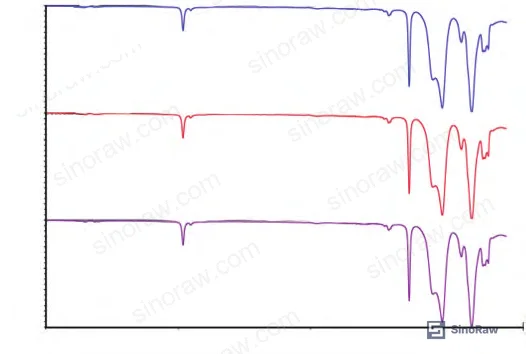
The fundamental trade-off: longer chains (high viscosity) form a more stable crosslinked network after cure but resist homogeneous mixing with crosslinker and catalyst during compounding. Shorter chains (low viscosity) carry more terminal hydroxyl groups per unit mass, react faster, and produce denser crosslink networks — but the resulting sealant is harder and less extensible.
Cure Speed, Extrudability, and Mechanical Properties: Full Test Data Across Six Formulations #
Six formulations were prepared under identical base conditions — same calcium carbonate loading, same fumed silica, same dimethyl silicone oil, oxime silane crosslinker, aminopropyl silane coupling agent, and organotin catalyst. Only the 107 gum grade and blend ratio changed. All mechanical specimens were cured at 23°C, 50% RH for 7 days per GB/T 528-2009, and hardness tested per GB/T 531.1-2008. Extrudability was measured per GB/T 13477.3-2017. Surface dry time followed GB/T 13477.5-2002.
Mechanical test results (23°C / 50% RH / 7-day cure):
| Formulation | Tensile Strength (MPa) | Elongation at Break (%) | Shore A Hardness |
|---|---|---|---|
| 1# — 5,000 mPa·s (100%) | 1.92 | 280 | 41.8 |
| 2# — 20,000 mPa·s (100%) | 1.88 | 402 | 38.3 |
| 3# — 20K/80K blend 4:1 | 1.74 | 382 | 34.7 |
| 4# — 20K/80K blend 1:1 | 1.91 | 441 | 36.3 |
| 5# — 20K/80K blend 1:4 | 1.85 | 428 | 35.5 |
| 6# — 80,000 mPa·s (100%) | 1.83 | 465 | 36.2 |
Surface dry time dropped from 30 minutes (5K grade) to 15 minutes (20K grade) to 14 minutes (80K grade). Cure depth followed the same inverse pattern — higher viscosity correlates with slower through-cure, because the long-chain polymer impedes uniform catalyst and crosslinker distribution throughout the matrix.
Extrudability data tells a stark story on the processing side: the 5K grade produced 717 g/min, while the 80K grade dropped to 173 g/min under identical pneumatic conditions. That’s a 4× reduction in output rate. For automated dispensing lines or cold-climate application, this is not a footnote — it’s a go/no-go criterion.
Honestly, most buyers over-specify tensile strength on RTV sealant and completely ignore extrudability. An 80K-grade sealant sitting in a drum at 5°C in a northern European winter is going to stop a production line. If your application involves any kind of automated bead dispensing, the 20K grade or a 20K/80K blend is a far safer starting point.
Where blending gets interesting: The 1:1 blend of 20K and 80K grades (formulation 4#) achieved the highest elongation at break — 441% — while recovering near-peak tensile strength at 1.91 MPa. The working hypothesis is that irregular chain length distribution in the blend reduces inter-chain void spacing, making the polymer network more reactive toward the crosslinker system. In other words, blending doesn’t just average the properties — it creates a microstructure that out-performs either single grade in extensibility.
Blend Optimization and Cure Behavior: What the Data Actually Tells Procurement Teams #
The cure depth data deserves more attention than it typically gets in supplier qualification. In supplier qualification work, we’ve seen samples fail minimum cure depth thresholds — three of six batches submitted by one vendor fell below 3.5 mm at 24 hours when the 80K-grade base was used without any viscosity blending. The formulation required a 4:1 or 1:1 blend with 20K material to reliably recover cure depth consistency. The single-grade 80K formulation simply struggled to distribute catalyst evenly enough for consistent depth of cure across the sample cross-section.
Blended formulations (3#, 4#, 5#) achieved surface dry times of 13–16 minutes — faster than either single-grade extreme at the same cure conditions. This is counterintuitive to most formulators who assume higher viscosity always means slower cure. The mechanism is chain packing: mixed molecular weight distributions pack more densely, reducing the effective diffusion path for moisture and catalyst through the matrix.
Most procurement teams don’t realize that ISO 11600 — the primary international standard governing building sealant classification — distinguishes sealant types partly on elongation recovery behavior, not just initial elongation. A sealant that passes ISO 11600 F25LM classification needs 25% movement accommodation with low modulus characteristics. The 80K single-grade or the 1:1 blend formulations align well with this requirement. The 5K-only formulation, with Shore A of 41.8 and elongation of only 280%, would likely struggle in façade glazing applications subject to significant thermal movement.
For electronics encapsulation or automotive underhood sealing governed by IEC 60068-2-14 thermal shock testing, the elongation advantage of higher-viscosity blends becomes even more pronounced.
The deketoxime cure chemistry — releasing methyl ethyl ketoxime as a byproduct rather than acetic acid — is what makes this sealant class suitable for sensitive metal substrates and electronics. The operating temperature window for cured deketoxime RTV is –50°C to 200°C. For applications where you’re considering silicone-based sealing solutions at the extremes of that range, the crosslink density — and therefore the base polymer viscosity — becomes the controlling variable for long-term mechanical retention.
Practical Guidance for Buyers #
When you’re evaluating Chinese RTV sealant suppliers, the COA for 107 gum viscosity is not optional — it’s the first thing to request. Ask whether the formulation uses a single-grade base or a blended base, and at what ratio. Most mid-tier Chinese manufacturers default to 20K-grade single base for its balanced properties, but they rarely optimize the blend ratio for your specific application.
For structural glazing or curtain wall applications requiring high movement accommodation, push for a 1:1 or 1:4 blend of 20K/80K grades — the data shows elongation gains of 10–15% over single-grade 20K without sacrificing tensile integrity. For automated dispensing applications, cap your base polymer at 20K viscosity or expect to engineer around poor extrudability at lower temperatures.
At sinoraw.com, we work with procurement teams sourcing from verified Chinese manufacturers across industrial sealing categories — our process includes reviewing raw material specifications like 107 gum grade before qualifying any sealant supplier. If you’re comparing multiple Chinese sources for RTV sealant and want formulation-level clarity before issuing an RFQ, that’s exactly where our industrial adhesives and sealing supplier qualification service can accelerate your sourcing decision.
Key actions: request the 107 gum viscosity grade in writing, ask for cure depth data at 24 hours under your site’s worst-case humidity conditions, and run extrudability verification at your minimum application temperature. Don’t accept tensile strength alone as a proxy for sealant quality.
Frequently Asked Questions #
What viscosity of 107 PDMS gives the best overall RTV silicone sealant performance?
There’s no single answer — it depends on your priority. If elongation and flexibility are critical (façade sealing, expansion joints), a 1:1 blend of 20,000 mPa·s and 80,000 mPa·s grades delivers the best combination of tensile strength (1.91 MPa) and elongation at break (441%) in controlled testing. If application speed and extrudability matter most, the 20K single grade is the safer choice.
Why does higher-viscosity 107 gum slow down cure depth?
High-viscosity polymer chains are longer and entangle more, which physically impedes the even distribution of catalyst and crosslinker through the matrix. The cure reaction — moisture-activated oxime condensation — depends on these components reaching all points in the sealant mass. Uneven distribution reduces local reaction rate and produces inconsistent cure depth, particularly in thick-section joints.
Can blending two viscosity grades of 107 gum improve cure speed?
Yes, and this is underused in practice. Blended 20K/80K formulations in the 4:1, 1:1, and 1:4 ratios all showed surface dry times of 13–16 minutes, faster than the single 20K grade at 15 minutes and single 80K at 14 minutes. The mixed chain-length distribution tightens inter-molecular spacing, facilitating more rapid crosslinker access.
What standard tests should I require in a supplier COA for one-component deketoxime RTV sealant?
At minimum: surface dry time (GB/T 13477.5), cure depth at 24h, extrudability (GB/T 13477.3), tensile strength and elongation at break after 7-day cure (GB/T 528), and Shore A hardness (GB/T 531.1). For construction applications, ask for ISO 11600 classification documentation. For electronics or automotive use, thermal cycle performance per IEC 60068-2-14 is worth specifying.
Is deketoxime RTV sealant safe to use on copper or sensitive electronics?
Yes — this is one of the main reasons deketoxime formulations are preferred over acetoxy-cure silicones in electronics assembly and precision instrument sealing. The oxime byproduct is non-corrosive to copper and most metals. Acetoxy types release acetic acid during cure, which is incompatible with copper-bearing substrates and many adhesive bond lines.
Published by sinoraw.com Technical Team | Request a sourcing quote
Content reviewed by michael.fang | © sinoraw.com — All rights reserved. Unauthorized reproduction prohibited.


