

TL;DR #
At 200 °C and 45 MPa initial compression stress, PTFE gasket creep deformation after 100 hours reaches approximately 1.9 mm — a 75%+ increase over room-temperature baseline — confirming that thermal and stress loading are strongly coupled in long-term sealing applications. Buyers specifying PTFE gaskets for chlor-alkali, electrolyzer, or high-temperature flange applications without accounting for this creep magnitude are accepting measurable leak risk as a design assumption, not an engineering margin. Require suppliers to provide creep deformation data at your actual service temperature and bolt load, not just ambient-condition specs.
Overview #
PTFE gaskets rarely fail catastrophically — they creep until the bolt preload drops below the minimum seating stress, and then they leak. That’s the failure mode procurement teams consistently underestimate. Engineering teams at a recognized general machinery research institute conducted controlled compression creep testing on DN80 flat PTFE gaskets (inner diameter 89.0 mm, outer diameter 148.5 mm, thickness 3.0 mm) across a full matrix of four temperatures (ambient, 100 °C, 150 °C, 200 °C) and three initial compression stresses (25, 35, 45 MPa), with continuous displacement measurement at 0.1 μm resolution over 100-hour test durations. This is significantly longer than the 4-hour creep window specified by EN 13555 — which is the standard most suppliers will quote when you ask them for creep data. The gap between that 4-hour number and 100-hour reality is where sealing failures hide.
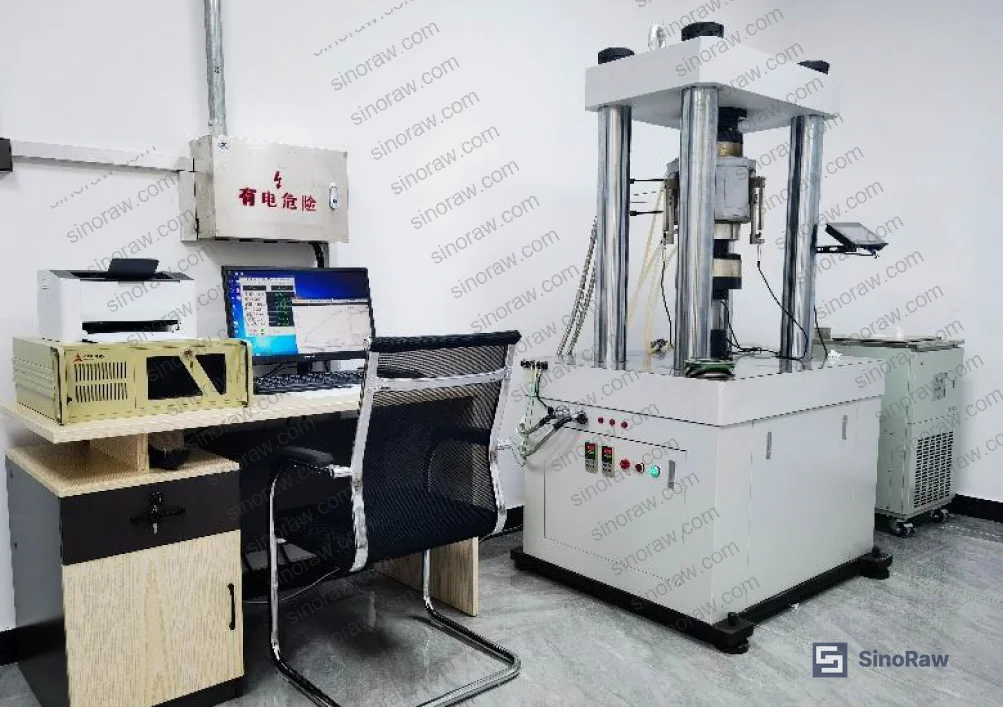
The test apparatus used three circumferentially distributed high-precision displacement sensors measuring upper and lower platen separation, averaged to derive axial gasket deformation. Load range was 0–500 kN with ±0.5% force accuracy, temperature control within ±0.2 °C, and deformation resolution at 0.1 μm. These are serious metrological conditions — not a simplified compression test dressed up as creep data.
For buyers sourcing Sealing & Thermal components for corrosive process environments, this test program provides the kind of long-duration, multi-variable dataset that lets you build a real creep budget into your flange design — rather than relying on manufacturer datasheets that were generated in a single-point test at room temperature.
PTFE Gasket Creep Behavior Under Combined Temperature and Stress Loading #
PTFE is a linear polymer. Its deformation under sustained load is not a single mechanism — it’s the superposition of elastic strain from bond-length and bond-angle changes, viscoelastic deformation from chain-segment mobility, and viscous flow from macromolecular center-of-mass migration. As temperature rises, molecular motion frequency increases, which amplifies the viscoelastic contribution and accelerates total creep. This is why you cannot simply apply a safety factor to room-temperature creep data and assume it covers your 150 °C service condition.
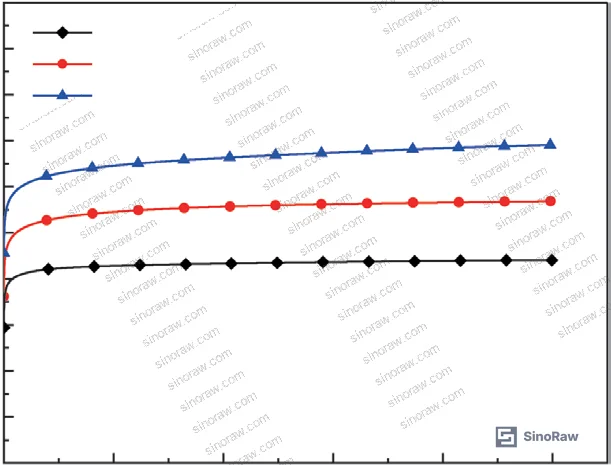
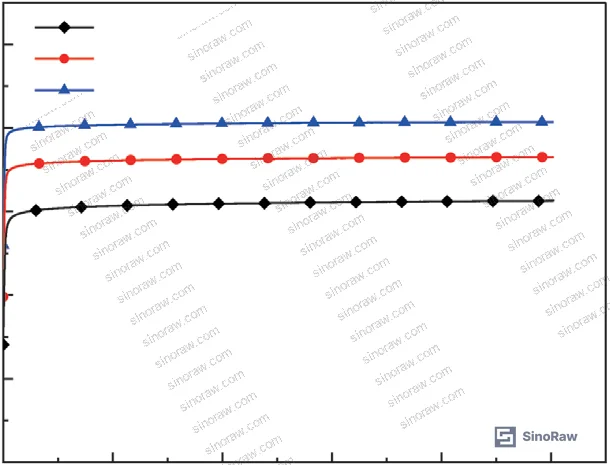
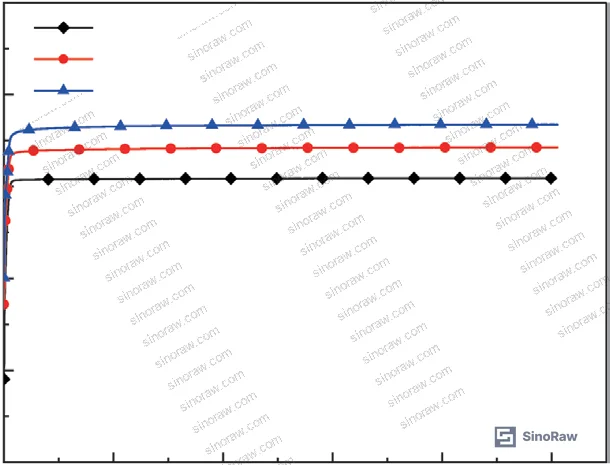
The creep curves show a clear two-stage profile typical of polymer viscoelastic behavior: a high initial creep rate that decays rapidly, transitioning to a low-rate steady-state plateau. The practical implication of this shape is important: the majority of total creep deformation occurs early.
Stress sensitivity — quantified:
At constant temperature (25 °C), increasing initial compression stress from 25 MPa to 35 MPa and 45 MPa produced the following 100-hour deformation values:
- 25 MPa → 0.882 mm
- 35 MPa → 1.136 mm (+28.8%)
- 45 MPa → 1.382 mm (+56.7%)
Stress sensitivity is nonlinear. Doubling the stress increment from +10 MPa to +20 MPa nearly doubles the creep increment.
Temperature sensitivity — quantified:
At constant initial stress (25 MPa), increasing temperature from 25 °C to 100 °C, 150 °C, and 200 °C produced:
- 25 °C → 0.882 mm
- 100 °C → 1.252 mm (+42.0%)
- 150 °C → 1.339 mm (+51.8%)
- 200 °C → 1.546 mm (+75.3%)
Temperature effect on creep rate is not linear either — acceleration between 25 °C and 100 °C is 42%, but the additional step from 150 °C to 200 °C is disproportionately large. If your process runs at 180–200 °C, you are operating near a sensitivity inflection that datasheet specs rarely capture.
The coupling effect is critical. At elevated temperature, the model parameters show that stress sensitivity itself increases — meaning a PTFE gasket at 200 °C is more sensitive to over- or under-torquing than the same gasket at ambient. A bolt load that would produce acceptable creep at room temperature becomes problematic at operating temperature, and vice versa. Most procurement teams don’t realize that this coupling behavior means single-temperature or single-stress creep data is essentially useless for high-temperature, high-load applications.
| Test Condition | 100-hr Deformation (mm) | Change vs. 25°C/25MPa Baseline |
|---|---|---|
| 25 °C, 25 MPa | 0.882 | Baseline |
| 25 °C, 35 MPa | 1.136 | +28.8% |
| 25 °C, 45 MPa | 1.382 | +56.7% |
| 100 °C, 25 MPa | 1.252 | +42.0% |
| 150 °C, 25 MPa | 1.339 | +51.8% |
| 200 °C, 25 MPa | 1.546 | +75.3% |
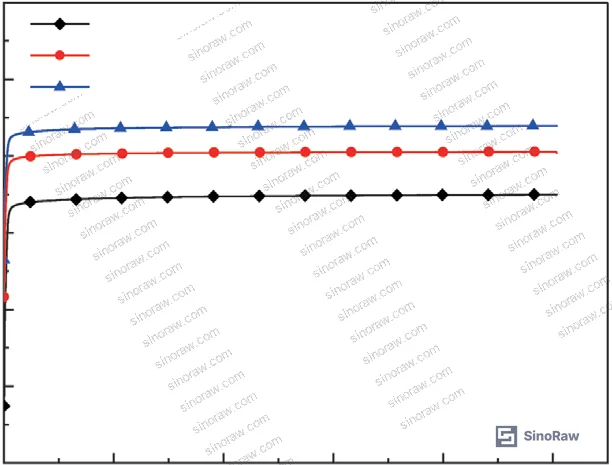
Creep Constitutive Models and Their Predictive Accuracy for PTFE Sealing Components #
Two empirical models were fitted to the test data: the Findley power-law model and a logarithmic constitutive model.
The Findley model expresses creep deformation as:
DG = DK · (ε₀ + a · t^b)
Where DG is total gasket deformation (mm), DK is maximum non-creep deformation (mm), t is creep time (hours), and ε₀, a, b are material constants determined by nonlinear fitting.
The logarithmic model takes the form:
DG = DK · [a · ln(bt + 1) + c]
Where a relates to initial creep rate, b to creep rate decay, and c to initial deformation. The logarithmic form is physically justified because PTFE creep curves exhibit hyperbolic characteristics — rapid initial rate followed by progressive saturation.
Model comparison findings:
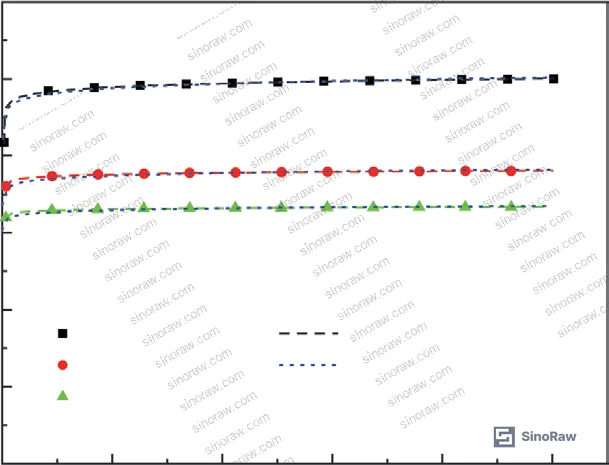
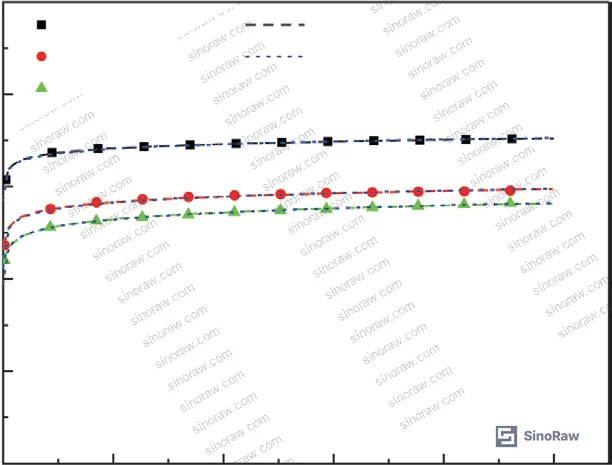
Both models performed well at room temperature — the curves were nearly superimposed on the experimental data at 25 °C. As temperature increases, both models lose some accuracy in predicting the initial creep stage (first 10–20 minutes), but both maintain good agreement in the steady-state plateau region. At 200 °C, the logarithmic model shows meaningfully better accuracy across all stress levels, particularly in the transient phase.
This has a direct procurement implication. If you are specifying PTFE gaskets for high-temperature service and a supplier provides you with Findley model parameters from low-temperature tests, those parameters will underpredict the early creep rate at operating temperature. The logarithmic model is the more appropriate tool for high-temperature applications.
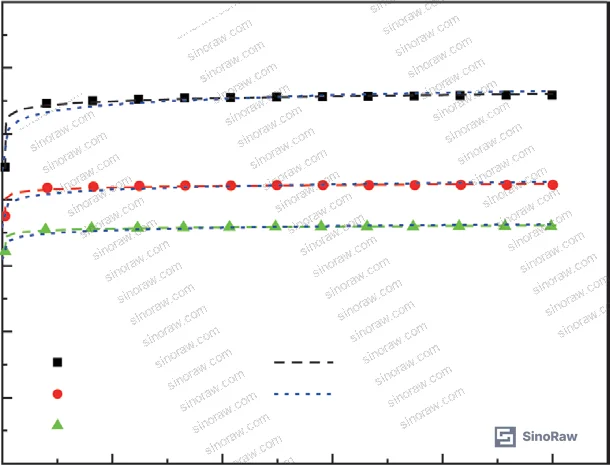
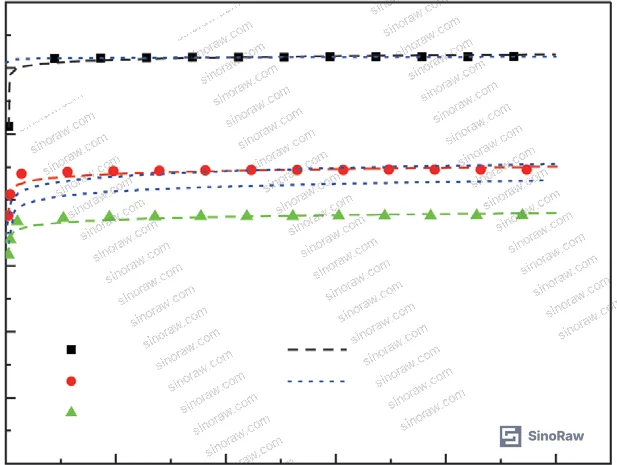
Analysis of the logarithmic model parameters reveals additional physical insight:
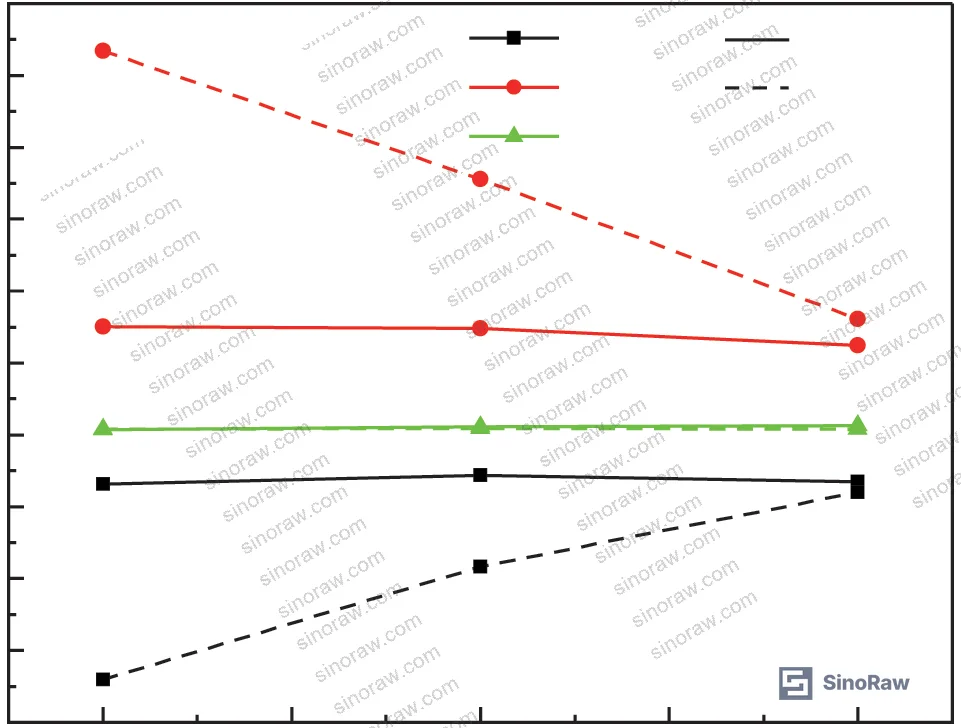
- Parameter a (initial creep rate): decreases as temperature increases — meaning the rate accelerates faster toward saturation at high temperature
- Parameter b (creep rate decay): increases with temperature — the system decays faster, which also means more of the total deformation is front-loaded
- At 200 °C, both a and b vary linearly with initial stress, confirming strong stress-temperature coupling. At 25 °C, stress changes do not significantly shift a or b — the material is relatively stress-insensitive at ambient temperature.
Practical Guidance for Buyers #
The single most actionable finding from this dataset is the 4-hour re-torque recommendation. At all three stress levels tested, approximately 88–94% of the total 100-hour creep deformation occurred within the first 4 hours. At 25 MPa, 35 MPa, and 45 MPa initial load, gasket deformation after 4 hours was 0.826 mm, 1.024 mm, and 1.212 mm respectively — accounting for 94%, 90%, and 88% of the full 100-hour value. This means that re-torquing bolts to the design preload at the 4-hour mark recovers nearly all the bolt load lost to early creep, and the remaining creep over the service life is comparatively small. Skipping the re-torque step is the primary reason PTFE-gasketed joints in chlor-alkali and electrolyzer applications develop early leaks.
Honestly, most buyers over-specify PTFE grade and under-specify creep performance parameters. You’ll see RFQs with demanding PTFE purity requirements and no mention of acceptable creep deformation at service temperature. The purity spec keeps the chemist happy; the missing creep spec is what lets the plant leak.
When evaluating Chinese suppliers of PTFE gaskets for corrosive process duty, the key differentiation is not price or delivery — it’s whether the supplier has actually characterized creep behavior at your service conditions. A supplier who can only provide ambient-condition compression data is not qualified for high-temperature applications, full stop. Compliance with ISO 9001:2015 Quality management systems tells you a supplier has a documented process — it does not tell you they’ve measured creep at 150 °C. Require the actual test data.
For applications covered by chemical exposure requirements, also verify that gasket materials comply with REACH Regulation (EC) No 1907/2006 — particularly relevant for PTFE additives and processing aids used in filled or modified grades.
At sinoraw.com, we work with procurement engineers and sourcing managers at industrial facilities globally, helping them identify and pre-qualify Chinese gasket manufacturers before RFQ — specifically on the technical documentation requirements that separate competent suppliers from catalog vendors.
Need help identifying qualified suppliers for PTFE sealing gaskets? Talk to our sourcing team →
Supplier Qualification Questions #
- Can you provide compression creep test data at our specific service temperature (state your temperature: 100–200 °C) and bolt load, with deformation measured continuously over a minimum 100-hour duration — not just the 4-hour EN 13555 PQR window?
- At 25 MPa initial compression stress and 200 °C, what is your measured 100-hour gasket deformation, and does it fall within the reference range of approximately 1.5–1.9 mm consistent with validated PTFE material behavior?
- What constitutive model do you use to characterize long-term creep — Findley power-law or logarithmic — and can you provide the fitted material constants (a, b, c or ε₀, a, b) for each temperature and stress condition in your operating range?
- What is the 4-hour deformation as a percentage of 100-hour total deformation in your batch release data? Field data indicates this should be in the 88–94% range; values significantly lower suggest atypical creep behavior that warrants investigation.
- At 25 °C and 45 MPa initial stress compared to 25 MPa, what is the percentage increase in 100-hour creep deformation? The expected range based on PTFE polymer physics is approximately 50–60%; values outside this range suggest material formulation or density inconsistencies.
Sourcing Checklist #
- ☐ Supplier provides creep test data at ≥2 temperatures in the 25–200 °C range, not ambient-only
- ☐ 100-hour deformation at 25 MPa/25 °C is documented between 0.80–0.95 mm for standard 3.0 mm thick DN80 flat gaskets
- ☐ 4-hour deformation represents ≥88% of 100-hour total deformation (confirming material front-loaded creep profile)
- ☐ Supplier’s creep test apparatus measures deformation at ≤1 μm resolution with temperature control within ±0.5 °C
- ☐ Material compliance with REACH regulation confirmed for all additives and processing compounds in filled PTFE grades
- ☐ Gasket dimensional tolerances (ID ±0.5 mm, OD ±0.5 mm, thickness ±0.1 mm) verified per incoming inspection under ISO 2859-1:1999 sampling procedures
- ☐ Supplier can provide logarithmic model parameters for high-temperature (≥150 °C) applications, not only Findley model data
- ☐ Re-torque procedure (bolt retightening at 4-hour mark) is documented in the installation guide accompanying the gasket shipment
Key Specifications Table #
| Parameter | Recommended Value | Verification Method |
|---|---|---|
| 100-hr creep deformation at 25 °C / 25 MPa | ≤0.90 mm (3.0 mm gasket) | Constant-load compression test, 0.1 μm displacement resolution, 100 h duration |
| 100-hr creep deformation at 200 °C / 25 MPa | ≤1.60 mm | High-temperature creep test per EN 13555 extended protocol, 100 h minimum |
| 4-hour deformation as % of 100-hour total | ≥88% at all stress levels | Ratio of 4 h to 100 h deformation from same test curve |
| Stress sensitivity index (25 MPa → 45 MPa increase at 25 °C) | +50–60% deformation increase | Comparative test at ≥2 stress levels, same temperature and duration |
| Temperature sensitivity index (25 °C → 200 °C at 25 MPa) | ≤+80% deformation increase | Comparative test at ≥3 temperatures, same stress and duration |
| Test temperature control accuracy | ±0.2 °C | Calibrated thermocouple, verified against reference standard |
Can’t find a supplier meeting these specs? Submit your requirements and we’ll match you within 48 hours.
References #
Data source: Compressive Creep Behavior and Constitutive Modeling of PTFE Gaskets Under Coupled Temperature and Stress Conditions, K. Lei et al., Polymer Testing, 2024
Frequently Asked Questions #
Why does PTFE creep so much more at elevated temperature compared to ambient?
PTFE is a linear-chain fluoropolymer, and its creep mechanism involves three overlapping deformation processes: elastic strain from bond geometry changes, viscoelastic strain from chain segment mobility, and viscous flow from macromolecular diffusion. Temperature accelerates all three simultaneously. Between 25 °C and 200 °C, the 100-hour creep deformation at 25 MPa increases by approximately 75%, driven primarily by the amplified viscoelastic contribution at higher thermal energy. The key insight is that these are not separable effects — you cannot predict high-temperature creep by scaling ambient data.
Is the EN 13555 standard sufficient for qualifying PTFE gaskets in high-temperature applications?
No. EN 13555 specifies a 4-hour creep measurement window for the PQR parameter. Test data confirms that approximately 88–94% of 100-hour creep deformation occurs within that 4-hour window — so EN 13555 data captures most early-stage deformation. However, it provides no information on steady-state creep behavior, temperature sensitivity, or coupled stress-temperature effects over extended service. For chlor-alkali and electrolyzer applications where gaskets remain in service for months or years, supplementary long-duration testing at service conditions is necessary.
What is the practical significance of re-torquing bolts at 4 hours after initial assembly?
This is probably the most directly actionable maintenance item for any PTFE-gasketed joint. Since 88–94% of total 100-hour creep deformation occurs within the first 4 hours, re-torquing at that point recovers the bolt preload lost to early creep before it accumulates further. Skipping this step is a documented root cause of early leakage in chlor-alkali and electrolyzer service. The re-torque procedure must restore bolts to the original design preload, not simply check for looseness.
Which constitutive model should I request from suppliers — Findley or logarithmic?
For ambient-temperature applications, either model is adequate — at 25 °C the two model curves are nearly superimposed on test data. For any application above 100 °C, request the logarithmic model parameters. The Findley model loses accuracy in predicting the initial creep stage at elevated temperature, while the logarithmic model maintains better accuracy across the full 100-hour curve at all stress levels. At 200 °C especially, the difference in predictive accuracy is measurable and procurement-relevant.
Can I use the same PTFE gasket specification for a chlor-alkali service at 80 °C and a PEM electrolyzer at 180 °C?
No. The test data shows that creep deformation at 150–200 °C is 50–75% higher than at ambient under the same bolt load. A gasket sized and specified for 80 °C service will exhibit unacceptable long-term bolt load relaxation at 180 °C. You need separate creep budgets, potentially different gasket thicknesses, and almost certainly different re-torque schedules. The stress-temperature coupling effect also means the optimal torque value shifts with operating temperature — so a single torque spec across both applications is not safe engineering practice.
Published by sinoraw.com Technical Team | Request a sourcing quote


