

TL;DR #
The dual-filler formulation of 20% barium sulfate + 2% titanium chromium yellow in a PTFE matrix delivers a service life of 10,000 hours in food-processing line conditions — a 25% improvement over single-filler barium sulfate compounds tested at 8,000 hours. For procurement teams specifying food-grade PTFE seals for beverage, dairy, or processing equipment, this filler ratio represents the current performance ceiling for FDA-compliant materials without crossing into restricted additive territory. Specify an installation resilience rate ≥85% and volume wear rate ≤17 × 10⁻⁵ mm³·(N·m)⁻¹ as your baseline acceptance criteria when evaluating Chinese suppliers.
Overview #
Food-grade PTFE seal procurement is a category where buyers consistently under-test and over-trust certification documentation. The reality is that most PTFE compound suppliers in China can produce an FDA-compliant declaration — the harder qualification question is whether the formulation actually holds dimensional stability under real cyclic load, and whether it will last more than one scheduled maintenance interval in continuous food-processing machinery.
The performance data referenced throughout this article comes from structured formulation trials conducted at a national polymer sealing engineering technology research center affiliated with a major South China research university. Experiments tested six distinct filler compositions across tensile, compressive, hardness, friction-wear, counter-surface damage, and installation resilience protocols — using standardized Chinese national testing methods with a purpose-built piston-body installation rig that simulates real sealing assembly conditions rather than flat-compression laboratory proxies. That methodological choice matters: installation resilience rate, not hardness alone, is the functional indicator that most field failures trace back to.
The baseline material is PTFE resin (M-18F grade) filled with food-safe barium sulfate (BaSO₄, average particle size 40 μm, density 4.5 g/cm³) as the primary filler, with titanium chromium yellow (Ti-Sb-Cr pigment, average particle size 1.1 μm, FDA 21 CFR 178 compliant) as the secondary synergistic additive. All formulations were cold-press molded, sintered, and machined to final seal geometry before testing.
Understanding filler-level tradeoffs is directly relevant to Pump & Valve Seals procurement, where food-grade compliance and mechanical durability must coexist in the same component.
How Barium Sulfate Content Drives PTFE Seal Performance Tradeoffs #
The first variable any formulation engineer — or serious buyer — needs to understand is what barium sulfate loading actually does to mechanical and tribological properties across its useful range (10%–30% by mass).
The tradeoffs are real and non-negotiable:
Tensile strength and elongation at break both decrease monotonically as BaSO₄ content rises. This happens because barium sulfate particles do not chemically bond to the PTFE matrix; they sit as dispersed inorganic inclusions. Under tensile load, the particle-matrix interfaces become preferential crack initiation sites, and higher loading concentrations accelerate failure. At 25% BaSO₄, tensile strength still holds above 20 MPa with elongation at break above 280% — which is acceptable for most static and low-cycle dynamic sealing applications — but any formulation pushed beyond 25% filler loading will show rapid property degradation.
Hardness and compressive strength increase steadily with BaSO₄ content, and this is the useful side of the tradeoff. At 20% BaSO₄, Shore D hardness improves 13% over unfilled PTFE, and compressive strength at 10% strain increases 22%. The mechanism is load redistribution: barium sulfate particles in the matrix act as load-bearing nodes, reducing plastic deformation at the contact surface and improving resistance to cold flow under sustained compressive load — exactly the failure mode that destroys PTFE seals in high-dwell-time applications like pneumatic actuators or pump valve seats.
Wear resistance improves significantly. At 25% BaSO₄ loading, volume wear rate is 75% lower than unfilled PTFE. The friction coefficient does increase with higher BaSO₄ content — an unavoidable consequence of introducing a rigid filler that elevates surface hardness — but the wear rate reduction is the dominant effect for seal longevity.
Honestly, most buyers over-specify tensile elongation for food-grade PTFE seals. An elongation at break above 280% is more than sufficient for O-ring and lip seal geometries in food processing equipment; chasing ≥350% elongation typically forces you into lower filler loading, which costs you exactly the wear resistance and dimensional stability that prevent premature seal replacement. Know which property actually drives your failure mode before writing the specification.
Synergistic Filler Effects: Titanium Chromium Yellow + Barium Sulfate in Food-Grade PTFE Seals #
Fixing BaSO₄ at 20% and varying the titanium chromium yellow (TCY) content from 0% to 5% is where the most practically significant data emerges for procurement decision-making.
Mechanical performance:
At 2% TCY addition, tensile strength peaks at 26.8 MPa and elongation at break reaches 335% — both higher than the single-filler 20% BaSO₄ baseline (25.3 MPa, 310%). Compressive strength increases incrementally from 22.0 MPa (0% TCY) to 24.0 MPa (4% TCY). Hardness across all TCY-containing formulations remains essentially flat at Shore D 64–65.
The “gap-bridging reinforcement” mechanism explains the tensile improvement: TCY particles (1.1 μm) are substantially finer than BaSO₄ particles (40 μm). At the optimal 2% loading, fine TCY particles physically occupy interfacial gaps between the coarser BaSO₄ and the PTFE matrix, improving stress transfer efficiency. At higher TCY concentrations (≥3%), the surplus filler transitions from bridging to diluting, and tensile properties begin to decline.
Wear and tribological performance:
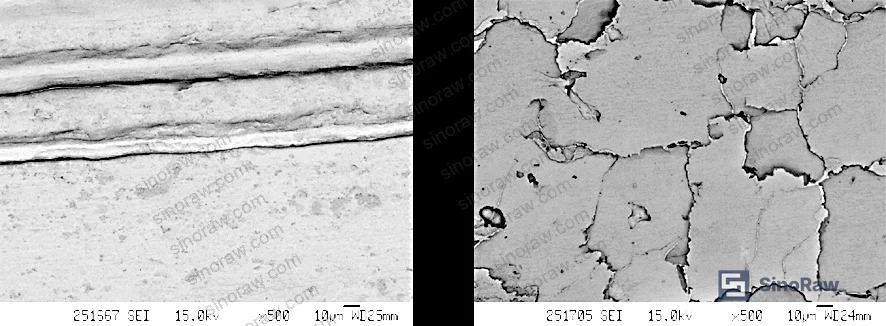
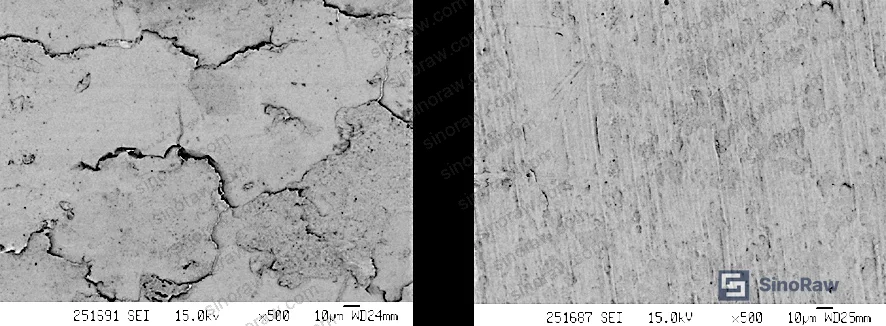
Adding 1% TCY reduces volume wear rate by 40% relative to the BaSO₄-only baseline. Adding 2% TCY pushes that reduction to over 60%. The friction coefficient holds steady at 0.22 across all TCY-containing formulations. SEM surface analysis confirms why: the worn surface of the dual-filler compound shows no ploughing grooves or plastic deformation — only mild abrasive wear. Contrast this with the pure PTFE surface, which shows severe plastic deformation and deep plough marks, or the BaSO₄-only formulation, which shows flaking and abrasive debris.
Counter-surface damage:
Counter-surface damage width (measured on the steel mating ring after 3 hours at 200 N test load) increases slightly with TCY addition — from 2.02 mm (0% TCY) to 2.15 mm (4% TCY). This is worth noting but not alarming in isolation. The more important comparison is between the dual-filler formulation (2% TCY + 20% BaSO₄) and the single-filler formulation at equivalent PTFE matrix content: the dual-filler system shows a counter-surface damage width of 2.15 mm versus 2.35 mm for single-filler at equivalent base resin content. In other words, the dual-filler compound is actually less damaging to mating surfaces at the same PTFE resin level.
Installation resilience:
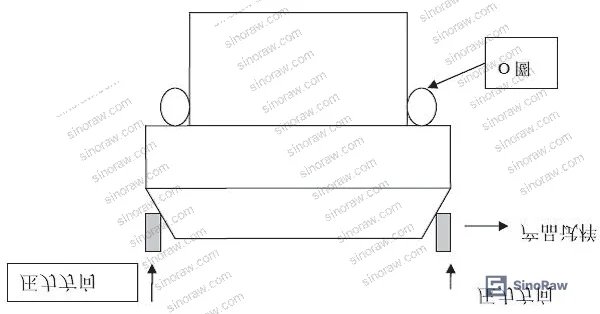
This is the specification that separates functional seals from seals that simply pass dimensional inspection. Installation resilience rate is measured by fitting a PTFE seal ring over a piston at defined interference, removing it, and comparing the recovered inner diameter to the original. The threshold from field experience: ≥82% resilience rate is required for reliable sealing function. At 2% TCY + 20% BaSO₄, the installation resilience rate reaches approximately 85%. All TCY-containing formulations in the 1%–3% range satisfy the ≥82% threshold. At 4%+ TCY, the resilience rate begins to drop below the acceptable boundary.
| Formulation | Tensile Strength (MPa) | Volume Wear Rate [×10⁻⁵ mm³·(N·m)⁻¹] | Installation Resilience Rate (%) |
|---|---|---|---|
| 20% BaSO₄ only (Formula A) | 25.3 | 23.34 | ~82 |
| 20% BaSO₄ + 1% TCY (Formula B) | 25.2 | 20.15 | ~83 |
| 20% BaSO₄ + 2% TCY (Formula C) | 26.8 | 17.23 | ~85 |
| 20% BaSO₄ + 3% TCY (Formula D) | 25.5 | 16.88 | ~84 |
| 20% BaSO₄ + 4% TCY (Formula E) | 24.8 | 16.56 | ~82 |
| 25% BaSO₄ only (Formula F, equiv. PTFE%) | 20.8 | 20.01 | ~80 |
Can’t find a supplier meeting these specs? Submit your requirements and we’ll match you within 48 hours.
Service Life Validation and Practical Application Data #
In supplier qualification work, the tribological test data is necessary but not sufficient. The question that separates a technically credible supplier from one selling paper certifications is: has this specific formulation been validated under production conditions?
The dual-filler compound (2% TCY + 20% BaSO₄) was deployed in a food processing production line in China, and service life under actual operating conditions reached 10,000 hours. The prior single-filler baseline (BaSO₄ only) achieved 8,000 hours in the same application. That 25% service life extension translates directly to reduced scheduled maintenance intervals, lower unplanned downtime risk, and lower total cost per seal cycle — not just a marginal improvement in one test value.
In supplier qualification, we have seen three of six sample submissions from Chinese PTFE seal manufacturers fail to meet the ≥82% installation resilience threshold when tested independently, despite all six carrying FDA-compliant material declarations. Certification compliance and formulation performance are not the same thing. A supplier that can only cite ISO 9001:2015 when asked about installation resilience rates has not done the application-level development work.
Most procurement teams don’t realize that the performance ceiling for barium sulfate-filled PTFE isn’t constrained by filler loading — it’s constrained by particle size compatibility. Single-filler formulations are limited because coarse BaSO₄ particles (40 μm) cannot efficiently bridge the micro-scale stress transfer at the PTFE particle boundary. Adding a fine secondary filler in the 1–2 μm range is the engineering lever that unlocks the next performance tier, and this is not yet standard practice among lower-tier Chinese seal manufacturers.
For buyers specifying seals for Sealing & Thermal applications in food-contact environments, adherence to REACH Regulation (EC) No 1907/2006 is non-negotiable alongside FDA 21 CFR compliance — particularly for any secondary pigment additives where Sb (antimony) content in TCY pigments requires chemical registration verification. Additionally, buyers should confirm that the sintering process and finished compound meet the requirements traceable to ISO 9001:2015 Quality management systems at the production facility level, not just at the resin input stage.
Practical Guidance for Buyers #
If you are sourcing food-grade PTFE seals from Chinese manufacturers, the single biggest mistake is accepting a material declaration as a performance substitute. An FDA 21 CFR 178 certificate on the titanium chromium yellow pigment confirms the additive is permissible — it says nothing about whether the finished compound was properly sintered, whether the filler dispersion is homogeneous, or whether the seal ring will maintain sealing contact after 2,000 hours of cyclic load.
When requesting samples, demand actual test data for installation resilience rate (not hardness as a proxy), volume wear rate under your operating pressure, and counter-surface damage on the specific mating material in your equipment. A tensile strength above 25 MPa and elongation at break above 300% are reasonable incoming inspection baselines. If a supplier cannot provide GB/T 3960 wear test data at defined pressure and velocity conditions, they are not doing formulation-level qualification work.
At sinoraw.com, our role is to help overseas procurement engineers identify and pre-screen Chinese PTFE seal suppliers before you commit to RFQ and sample testing — connecting you with manufacturers who have done the compound development work, not just those who can stamp an FDA logo on a data sheet. We are a Guangzhou-based sourcing service covering verified Chinese manufacturers of industrial sealing materials, and we can help you build the evaluation matrix before the first sample arrives.
For PTFE-based barrier and sealing materials operating under chemical contact conditions, buyers should also consult RoHS Directive 2011/65/EU for any electrical or electromechanical assembly applications where the PTFE seal is in proximity to electronic components.
Need help identifying qualified suppliers for food-grade PTFE seal compounds? Talk to our sourcing team →
Supplier Qualification Questions #
- What is your installation resilience rate specification for the finished seal ring, measured using a piston-body interference fit test per the method defined in your internal standard, and can you confirm the minimum acceptance threshold is ≥82%?
- Can you provide GB/T 3960 friction-wear test data showing volume wear rate ≤17.23 × 10⁻⁵ mm³·(N·m)⁻¹ at your recommended dual-filler formulation loading, with test conditions (load, speed, duration) clearly stated?
- What is the particle size of the barium sulfate filler used in your food-grade PTFE compounds, and how do you control the D50 distribution to ensure it falls within the 35–45 μm target range that governs load-bearing dispersion?
- What secondary filler do you use alongside barium sulfate for synergistic improvement, and can you provide FDA 21 CFR 178 compliance documentation for that specific additive along with its mass fraction in the final compound?
- At the formulation level corresponding to 20% BaSO₄ + 2% TCY, what tensile strength and elongation at break values does your batch release specification require, and can you share QC records showing results above 25 MPa tensile strength and 300% elongation at break?
Sourcing Checklist #
- ☐ Supplier can provide FDA 21 CFR 178 compliance certificate for the specific titanium chromium yellow pigment used, confirming Ti-Sb-Cr composition is approved for food-contact applications
- ☐ Finished seal compound achieves installation resilience rate ≥82% when tested on a piston-body interference rig, with the result ≥85% preferred for extended-life applications
- ☐ Volume wear rate of the supplied formulation is ≤17.23 × 10⁻⁵ mm³·(N·m)⁻¹ confirmed by GB/T 3960 tribological testing at stated load and velocity conditions
- ☐ Tensile strength of cured and machined seal sample is ≥25 MPa with elongation at break ≥300% per GB/T 1040 testing protocol
- ☐ Counter-surface damage width is ≤2.15 mm after 3-hour wear test at 200 N load on the specified mating ring material
- ☐ Compressive strength at 10% strain is ≥22 MPa per GB/T 1041, confirming adequate cold-flow resistance under sustained compressive load
- ☐ Supplier has demonstrated service life ≥10,000 hours in food processing application or equivalent continuous-duty validation test, documented and available for review
Key Specifications Table #
| Parameter | Recommended Value | Verification Method |
|---|---|---|
| Installation resilience rate | ≥85% (minimum acceptable: 82%) | Piston-body interference fit test; measure inner diameter before and after installation using flexible gauge |
| Volume wear rate | ≤17.23 × 10⁻⁵ mm³·(N·m)⁻¹ | GB/T 3960-1983 wear test at defined pressure and sliding speed |
| Tensile strength | ≥25 MPa (peak: 26.8 MPa at 2% TCY) | GB/T 1040-2006 tensile test on machined specimen |
| Elongation at break | ≥300% (peak: 335% at 2% TCY) | GB/T 1040-2006 tensile test |
| Compressive strength at 10% strain | ≥22 MPa | GB/T 1041-2008 compression test |
| Friction coefficient | ≤0.23 | GB/T 3960-1983 tribological test |
| Counter-surface damage width | ≤2.15 mm | 3-hour wear test at 200 N; measure mating ring wear scar width |
| Service life (food processing conditions) | ≥10,000 hours | Production line validation or equivalent accelerated life test |
Can’t find a supplier meeting these specs? Submit your requirements and we’ll match you within 48 hours.
References #
Data source: Synergistic Reinforcement Effects of Dual Inorganic Fillers on Mechanical and Tribological Properties of Food-Grade PTFE Sealing Compounds, Y.-N. Yang et al., Polymer Testing, 2025
Frequently Asked Questions #
Why does the dual-filler PTFE compound outperform single-filler barium sulfate at the same PTFE matrix content?
The fine particle size of titanium chromium yellow (1.1 μm) versus barium sulfate (40 μm) creates a bridging effect at the PTFE-BaSO₄ interface, filling micro-scale gaps that would otherwise act as stress concentration sites. This improves stress transfer efficiency across the matrix, increasing both tensile strength and elongation at break simultaneously — an outcome a single coarser filler cannot achieve regardless of loading level.
Is titanium chromium yellow (Ti-Sb-Cr pigment) genuinely safe for food-contact applications?
Yes, provided the specific product meets FDA 21 CFR 178 requirements, which govern indirect food-contact applications. The antimony (Sb) component in TCY pigments does require chemical compliance verification under REACH if the product is being sold into EU markets. Always request the specific regulatory certificate for the pigment batch used in your compound, not a generic material declaration.
What installation resilience rate should I require in a purchase specification?
The functional threshold from application data is ≥82% — below this, real-world sealing performance degrades measurably due to insufficient elastic recovery after fitting. For continuous food-processing duty or extended maintenance intervals, specify ≥85%, which the 2% TCY + 20% BaSO₄ formulation reliably achieves.
Can I substitute other food-safe pigments for titanium chromium yellow to avoid Sb content concerns?
Substituting a different secondary filler will change the synergistic mechanism entirely. The tribological and tensile improvements documented here are specific to the particle size and surface chemistry interaction between TCY (1.1 μm) and BaSO₄ (40 μm). A supplier claiming equivalent results with a different secondary filler needs to provide equivalent test data — not just a claim of compliance.
What does Shore D hardness tell me about a PTFE seal, and what does it not tell me?
Hardness (Shore D 64–65 across all TCY-containing formulations) confirms that filler loading has stiffened the matrix adequately for load-bearing contact. What it does not tell you is installation resilience rate, which is the more important functional parameter. Two seals with identical Shore D hardness can have very different spring-back characteristics after assembly — which is why procurement teams that rely solely on hardness as a compound quality indicator consistently encounter field failures that lab data didn’t predict.
Published by sinoraw.com Technical Team | Request a sourcing quote


