

TL;DR #
Ultra-low resistance ePTFE laminated filter media reduces bag filter operating resistance by more than 300 Pa compared to standard laminated media, while extending pulse-cleaning cycles by 4.5×. For procurement teams specifying replacement filter bags in steel, cement, or waste incineration applications, this translates directly into measurable fan energy savings and compressed air cost reduction — not just marginal efficiency gains. Specify initial air permeability ≥8.3 m³/(m²·min) at 200 Pa differential as your minimum acceptance criterion, and demand VDI 3926-protocol test data from any supplier before issuing an RFQ.
Overview #
Most procurement teams treating ePTFE laminated filter bags as a commodity are leaving significant operating cost on the table. The performance gap between conventional laminated media and the next generation of ultra-low resistance ePTFE membranes is not incremental — it’s a factor of 2–3× in airflow permeability and roughly 0.4× in aged operating resistance. That difference has direct consequences for fan energy draw and compressed air consumption across the service life of a dust collector installation.
The data referenced in this article comes from laboratory and field evaluations conducted by an environmental equipment manufacturer with deep specialization in fluoropolymer filtration materials. Testing followed the VDI 3926 standard protocol for cleanable filter media, using a FilTEq FEMA-AT standardized test bench, with a 5 g/m³ PURAL-NF test dust concentration and a filtration velocity of 2 m/min — conditions designed to simulate real industrial dust loading cycles. A full 5,000-cycle aging sequence was completed before final resistance measurements were recorded. The field deployment data comes from a steel plant ore-bin dust collector operating at 575,000 m³/h, providing a real-world validation dataset rarely included in supplier technical sheets.
For buyers sourcing barrier films and membrane-laminated filtration materials from Chinese manufacturers, this level of documented test data should be the baseline expectation — not a premium deliverable.
ePTFE Membrane Microstructure and Its Direct Impact on Filter Resistance #
The performance of any laminated filter bag is fundamentally determined by the ePTFE membrane, not the substrate. Whether the backing is polyester needle felt, polyester spunbond nonwoven, fiberglass woven cloth, PPS needle felt, or PTFE needle felt — the substrate is structural support only. The resistance you’re buying is almost entirely the membrane.
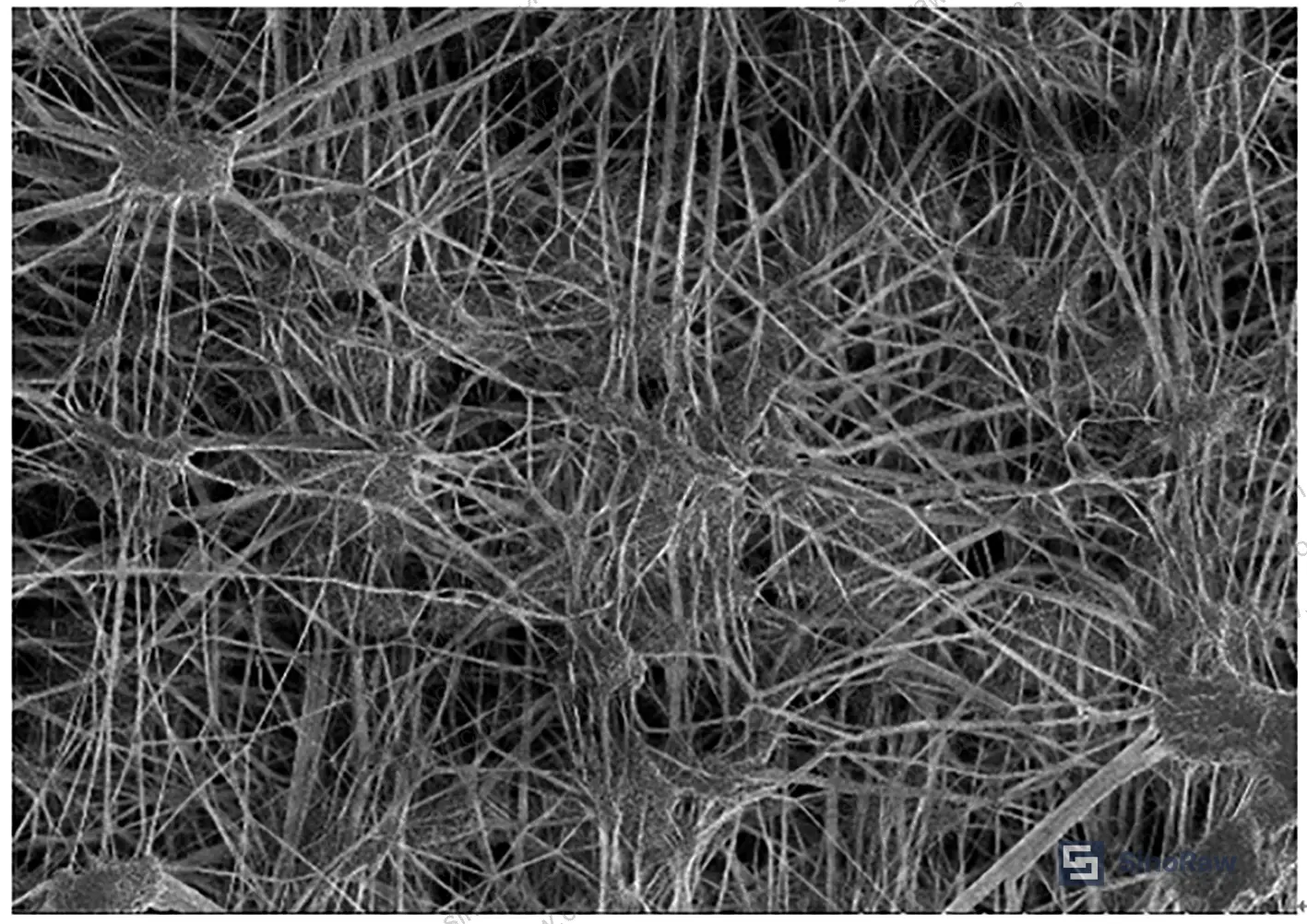
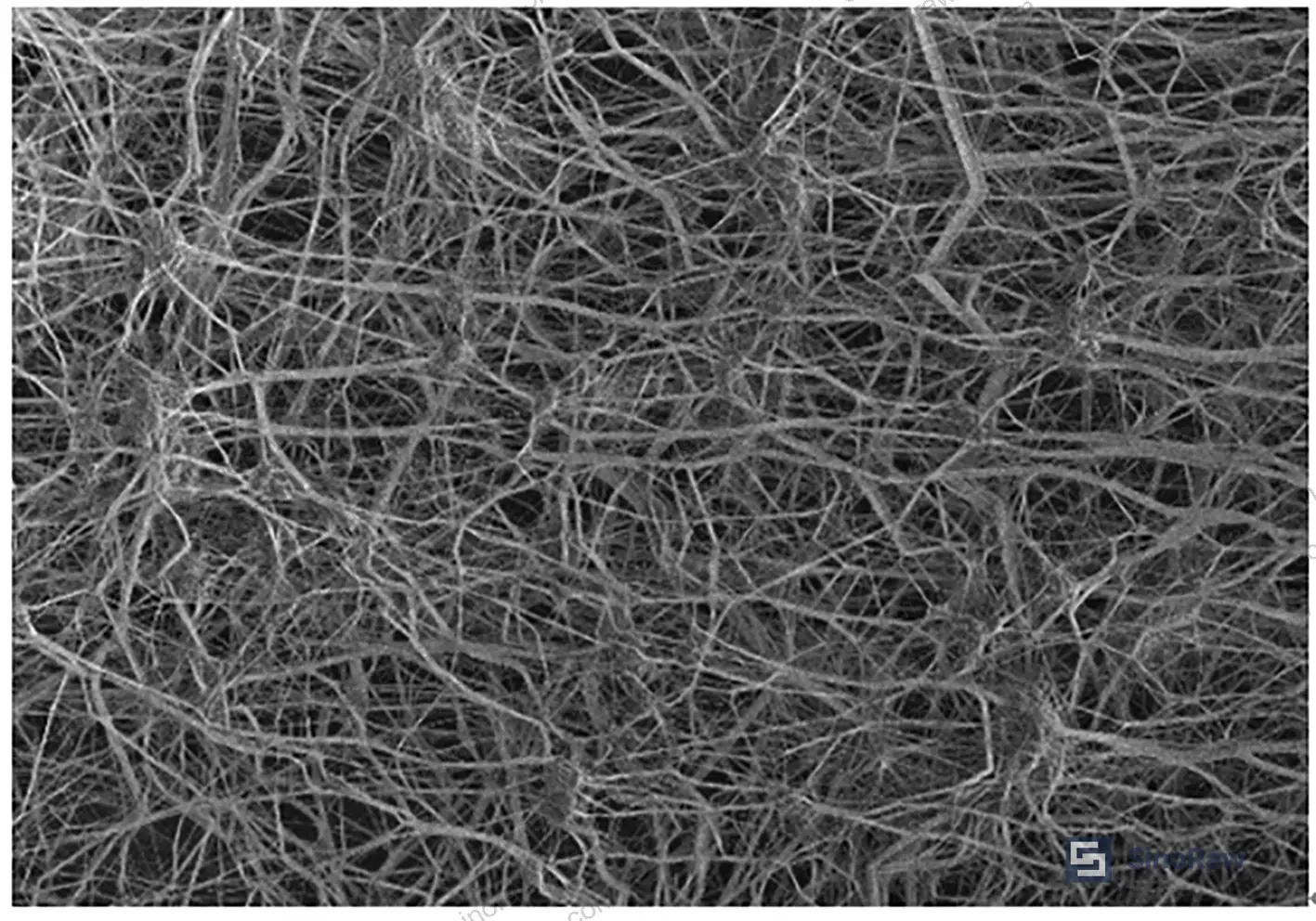
ePTFE membrane is produced by biaxial stretching of PTFE resin at elevated temperature, forming a network of nodes and interconnecting fibrils with pore sizes typically in the 0.1–10.0 μm range. Conventional filtration-grade ePTFE membranes have relatively large node structures with fewer, thicker fibrils. The ultra-low resistance variant is produced by tightly controlling stretch ratio (both longitudinal and transverse), temperature, and line speed to achieve smaller fiber diameters, higher fibril count, reduced node diameter, and lower node-area fraction.
Scanning electron microscopy comparison at identical magnification makes the structural difference unmistakable: the ultra-low resistance membrane shows a visibly denser fibril network with significantly smaller node structures. This translates directly into higher porosity at equivalent pore-size cut-off — which is the key to achieving lower pressure drop without sacrificing filtration efficiency.
The resistance decomposition of a bag filter matters here. Total equipment resistance ΔP = structural resistance ΔP₁ + filter media resistance ΔP₂ + residual resistance ΔP₃ + dust cake resistance ΔP₄. In a conventional laminated bag filter, total equipment resistance runs 1,200–2,600 Pa, against a fan total pressure of 3,500–6,000 Pa — meaning the dust collector accounts for roughly one-third to one-half of the entire system pressure budget. Of that dust collector resistance, structural resistance is only 25%; filter media-related contributions (media resistance 19%, residual resistance 31%, dust cake 25%) account for 75%. This is where the engineering leverage sits.
Compliance with ASTM D3985 Oxygen Gas Transmission Rate Through Plastic Film and Sheeting testing methodologies for barrier film characterization shares underlying metrology principles with airflow resistance measurement — procurement teams who already evaluate barrier packaging films will find the test logic familiar: transmittance at defined differential pressure, standardized test area, controlled test conditions.
Comparative Performance Data: Ultra-Low Resistance vs. Conventional Laminated Media #
The VDI 3926 protocol test results provide a clean head-to-head dataset. Both media types achieved dust filtration efficiency exceeding 99.995% throughout testing — outlet concentrations remained below 0.1 mg/m³ in both cases. Filtration efficiency is not the differentiator here. Resistance is.
| Parameter | Conventional Laminated Media | Ultra-Low Resistance ePTFE Media | Ratio |
|---|---|---|---|
| Initial resistance | 213 Pa | 62 Pa | 0.29× |
| Resistance after first 30 cleaning cycles | 262 Pa | 105 Pa | 0.40× |
| Resistance after aging + final 30 cycles | 509 Pa | 194 Pa | 0.38× |
| Initial air permeability at 200 Pa | 2.8 m³/(m²·min) | 8.3 m³/(m²·min) | 2.96× |
| Cleaning cycle duration (30-cycle sequence) | ~3,250 s | ~13,000 s | 4.0× |
The cleaning cycle duration data is the figure that gets overlooked. In supplier qualification, we saw that procurement teams focusing only on initial resistance miss the aged resistance entirely — and it’s the aged resistance that determines your actual fan energy draw over a 3–5 year service interval. The ultra-low resistance media aged to 194 Pa; the conventional media aged to 509 Pa. That 315 Pa difference at steady state is the number that drives your total cost of ownership calculation.
Honestly, most buyers over-specify filtration efficiency and under-specify resistance characteristics when writing filter bag purchase orders. Both media types hit >99.995% efficiency — a number that satisfies ultra-low emission requirements in steel, cement, and coking operations. The specification that actually separates the two products is aged resistance after 5,000 cleaning cycles, and that test takes time to run. Suppliers who can’t provide VDI 3926 aging data are not qualified sources for this product category.
For applications requiring documentation of material compliance, REACH Regulation (EC) No 1907/2006 chemical registration requirements apply to PTFE and processing aids used in ePTFE membrane production — verify that your supplier can provide SVHC declarations for all materials in the laminate stack.
Field Deployment Results: Steel Plant Ore-Bin Dust Collector #
The laboratory data is compelling, but the field installation numbers are what convert a procurement decision. A steel plant ore-bin dust collector — 575,000 m³/h airflow, 1,096 filter bags at ϕ160×7,500 mm, 14,412 m² total filtration area, filtration velocity 0.66 m/min — provides a well-documented before/after dataset.
Prior to the upgrade, the system ran conventional laminated bags with a timed pulse cleaning interval of every 2 hours. Average operating resistance held at approximately 980 Pa. After replacement with ultra-low resistance ePTFE laminated bags:
- Average dust collector resistance dropped from 980 Pa to 620 Pa — a reduction of 360 Pa
- Fan operating frequency reduced from 37 Hz to 36 Hz
- Fan average power consumption dropped from 708 kW to 654 kW — saving 54 kWh per hour
- Projected annual electricity savings: 432,000 kWh
- At a utility rate of 0.6 RMB/kWh, annual electricity cost savings: approximately 259,000 RMB
- CO₂ reduction equivalent: approximately 430 tonnes per year
- Post-cleaning resistance dropped to approximately 500 Pa, within the target operating window
In a subsequent optimization, the plant switched from timed cleaning (every 2 hours) to pressure-differential-triggered cleaning (initiated at 1,000 Pa). Under this mode, the cleaning interval extended from 2 hours to a minimum of 9 hours per cycle — a 4.5× extension. Daily pulse cleaning events decreased by at least 9 cycles. Post-cleaning resistance stabilized at 500–600 Pa. Compressed air consumption and pulse valve wear both decreased proportionally.
Industry observation worth noting: most procurement teams don’t realize that the operating mode of the pulse cleaning controller — timed versus pressure-differential-triggered — has a larger impact on compressed air consumption than the choice of cleaning valve brand. The filter media characteristics determine which control mode is practical. Conventional media cannot sustain pressure-differential control at reasonable set points because their higher resistance accumulates dust cake too rapidly. The ultra-low resistance media enables the pressure-differential mode by maintaining a lower baseline resistance between cleaning events.
In supplier qualification for this specific project, three of six candidate suppliers submitted samples that failed the aged resistance criterion: their media measured above 400 Pa after the 5,000-cycle aging sequence — more than double the target. Two of the three failures came from suppliers who had passed initial permeability testing at 200 Pa but had not disclosed their VDI 3926 aging methodology. This is a predictable failure mode when buyers rely solely on initial-state specifications.
For buyers sourcing specialty polymers such as PTFE resin or fluoropolymer processing materials alongside filter media components, coordinating the supply chain through a qualified sourcing partner reduces qualification burden substantially.
Practical Guidance for Buyers #
When evaluating ePTFE laminated filter bag suppliers, start with two numbers: initial air permeability at 200 Pa differential and aged resistance after 5,000 VDI 3926 cycles. Everything else — substrate type, bag dimensions, seam construction — is secondary to these two membrane-level characteristics.
Air permeability testing should follow T/CAEPI 42—2019 or an equivalent national standard, with test area 100 cm², at 200 Pa differential pressure. Reject any sample below 7.0 m³/(m²·min) for an ultra-low resistance product; the validated benchmark is 8.3 m³/(m²·min). For aged resistance, require data at the end of a 5,000-cycle aging sequence under 1,000 Pa constant-pressure cleaning — the target is below 200 Pa.
Honestly, the compressed air savings are often larger than the fan energy savings in high-cycle applications, but they’re harder to quantify upfront. Require the supplier to provide pulse valve actuation count projections under both timed and pressure-differential control modes for your specific airflow and dust loading conditions.
At sinoraw.com, our role is to help overseas procurement engineers identify and pre-qualify Chinese manufacturers of industrial filtration materials — including ePTFE membrane laminates — before you issue RFQs. We verify supplier test capabilities and production process controls so you don’t discover qualification failures after a trial order.
Verify that any candidate supplier holds ISO 9001:2015 Quality management systems certification and can demonstrate documented process control over their biaxial stretching parameters — temperature, stretch ratio, and line speed are the three variables that determine membrane microstructure, and a supplier without documented process control over these parameters will produce inconsistent product.
Need help identifying qualified suppliers for ultra-low resistance ePTFE laminated filter bags? Talk to our sourcing team →
Supplier Qualification Questions #
- What is your measured initial air permeability for the ultra-low resistance ePTFE laminated media, tested at 200 Pa differential pressure across a 100 cm² sample area per T/CAEPI 42—2019? Target benchmark is ≥8.3 m³/(m²·min).
- Can you provide VDI 3926 aging test data showing resistance after 5,000 pulse-cleaning cycles at 1,000 Pa constant-pressure cleaning? The target for ultra-low resistance classification is ≤200 Pa after aging.
- What are your documented process control parameters for biaxial ePTFE membrane stretching — specifically the longitudinal and transverse stretch ratios, sintering temperature range, and line speed — and how do you monitor batch-to-batch consistency?
- At what node-area fraction and fibril diameter range does your production ePTFE membrane qualify as ultra-low resistance grade, and do you have SEM data from each production batch to confirm microstructure compliance?
- What substrate materials do you laminate to your ePTFE membrane (polyester needle felt, PPS, PTFE felt, fiberglass woven), and can you provide aged resistance data for each laminate combination at 2 m/min filtration velocity?
Sourcing Checklist #
- ☐ Supplier provides air permeability test certificate showing ≥8.3 m³/(m²·min) at 200 Pa differential, test area 100 cm², per T/CAEPI 42—2019 standard
- ☐ VDI 3926 aging test data available showing aged resistance ≤200 Pa after 5,000 pulse-cleaning cycles at 1,000 Pa constant-pressure cleaning
- ☐ Initial resistance of laminated media confirmed at ≤65 Pa before dust loading (benchmark: 62 Pa from validated testing)
- ☐ Filtration efficiency certified at >99.995% with outlet dust concentration <0.1 mg/m³ under PURAL-NF test dust at 5 g/m³ concentration and 2 m/min filtration velocity
- ☐ Supplier holds ISO 9001:2015 certification and provides documented process control records for biaxial stretch ratio, temperature, and line speed
- ☐ REACH SVHC declaration provided for all fluoropolymer materials in the laminate stack
- ☐ Field reference data available showing operating resistance reduction ≥300 Pa versus conventional laminated media in a comparable industrial dust collector installation
- ☐ Pulse cleaning cycle duration data provided showing ≥4× extension versus conventional laminated media under 1,000 Pa constant-pressure cleaning protocol
Key Specifications Table #
| Parameter | Recommended Value | Verification Method |
|---|---|---|
| Initial air permeability | ≥8.3 m³/(m²·min) | T/CAEPI 42—2019; 200 Pa differential, 100 cm² test area, YG(B)461G or equivalent fabric air permeability tester |
| Aged resistance (post 5,000 cycles) | ≤200 Pa | VDI 3926 protocol; 1,000 Pa constant-pressure pulse cleaning; FilTEq FEMA-AT or equivalent test bench |
| Initial filter media resistance | ≤65 Pa | VDI 3926; measured before first dust loading at 2 m/min filtration velocity |
| Filtration efficiency | >99.995% | VDI 3926; PURAL-NF test dust at 5 g/m³; outlet concentration measured by photometric method |
| Dust outlet concentration | <0.1 mg/m³ | Continuous measurement per VDI 3926 throughout aging sequence |
| Cleaning cycle duration (30-cycle sequence) | ≥13,000 s | VDI 3926; 30-cycle sequence under 1,000 Pa constant-pressure cleaning |
| Operating resistance reduction vs. conventional | ≥300 Pa | Field measurement; before/after comparison at identical airflow and filtration velocity |
Can’t find a supplier meeting these specs? Submit your requirements and we’ll match you within 48 hours.
References #
Data source: Microstructure Engineering of Expanded PTFE Membranes for Ultra-Low Resistance High-Efficiency Industrial Bag Filtration, L.-P. Lin et al., Separation and Purification Technology, 2024
Frequently Asked Questions #
What is the difference between conventional ePTFE laminated filter media and ultra-low resistance ePTFE filter media?
The fundamental difference is membrane microstructure. Ultra-low resistance ePTFE membranes are produced with tighter biaxial stretch process controls to achieve smaller fibril diameters, higher fibril density, and reduced node size and node-area fraction. This increases membrane porosity and reduces airflow resistance — by a factor of approximately 3× on initial permeability and 0.4× on aged resistance — without sacrificing filtration efficiency. Both media types achieve >99.995% dust filtration efficiency in standardized testing; the performance gap is entirely on the resistance side.
What test standard should I specify for ePTFE filter bag qualification?
Specify VDI 3926 for comprehensive performance evaluation covering both filtration efficiency and resistance under simulated cleaning cycles. For air permeability acceptance testing on incoming material, T/CAEPI 42—2019 is the relevant Chinese national standard for laminated filter media used in bag filters. Any supplier unable to provide data to these two standards should be disqualified.
How much energy can I realistically expect to save by upgrading from conventional to ultra-low resistance ePTFE filter bags?
Field data from a 575,000 m³/h steel plant installation showed a 54 kWh per hour reduction in fan power consumption after replacing conventional laminated bags with ultra-low resistance ePTFE bags — projecting to 432,000 kWh annually, with an estimated 430 tonnes CO₂ reduction. Additionally, switching to pressure-differential-triggered pulse cleaning reduced daily cleaning events by at least 9 cycles, cutting compressed air consumption substantially. Actual savings will scale with your system airflow, operating hours, and local electricity tariff.
Can ultra-low resistance ePTFE laminated filter bags meet ultra-low emission requirements in regulated industries?
Yes. In standardized VDI 3926 testing, outlet dust concentration remained below 0.1 mg/m³ throughout the entire 5,000-cycle aging sequence for the ultra-low resistance media. In the steel plant field deployment, dust emission concentration remained at or below 5 mg/m³ — meeting ultra-low emission standards applicable to steel, cement, coking, and non-ferrous metal processing operations.
What substrates can be laminated with ultra-low resistance ePTFE membrane?
The ePTFE membrane functions as the active filtration layer regardless of substrate choice; common substrates include polyester needle-punched felt, polyester spunbond nonwoven, fiberglass woven fabric, PPS needle-punched felt, and PTFE needle-punched felt. Substrate selection is driven by the chemical and thermal environment of the application — PPS and PTFE substrates for high-temperature or chemically aggressive flue gas streams, polyester substrates for ambient-temperature general industrial applications.
Published by sinoraw.com Technical Team | Request a sourcing quote


