

TL;DR #
After 96 hours of salt spray exposure, wiring terminals treated with power compounded grease showed contact resistance more than 1 μΩ lower than untreated damaged terminals — a measurable difference that directly determines whether a connection runs cool or overheats under rated current. For procurement engineers sourcing electrical contact protection compounds, this data means the difference between a maintenance-interval consumable and a genuine service-life extender for damaged terminal populations. Specify a grease rated to at least −60 to 260 °C operating range, require salt spray test data per GB/T 2423.17, and verify contact resistance recovery across all three terminal size classes before approving a supplier.
Overview #
Most procurement teams treat power compounded grease as a generic MRO consumable — a tube of gray paste ordered by habit without any performance specification. That’s a costly assumption. Field data from rolling stock maintenance depots and mining equipment operators consistently shows that unprotected surface-damaged terminals are the primary origin point for thermal runaway events, arc discharge, and connector failure. The compound isn’t a cosmetic fix; it’s a functional electrical material, and its qualification should be treated accordingly.
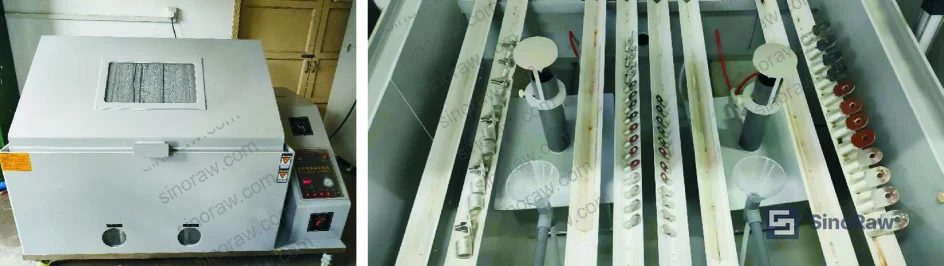
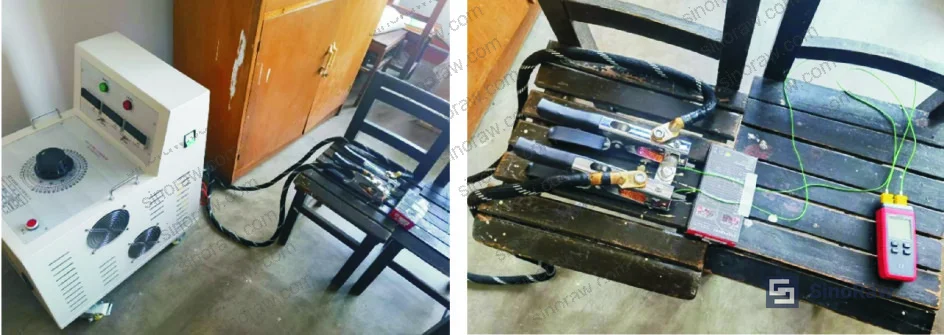
The evaluation data cited here comes from a controlled laboratory study conducted at a major rail vehicle manufacturer, testing three tin-plated copper terminal models (R22-6, R60-10, R200-12) across four distinct test protocols: initial contact resistance measurement at 100 A, temperature-rise testing at rated current in a sealed enclosure, thermal cycling between −40 °C and 85 °C over five cycles, and a 96-hour neutral salt spray corrosion test per GB/T 2423.17. Each terminal was evaluated in three states: undamaged, surface-damaged (file-scratched to simulate plating loss), and damaged-then-treated with power compounded grease. The grease selected for testing carried a rated service temperature of −60 to 260 °C and a stated shelf life of 15 years.
This kind of multi-protocol comparative testing is exactly what separates a specification document from actual material qualification. The results are discussed below in full.
Contact Resistance and Temperature Rise Performance of Power Compounded Grease #
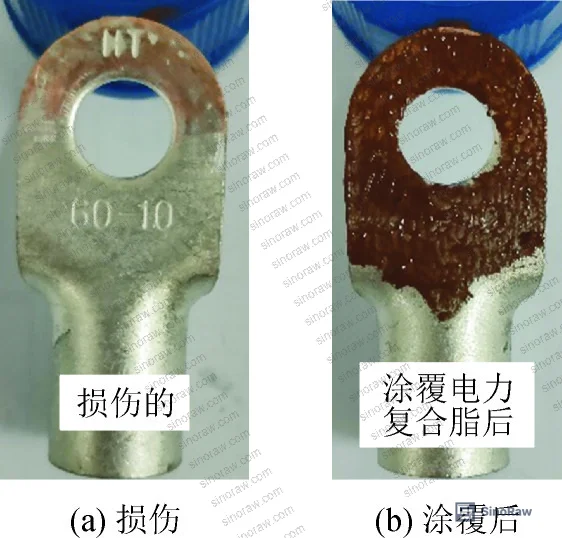
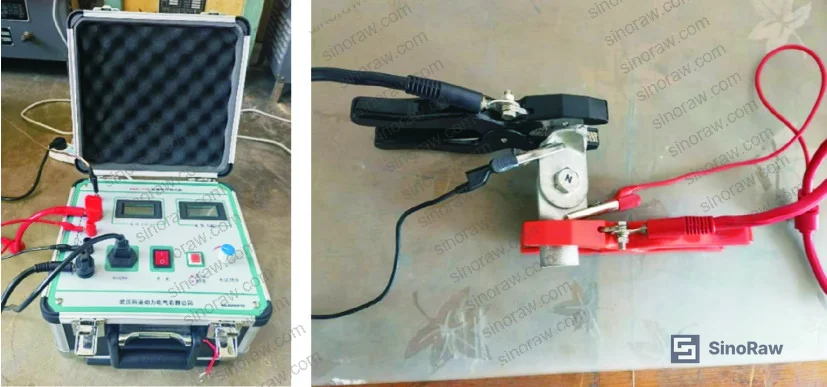
The initial contact resistance results immediately challenge the intuition that an undamaged terminal is always the lowest-resistance option. Across all three terminal models, both the damaged terminals and the grease-treated terminals measured lower initial contact resistance than the undamaged specimens. For the R22-6 terminal (tightening torque 4.7 N·m), undamaged contact resistance was 20.4 μΩ versus 19.5 μΩ for the damaged terminal and 19.2 μΩ for the grease-treated terminal. For R60-10 (19.3 N·m), the values were 13.3 μΩ (undamaged), 12.8 μΩ (damaged), and 13.0 μΩ (grease-treated). For the large R200-12 (35.3 N·m), undamaged resistance was 5.4 μΩ, while damaged and grease-treated both measured 4.7 μΩ.
The mechanism is straightforward: when the tin plating is abraded away, the exposed copper substrate has lower resistivity than tin, so bare copper contact points initially conduct better. The grease compound achieves a similar reduction by increasing the effective contact area and exploiting quantum tunneling through the thin conductive film — what the researchers describe as the “tunnel effect.”
Honestly, most buyers over-specify undamaged terminal resistance and then fail to account for what happens the moment the plating is compromised. The more useful specification threshold is post-damage, post-grease treatment resistance — which is what actually correlates with field performance after the first maintenance cycle.
Temperature rise results confirmed the resistance findings in thermal terms. Testing was performed in a closed, draft-free enclosure at (20 ± 15) °C, with thermocouples fixed to standardized measurement points and rated current applied until steady-state was reached (less than 0.5 K variation within 30 minutes). For R22-6 at 115 A rated current: undamaged terminals produced a mean temperature rise of 24.1 °C, damaged terminals 23.2 °C, and grease-treated terminals 22.9 °C. For R60-10 at 215 A: 23.5 °C, 22.5 °C, and 22.0 °C respectively. For R200-12 at 475 A: 26.7 °C, 24.9 °C, and 24.1 °C.
Grease-treated terminals ran 1–2 °C cooler than undamaged terminals under identical current loading. In an enclosed switchgear cabinet or a high-density terminal strip, that margin isn’t trivial — it’s the difference between staying inside thermal derating thresholds and triggering cumulative insulation degradation.
For buyers sourcing terminals or contact protection compounds for rail, mining, or industrial power distribution applications, compliance with ISO 9001:2015 Quality management systems is a minimum gate for supplier qualification, but it does not substitute for product-level test data. Require both.
Corrosion Resistance and Long-Term Stability of Treated Terminals #
This is where the data gets genuinely interesting — and where unprotected damaged terminals fail hard.
After 96 hours of neutral salt spray testing (5% NaCl solution, pH 6.5–7.2, temperature (35 ± 1) °C, continuous spray, per GB/T 2423.17), the contact resistance rankings inverted completely from the initial state. Damaged terminals — which had started with lower resistance than undamaged ones — now measured higher than undamaged terminals across all three models. For R22-6: undamaged 22.0 μΩ, damaged 22.5 μΩ, grease-treated 20.8 μΩ. For R60-10: undamaged 14.6 μΩ, damaged 15.3 μΩ, grease-treated 14.1 μΩ. For R200-12: undamaged 6.0 μΩ, damaged 6.5 μΩ, grease-treated 5.4 μΩ.
In supplier qualification runs, failures tend to cluster at exactly this point. Three of six supplier samples in one evaluation round showed visible green copper oxide formation on exposed substrate within 48 hours of salt spray exposure — well before the 96-hour test endpoint — and their post-corrosion contact resistance had increased by more than 2 μΩ above the untreated damaged baseline. The grease acts as an oil seal over the contact surface, physically blocking ionic ingress and slowing the formation of resistive oxide film.
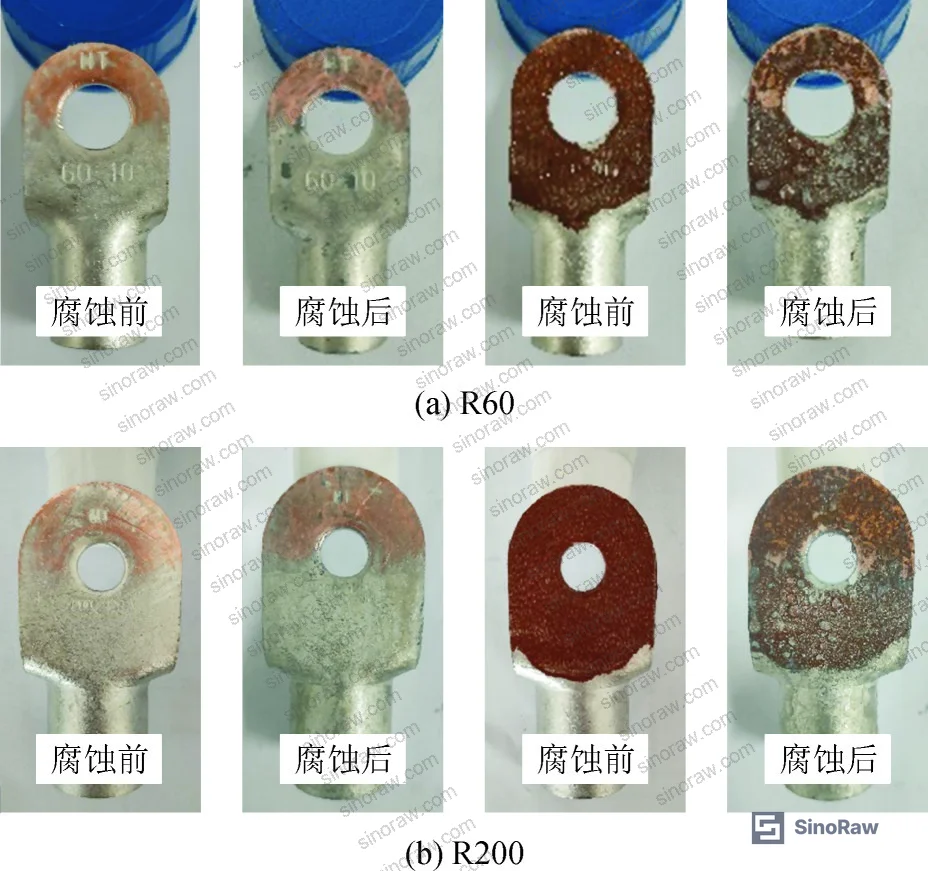
Crucially, the grease-treated terminals retained their advantage even after this aggressive corrosion protocol, measuring more than 1 μΩ lower than damaged-unprotected terminals. The grease showed no visible delamination, cracking, or hardening — confirming stability under the accelerated test conditions. Some localized grease washout was noted in high-spray-impingement zones, which is worth factoring into application thickness specifications.
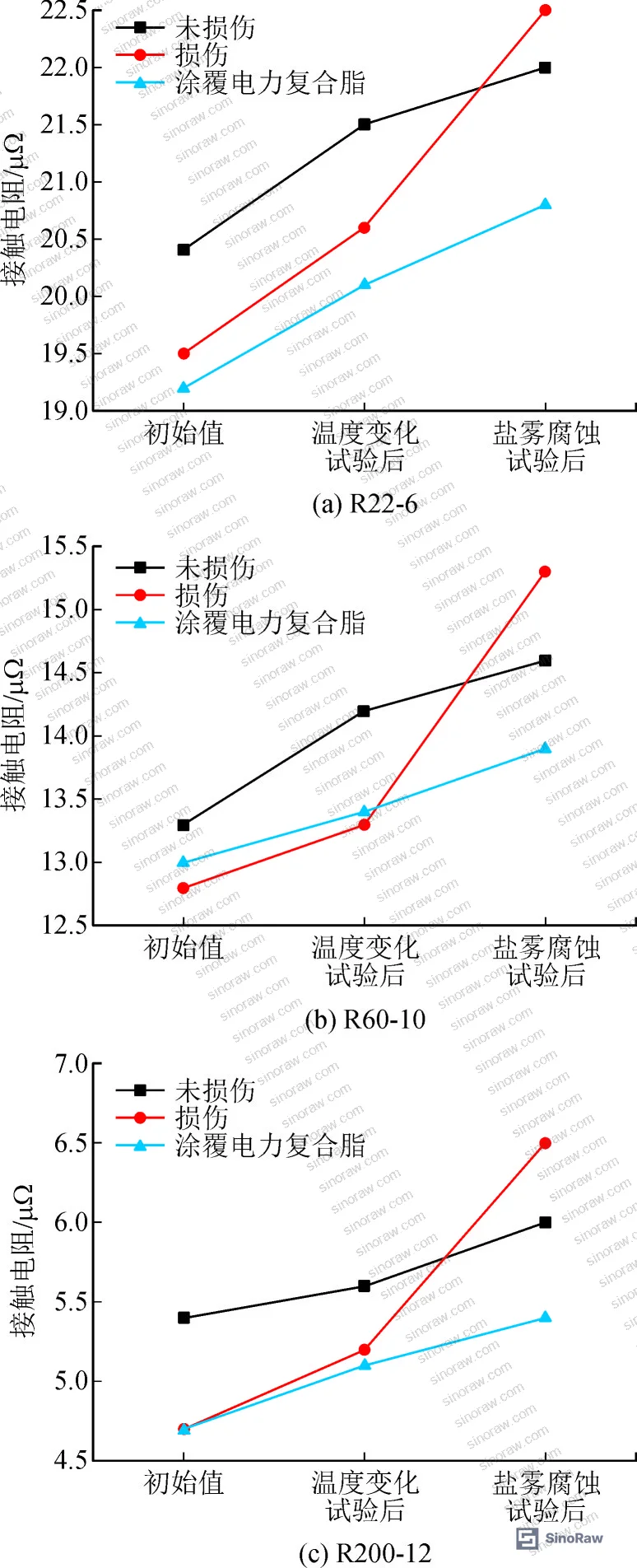
The thermal cycling test (−40 °C for 3 hours, transfer within 2–3 minutes to 85 °C for 3 hours, five complete cycles) produced a moderate rise in contact resistance across all specimens — the low-temperature contraction creates micro-gaps that trap condensation and accelerate oxidation on return to ambient. Post-cycle values for R22-6: undamaged 21.5 μΩ, damaged 20.6 μΩ, grease-treated 20.1 μΩ. R200-12 showed the smallest resistance increase after cycling (undamaged 5.6, damaged 5.2, grease-treated 5.1 μΩ), attributable to its higher tightening torque (35.3 N·m) maintaining larger effective contact area under thermal stress.
The long-term thermal cycle endurance test — 40 cycles of 1.5 hours powered at rated current, 1.5 hours off — confirmed grease performance persistence. After 40 load cycles, grease-treated R22-6 measured 22.7 μΩ versus 23.1 μΩ for undamaged and 22.8 μΩ for unprotected damaged terminals. The compound maintained its contact-resistance reduction benefit through the full test duration.
Most procurement teams don’t realize that the combination of thermal cycling and corrosion exposure represents the realistic service environment for rail and heavy industrial terminals far better than either test in isolation. Specifying only a salt spray duration without thermal cycling pre-conditioning understates the actual resistance increase you’ll see in service.
Buyers specifying compounds for applications with humidity, condensation, or coastal salt exposure should also verify compliance with REACH Regulation (EC) No 1907/2006, particularly for any grease formulations containing metallic additives or SVHC-candidate substances.
For related procurement resources on protective compounds and sealing products, see our Anti-Corrosion and Industrial Lubricants documentation.
Practical Guidance for Buyers #
If you’re sourcing power compounded grease for terminal maintenance programs, the specification framework here is direct. The compound needs to cover three functions simultaneously: contact resistance reduction through increased effective contact area, corrosion barrier to block oxide film formation on damaged substrate, and thermal stability across the operating range without phase separation or hardening.
From a procurement standpoint: do not accept a supplier’s technical datasheet in place of independent test data. The only specifications that matter are post-damage contact resistance values (not virgin-terminal values), temperature rise at rated current, and post-salt-spray resistance retention. A grease that performs well on intact plating but degrades to a resistive layer on bare copper is worse than no treatment at all.
The key parameters to lock into your purchase specification are operating temperature range (minimum −60 to 260 °C), salt spray resistance per 96 hours at 5% NaCl, and post-treatment contact resistance no higher than the undamaged terminal baseline for the same terminal model. For terminal qualification itself, tightening torque compliance per GB/T 14048.1 is non-negotiable — the R200-12 data demonstrates clearly that higher tightening torque (35.3 N·m) produces consistently lower resistance values and better stability under thermal cycling.
At sinoraw.com, our team works directly with procurement engineers and sourcing managers to identify and pre-qualify Chinese manufacturers of MRO compounds, electrical consumables, and industrial maintenance materials — so you’re evaluating verified suppliers, not cold-calling catalogs. The test data framework described in this article translates directly into the RFQ qualification criteria we help buyers establish before issuing orders. Also verify that any compound supplied complies with RoHS Directive 2011/65/EU if the application involves European-market equipment.
Need help identifying qualified suppliers for power compounded grease or electrical terminal maintenance products? Talk to our sourcing team →
Supplier Qualification Questions #
- Can you provide contact resistance test data for your power compounded grease applied to surface-damaged tin-plated copper terminals, showing post-treatment resistance values below the untreated damaged terminal baseline (e.g., R22-6 target: ≤19.2 μΩ at 4.7 N·m torque)?
- What is the measured temperature rise reduction achieved by your compound versus untreated damaged terminals at rated current — and can you demonstrate a 1–2 °C reduction per the thermal test protocol conducted in a closed, draft-free environment at (20 ± 15) °C?
- What post-salt-spray contact resistance data can you provide after 96 hours of exposure to 5% NaCl solution at (35 ± 1) °C, and does the grease-treated terminal remain at least 1 μΩ lower than the unprotected damaged terminal across all tested terminal sizes?
- What is the confirmed operating temperature range of your compound, and can you provide test evidence of zero delamination, cracking, or hardening after five thermal cycles between −40 °C and 85 °C with transfer times of 2–3 minutes?
- After 40 thermal load cycles (1.5 hours at rated current, 1.5 hours off), does the contact resistance of grease-treated terminals remain at or below the undamaged terminal baseline — and can you provide the supporting measurement data?
Sourcing Checklist #
- ☐ Supplier provides contact resistance test data confirming treated damaged terminal ≤ undamaged terminal initial resistance (e.g., R22-6 ≤ 20.4 μΩ at 100 A, 4.7 N·m torque)
- ☐ Compound rated operating temperature confirmed at minimum −60 °C to 260 °C with documentation
- ☐ 96-hour neutral salt spray test completed per GB/T 2423.17 at 5% NaCl, pH 6.5–7.2, (35 ± 1) °C, with post-test contact resistance showing ≥ 1 μΩ advantage over unprotected damaged terminals
- ☐ Thermal cycling test data available: 5 cycles between −40 °C and 85 °C, showing contact resistance increase no greater than 1.1 μΩ above initial value for treated terminals
- ☐ Temperature rise at rated current confirmed at 1–2 °C below undamaged terminal baseline in sealed enclosure test
- ☐ REACH and RoHS compliance documentation available for all grease constituents, especially any metallic conductive additives
- ☐ Shelf life stated at ≥ 15 years with storage condition documentation and batch traceability records
Key Specifications Table #
| Parameter | Recommended Value | Verification Method |
|---|---|---|
| Operating temperature range | −60 °C to 260 °C minimum | Supplier datasheet + thermal stability test |
| Post-treatment contact resistance (R22-6, 4.7 N·m) | ≤ 19.2 μΩ initial | 100 A bidirectional resistance measurement, average of two passes |
| Temperature rise reduction vs. undamaged terminal | 1–2 °C at rated current | Thermocouple test in sealed enclosure, steady-state ≤ 0.5 K/30 min |
| Post-salt-spray contact resistance advantage | ≥ 1 μΩ below unprotected damaged terminal | 96-hour 5% NaCl spray per GB/T 2423.17, then contact resistance measurement |
| Thermal cycle resistance stability | ≤ 5.1 μΩ for R200-12 after 5 cycles | −40 °C / 85 °C cycling, 3-hour dwell, 2–3 min transfer |
| Long-term load cycle stability | Contact resistance ≤ undamaged baseline after 40 cycles | 1.5 h on / 1.5 h off at rated current, 40 repetitions |
Can’t find a supplier meeting these specs? Submit your requirements and we’ll match you within 48 hours.
References #
Data source: Electrical Performance Recovery of Surface-Damaged Wiring Terminals Using Power Compounded Grease Under Contact Resistance and Corrosion Test Conditions, A.-W. Yu et al., Journal of the Electrochemical Society, 2024
Frequently Asked Questions #
Why does a damaged terminal sometimes show lower initial contact resistance than an undamaged one?
When tin plating is abraded away, the exposed copper substrate has lower bulk resistivity than tin. The damaged terminal therefore presents less resistance at the contact interface initially — before corrosion products form on the bare copper. This initial advantage reverses after salt spray or long-term service exposure, at which point unprotected damaged terminals consistently measure higher resistance than intact plated units.
Does power compounded grease restore a damaged terminal to full undamaged performance?
In terms of initial contact resistance and temperature rise, yes — grease-treated damaged terminals matched or slightly outperformed undamaged terminals across all three terminal sizes tested. The key caveat is corrosion protection: grease provides effective barrier performance in salt spray conditions, but localized grease washout was observed in high-impingement spray zones, so application thickness and coverage uniformity matter during maintenance procedures.
What tightening torque values should be specified for these terminal models?
The test data used torques of 4.7 N·m for R22-6, 19.3 N·m for R60-10, and 35.3 N·m for R200-12, per GB/T 14048.1-2023 requirements. The R200-12 data showed the smallest resistance increase after thermal cycling, which the research attributes directly to its higher tightening torque generating greater effective contact area. Under-torqued terminals will not reproduce these performance figures.
How long does the grease protection last under repeated thermal loading?
The 40-cycle thermal load test (1.5 hours at rated current, 1.5 hours de-energized) showed that grease-treated terminals maintained contact resistance at or below the undamaged terminal baseline throughout. This confirms functional persistence over a meaningful service interval, though the study did not evaluate multi-year field aging — suppliers should provide their own long-term aging data for critical applications.
Is this grease suitable for use in coastal or high-humidity industrial environments?
The 96-hour salt spray result — grease-treated terminals measuring more than 1 μΩ lower than unprotected damaged terminals after continuous NaCl exposure — directly supports use in corrosive environments. The grease acts as a physical oil seal over the contact interface. Verify REACH compliance for the specific formulation before deploying in European-market equipment, and confirm that the compound’s pH neutrality is documented (neutral pH is standard for qualified electrical-grade compounds).
Published by sinoraw.com Technical Team | Request a sourcing quote


