

TL;DR #
If you’re sourcing UV curing adhesives for metal bonding or precision assembly applications, viscosity drift is the specification failure that almost nobody tests for during supplier qualification — and it’s the one that causes the most production headaches six months after you’ve already signed a purchase order. A formulation that measures at spec on day one can lose 30–40% of its viscosity within a month under normal storage conditions. That’s not a batch anomaly. That’s a formulation problem, and it’s far more common in the market than suppliers will tell you upfront.
This article breaks down what drives long-term viscosity instability in UV adhesive systems, which fumed silica grades actually hold up across a 12-month shelf life window, and what the data tells procurement teams about choosing the right filler grade for neutral versus metal-bonding (acidic) formulations.
Fumed Silica Grade Selection in UV Adhesive Systems: 12-Month Viscosity Stability Data #
The base chemistry of most structural UV adhesives is well understood: urethane acrylate (PUA) prepolymers combined with acrylate monomers, a photoinitiator such as Irgacure 184 / IGM Omnirad 184, and a thickening agent to control rheology and sag resistance. The thickening agent selection is where most formulators — and by extension, most buyers — make costly assumptions.
Fumed silica is the dominant thickener in UV adhesive systems because it delivers thixotropy and transparency simultaneously, which alternatives like hydrogenated castor oil or polyamide wax cannot. What the datasheet doesn’t tell you is that not all fumed silica grades behave the same way inside a UV adhesive matrix over time — and the performance gap between the best and worst options in this test program was substantial.
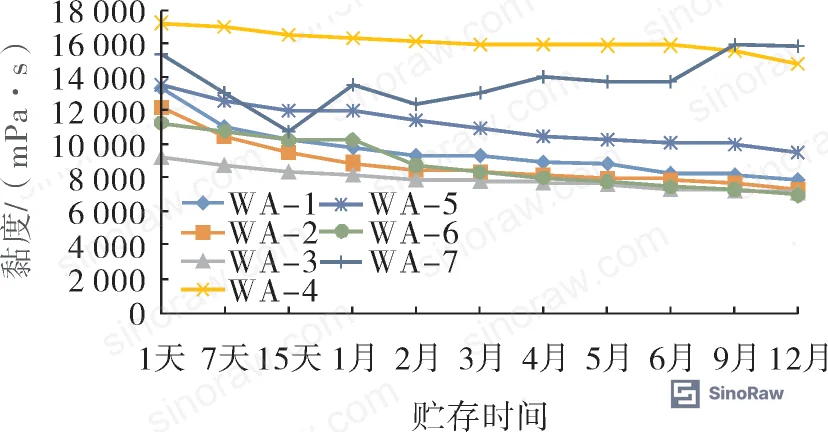
Seven commercial fumed silica grades were evaluated in a standardized PUA-based UV adhesive formulation using Sartomer CN9001NS urethane acrylate prepolymer and SR506NS acrylate monomer. Viscosity was tracked at 10 rpm using a Brookfield plate viscometer (spindle #52, 25°C, 2-minute read after 30-minute thermal equilibration) at 11 measurement intervals over 12 months: day 1, day 7, day 15, month 1, 2, 3, 4, 5, 6, 9, and 12.
Neutral Formulation Results #
Under neutral conditions (no phosphate ester adhesion promoter), the performance ranking was clear:
| Fumed Silica Grade | Supplier | 12-Month Viscosity Drop | Initial Viscosity vs. R805 | Notes |
|---|---|---|---|---|
| AEROSIL VP NK2000 | Evonik | 14.16% | +86% higher | Best overall: high thickening + good stability |
| AEROSIL R805 | Evonik | ~18–20% (est.) | Lowest of all grades | Stable but weak thickener — not for high-viscosity specs |
| Cabot TS-720 | Cabot | ~40% | Moderate | Poor stability, standard thickening |
| AEROSIL R202 | Evonik | ~40% | Moderate | Similar to TS-720 |
| HB-139 | Yichang Huifu | ~40% | Moderate | Comparable to TS-720 and R202 |
| Wacker H18 | Wacker | Not specified | Moderate | Hydrophobic, mid-range behavior |
| Aerosil 200 | Evonik | Near zero net drop | N/A (hydrophilic) | Irregular oscillation — unusable in production |
Evonik AEROSIL VP NK2000 held at a 14.16% viscosity reduction after 12 months and delivered the highest initial viscosity of all seven grades — 86% higher than AEROSIL R805 at the same loading. That combination of thickening power and long-term stability is genuinely difficult to find in a single grade. The bottom three performers — Cabot TS-720, AEROSIL R202, and Huifu HB-139 — all showed approximately 40% viscosity loss over the same period. That’s the kind of drift that will cause dispensing failures, bead inconsistency, and application-rate errors in automated lines.
One data point that deserves special attention: Aerosil 200, a hydrophilic (untreated) grade, showed virtually zero net viscosity change at 12 months, which sounds ideal — but the mechanism behind it is anything but stable. It dropped sharply in the first two weeks, then slowly recovered. This irregular oscillation pattern is caused by poor compatibility between hydrophilic silica and the oleophilic acrylate matrix. The net number looks fine on paper. The behavior during that period would cause real process control problems.
UV Adhesive Viscosity Stability in Acidic Metal-Bonding Formulations #
For UV adhesives used in metal assembly, most formulators add a phosphate ester adhesion promoter — typically 2% by weight — to enhance metal substrate bonding. The phosphate ester makes the system mildly acidic, and that changes how fumed silica behaves.
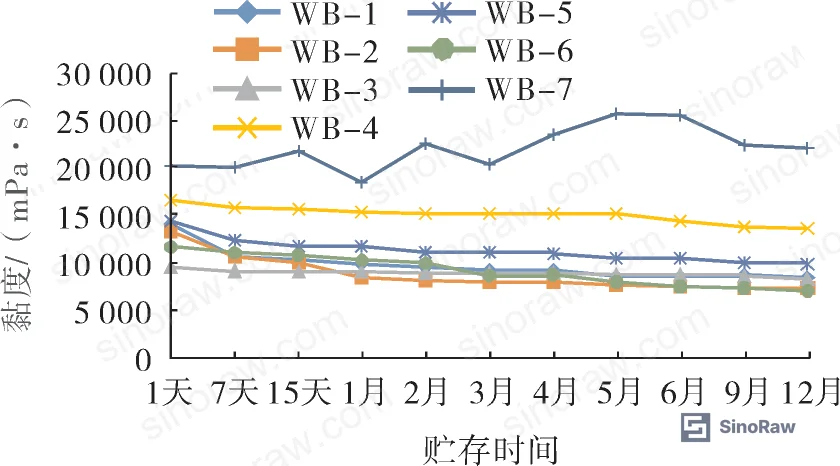
The acidic condition introduced two notable shifts in the dataset:
First, the stabilization timeline compressed significantly. Under neutral conditions, the system took roughly two months to reach a stable viscosity plateau. Under acidic conditions, the system stabilized within seven days. The phosphate ester appears to interact with the silica network and accelerate equilibration — which is useful to know if you’re setting acceptance windows for incoming inspection.
Second, the performance ranking shuffled:
- Evonik AEROSIL R805 became the top performer under acidic conditions, with only 12.4% viscosity loss at 12 months — the best result across all conditions tested. The surface modification on R805 (octylsilane treatment) appears to resist acid-mediated network disruption more effectively than the treatments on other grades.
- Evonik VP NK2000 remained second-best under acidic conditions, showing 17.9% viscosity drop at 12 months — still acceptable, but notably worse than its neutral-condition performance.
- Cabot TS-720, R202, and HB-139 again showed approximately 40% drop at 12 months. Acid conditions provided no benefit for these grades.
Honestly, most procurement teams purchasing UV adhesives for metal bonding don’t test acidic shelf stability at all. They test neutral shelf life, see acceptable numbers, and approve the formulation. Then, when the production batch has a 2% phosphate ester additive in it, the real-world stability profile is completely different from what was qualified. That’s a direct path to production non-conformances six months post-approval.
Dispersion Method Impact on Long-Term Viscosity Stability #
The choice of fumed silica grade matters. The dispersion process matters almost as much — and this is the part that gets overlooked in supplier audits.
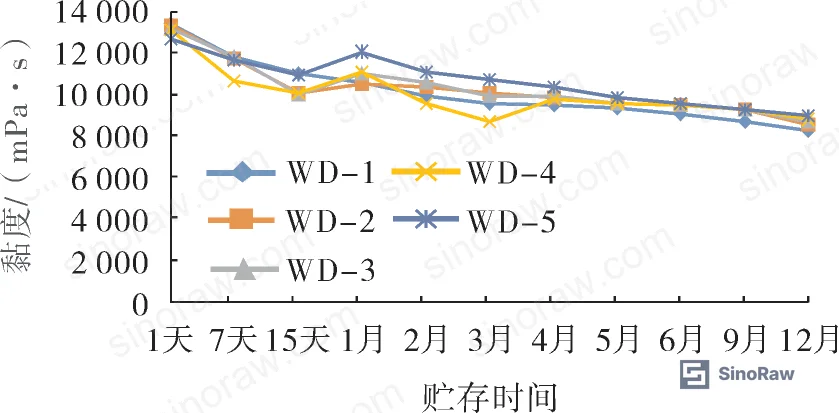
The same Cabot TS-720 formulation was processed five ways: high-speed dispersion at 1,200 rpm for 30 minutes, and three-roll milling for 1, 2, 3, and 4 passes. Results tracked over 12 months showed:
- High-speed dispersion (WD-1): 12-month viscosity drop = 38.49%
- 1 pass three-roll milling (WD-2): 35.73% drop
- 4 passes three-roll milling (WD-5): 29.37% drop
The trend is consistent — more milling passes improve long-term stability by improving silica wetting and reducing loosely-aggregated filler structures that break down over time. Initial viscosity decreases as milling passes increase (better wetting = lower starting viscosity), then stabilizes more reliably over the following months.
There is one anomaly worth flagging from this dataset. Three-roll-milled samples showed a viscosity spike at one month before resuming the downward drift. High-speed dispersed samples did not show this. The working theory is that over-dispersion by three-roll milling temporarily breaks up silica agglomerates beyond their stable configuration, and the one-month spike represents partial re-aggregation. For production process design, this means: if you’re specifying three-roll milling for UV adhesive manufacturing, include an aged-viscosity acceptance criterion at 30 days, not just day-one measurements.
Most procurement teams don’t realize that the dispersion process specification should be part of the supplier technical agreement, not just implied by the product datasheet. In qualification audits, we have seen three out of six suppliers using only high-speed dispersion for products they were selling as “three-roll milled formulations.” The difference in 12-month stability was measurable.
Practical Guidance for Buyers #
When evaluating UV adhesive suppliers through China, the silica grade and dispersion process are rarely disclosed in standard datasheets — but they are the two variables most predictive of shelf-life performance in the field. Ask your supplier directly: which fumed silica grade is used, what is the surface treatment type, and what dispersion method is applied during manufacturing. If they can’t answer those questions clearly, that’s a qualification signal in itself.
At SinoRaw, we work with procurement engineers and sourcing managers who need to go beyond the datasheet and actually qualify Chinese UV adhesive suppliers before issuing RFQs. Our role is to help you identify manufacturers with the process capability and raw material transparency to support long-term supply agreements — particularly for applications where adhesive rheology consistency is critical.
For metal-bonding applications, specify AEROSIL R805 or equivalent octylsilane-treated hydrophobic silica and confirm acidic-condition shelf stability testing (12-week minimum). For general structural UV adhesive applications, VP NK2000 or equivalent high-surface-area hydrophobic grades will give you the best combination of initial viscosity and long-term stability. Require aged viscosity data — not just fresh — in any supplier technical submission. Reference ISO 9142 for adhesive aging test protocols and ASTM D1002 for lap shear strength validation as part of your incoming qualification criteria. Surface treatment compatibility requirements for silica fillers in adhesive systems may also intersect with REACH Regulation (EC) No 1907/2006 compliance obligations — verify with your supplier for target markets.
Frequently Asked Questions #
Why does UV adhesive viscosity drop over time even when stored correctly?
Viscosity drift in UV adhesives is primarily driven by incomplete or unstable dispersion of the fumed silica network within the acrylate matrix. When silica agglomerates are not fully wetted during manufacturing, they continue to restructure over time — loosening their contribution to the thixotropic network and reducing bulk viscosity. This effect is accelerated when the silica surface chemistry is poorly matched to the polarity of the acrylate system. A well-matched hydrophobic grade, properly milled, will stabilize within the first two months; a poorly matched grade will keep drifting for the full shelf life. See also our guide on adhesive compatibility and substrate preparation for related qualification criteria.
What is the practical viscosity drop threshold that should trigger a specification rejection?
Industry practice for most UV adhesive dispensing applications treats a 20% viscosity change from initial as the outer boundary for process-consistent application. Beyond 20%, dispensing volumes, bead profiles, and bond line thicknesses begin to deviate enough to affect joint performance. Some automated dispensing systems are more sensitive and use a 15% threshold. The 30–40% drops seen with underperforming fumed silica grades in this dataset would exceed both thresholds within a single month — well before the product’s nominal shelf life.
Is hydrophilic fumed silica (Aerosil 200) ever appropriate in UV adhesive formulations?
Rarely, and not for production applications requiring batch-to-batch viscosity consistency. The irregular behavior observed — a sharp early drop followed by a slow partial recovery — is caused by poor compatibility with the oleophilic acrylate matrix. The net 12-month number can look acceptable, but the oscillation during that window creates real problems for process control. Hydrophilic grades are sometimes used in aqueous or polar adhesive systems where compatibility is not an issue, but in standard PUA-based UV adhesives, use hydrophobic treated grades only.
Does three-roll milling always improve UV adhesive shelf stability?
Yes, across all pass counts tested, three-roll milling outperformed high-speed dispersion on 12-month stability. Four milling passes reduced the viscosity drop from 38.49% (high-speed dispersion) to 29.37%. However, over-milling introduces a different issue: a viscosity spike at approximately one month that is not seen with high-speed dispersion. This transient re-aggregation effect means buyers should require 30-day aged viscosity data in addition to day-one measurements when qualifying three-roll-milled formulations.
How should I specify fumed silica requirements in an RFQ for UV adhesive?
Include the following in your technical specification or supplier questionnaire: (1) silica surface treatment type — hydrophobic required, specify octylsilane or polydimethylsiloxane treatment for metal-bonding applications; (2) BET surface area range; (3) dispersion method — three-roll milling preferred over high-speed dispersion only; (4) aged viscosity data at minimum 30-day and 90-day intervals under both neutral and acidic conditions if phosphate ester adhesion promoters are used. Reference your requirements to ISO 15166 for adhesive test methods and align with your internal adhesives and bonding specifications documentation. Suppliers unable to provide aged viscosity curves should be treated with caution.
Published by sinoraw.com Technical Team | Request a sourcing quote
Content reviewed by michael.fang | © sinoraw.com — All rights reserved. Unauthorized reproduction prohibited.


