

TL;DR #
If you’re sourcing RTV-2 silicone sealant for appliance assembly — ovens, microwave housings, induction cooktops, refrigerator door seals — the coupling agent selection is where most procurement decisions quietly fail. The base polymer gets all the attention, but in practice, what determines whether a two-part condensation-cure silicone actually bonds to powder-coated aluminum or sprayed stainless steel is the silane chemistry in the B component. Get that wrong and you’re looking at adhesion failures on low-surface-energy substrates that won’t show up until your customer’s QC team pulls a peel test.
This article draws on formulation and qualification work with dealcoholization-type RTV-2 silicone sealant systems specifically engineered for home appliance sealing. The substrate mix in that industry is brutal: ceramic glass panels, powder-coated metal enclosures, brushed stainless, engineering plastics — each with different surface energy profiles, and many pre-treated in ways that actively resist adhesion.
The findings here are directly applicable to any procurement team evaluating two-part RTV silicone for electronics enclosure sealing, industrial equipment assembly, or any application where the bondline involves a treated or low-energy surface.
RTV-2 Silicone Sealant Coupling Agent Selection: Performance Data Comparison #
The formulation system under evaluation uses α,ω-dihydroxy polydimethylsiloxane (PDMS) at 5,000–80,000 mPa·s viscosity as the polymer backbone, combined with nano-active calcium carbonate (KS-80, mean particle size 80 nm), heavy calcium carbonate (UF-135, mean particle size 200 nm), and hydrophilic fumed silica as the filler system. The A component is produced under vacuum mixing to eliminate entrapped air. The B component — which carries the crosslinker, catalyst (dibutyltin dilaurate, DBTDL), and coupling agents — is mixed separately and combined with A at a 10:1 mass ratio at point of application.
Five silane coupling agents were evaluated individually before composite blending was explored:
- A — γ-isocyanatopropyltrimethoxysilane (isocyanate-functional silane)
- B — KH-550 (γ-aminopropyltriethoxysilane, primary amine)
- C — KH-560 (epoxy-functional silane)
- D — KH-792 (diaminofunctional silane)
- E — KH-540 (γ-aminopropyltrimethoxysilane)
Testing was conducted at 25°C per GB/T 13477.5 for tack-free time and GB/T 13477.8 for tensile adhesion, with tensile strength measured per GB/T 528 on a UTM-4104 universal testing machine.
| Coupling Agent | Working Time (min) | Tack-Free Time (min) | Adhesion: Powder-Coated Aluminum | Surface Gloss |
|---|---|---|---|---|
| A (isocyanate silane) | 130 | >160 | +++ (cannot peel) | Poor |
| B (KH-550) | 75 | 90 | — (releases without effort) | Fair |
| C (KH-560) | 150 | >180 | — (releases without effort) | Poor |
| D (KH-792) | 15 | 18 | +++ (cannot peel) | Poor |
| E (KH-540) | 37 | 40 | ++ (peels with difficulty) | Good |
Key findings from single-agent testing: Amino-functional silanes (D and E) showed the strongest co-catalytic effect on crosslink cure speed — KH-792 was fastest with a working time of just 15 minutes and tack-free at 18 minutes. But the isocyanate silane (A) was the only single agent that delivered reliable adhesion to powder-coated substrates across all three difficult surfaces (ceramic board, powder-coated aluminum, powder-coated stainless steel). The tradeoff: working time exceeding 130 minutes and poor gloss — completely unacceptable for visible appliance components.
Honestly, this is where most formulators and buyers get stuck. They see the adhesion rating for Agent A and immediately want to specify it. They don’t account for the fact that 130+ minute working time on a production assembly line is operationally dead — and poor gloss on an oven fascia is a cosmetic reject waiting to happen.
Composite Coupling Agent Blends for RTV-2 Silicone: Cure Speed, Gloss, and Storage Stability #
Single-agent results established the tradeoffs clearly enough. The more useful engineering work was the composite blending study, where the five agents were combined in varying mass ratios to find combinations that balanced cure speed, adhesion to difficult substrates, and post-cure gloss simultaneously.
The A/E (isocyanate silane / KH-540) and D/E (KH-792 / KH-540) combinations at mass ratios of 1:1 and 1:3 showed the best overall profiles. At A/E = 1:3, the system achieves a working time of 41 minutes, tack-free at 48 minutes, and full debond time of 67 minutes — with good gloss and +++ adhesion to ceramic and powder-coated aluminum. The D/E = 1:3 combination is faster (working time 23 min, tack-free 28 min) but delivers only ++ adhesion to powder-coated substrates.
Storage stability was evaluated using an accelerated aging protocol: B component stored at 70°C for 7 days, then mixed with A at 10:1 ratio. This method is widely used to simulate in excess of 180 days of ambient storage. Results showed a moderate increase in cure times across all formulations — working time for A/E 1:3 increasing from 41 to 46 minutes post-aging, tack-free from 48 to 56 minutes — but gloss remained unaffected. Critically, the A/E 1:3 blend maintained +++ adhesion to all three difficult substrates even after accelerated aging, while the D/E 1:3 blend degraded from ++ to + on powder-coated surfaces post-aging. That’s not a marginal difference — that’s a qualification failure in high-humidity or warm-storage logistics scenarios.
In supplier qualification work on two-part RTV silicone products, we’ve seen exactly this failure mode appear: three of six B-component samples submitted by different Chinese manufacturers showed meaningful adhesion degradation to powder-coated aluminum after standard aging simulation, even though their initial tack-free and working times appeared acceptable. The failure only shows up when you push the B component through thermal storage conditions before final mixing and peel testing. If your incoming inspection protocol only tests freshly-mixed material, you’re missing it.
Most procurement teams don’t realize that the storage stability risk in two-part RTV systems sits almost entirely in the B component — not in the mixed product. The B component contains the crosslinker, catalyst, and coupling agents in a reactive environment. Once the A component’s polymer and filler system are stable, the B side is where shelf-life degradation originates. This is why the 70°C/7-day aging test is applied exclusively to the B component in this evaluation — and it’s a protocol worth writing explicitly into your supplier qualification requirements.
For buyers sourcing silicone sealant and RTV products for appliance or electronics assembly, this distinction in qualification protocol can be the difference between a six-month warranty pass rate and an early-life field failure pattern.
Thermal Resistance of RTV-2 Silicone Sealant Under Sustained High-Temperature Exposure #
For appliance applications — specifically ovens, microwave cavities, and range hoods — the sealant bondline routinely sees 100–200°C in service, with excursion temperatures potentially reaching 250°C in proximity to heating elements. This is where the choice of composite coupling agent goes beyond adhesion and into long-term mechanical durability.
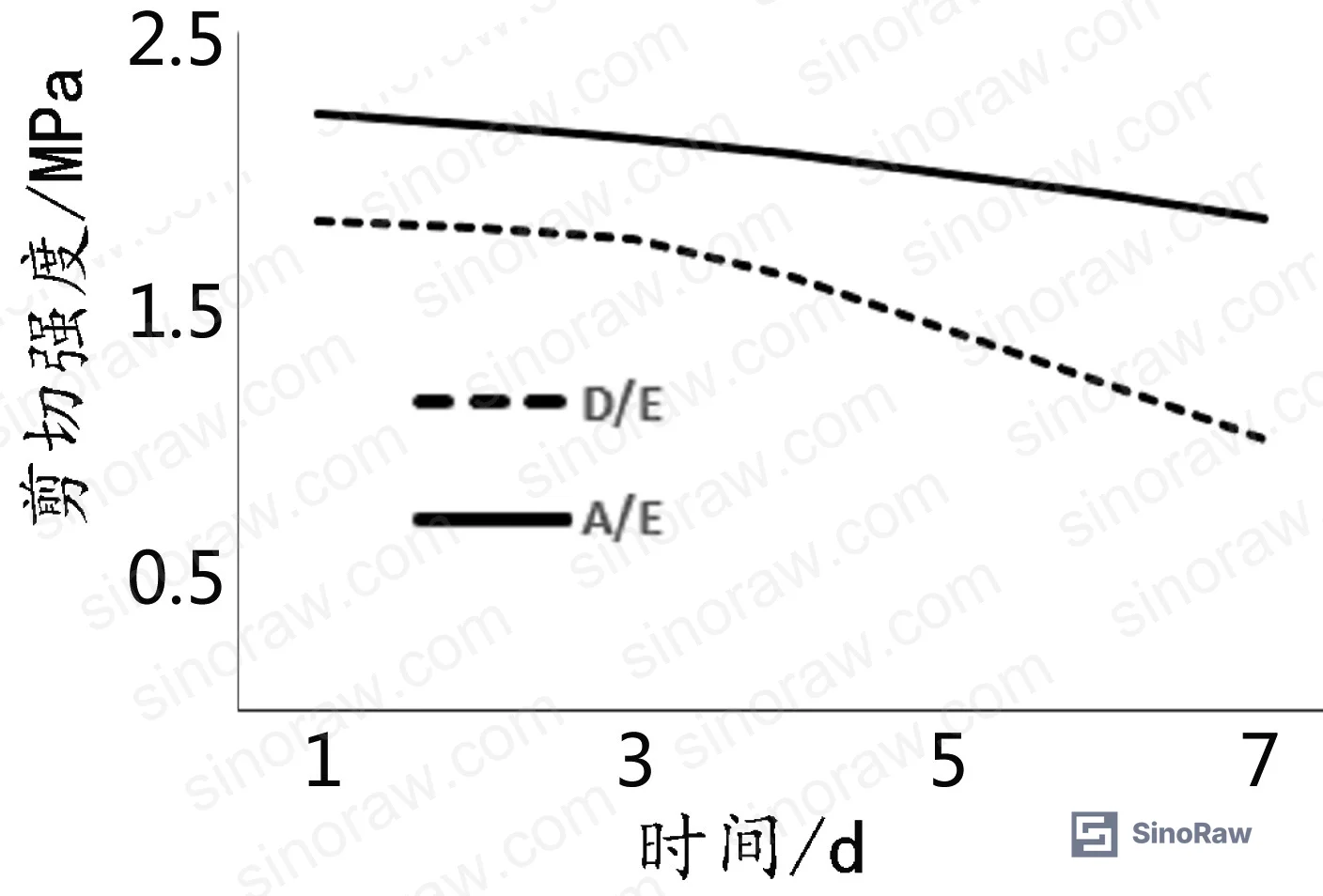
The thermal resistance evaluation used aluminum-aluminum lap shear specimens and dumbbell tensile specimens, cured 72 hours at room temperature before oven exposure. Samples were then placed in 250°C hot air and tested at intervals for both tensile strength and shear strength per GB/T 528 and GB/T 13477.8 respectively.
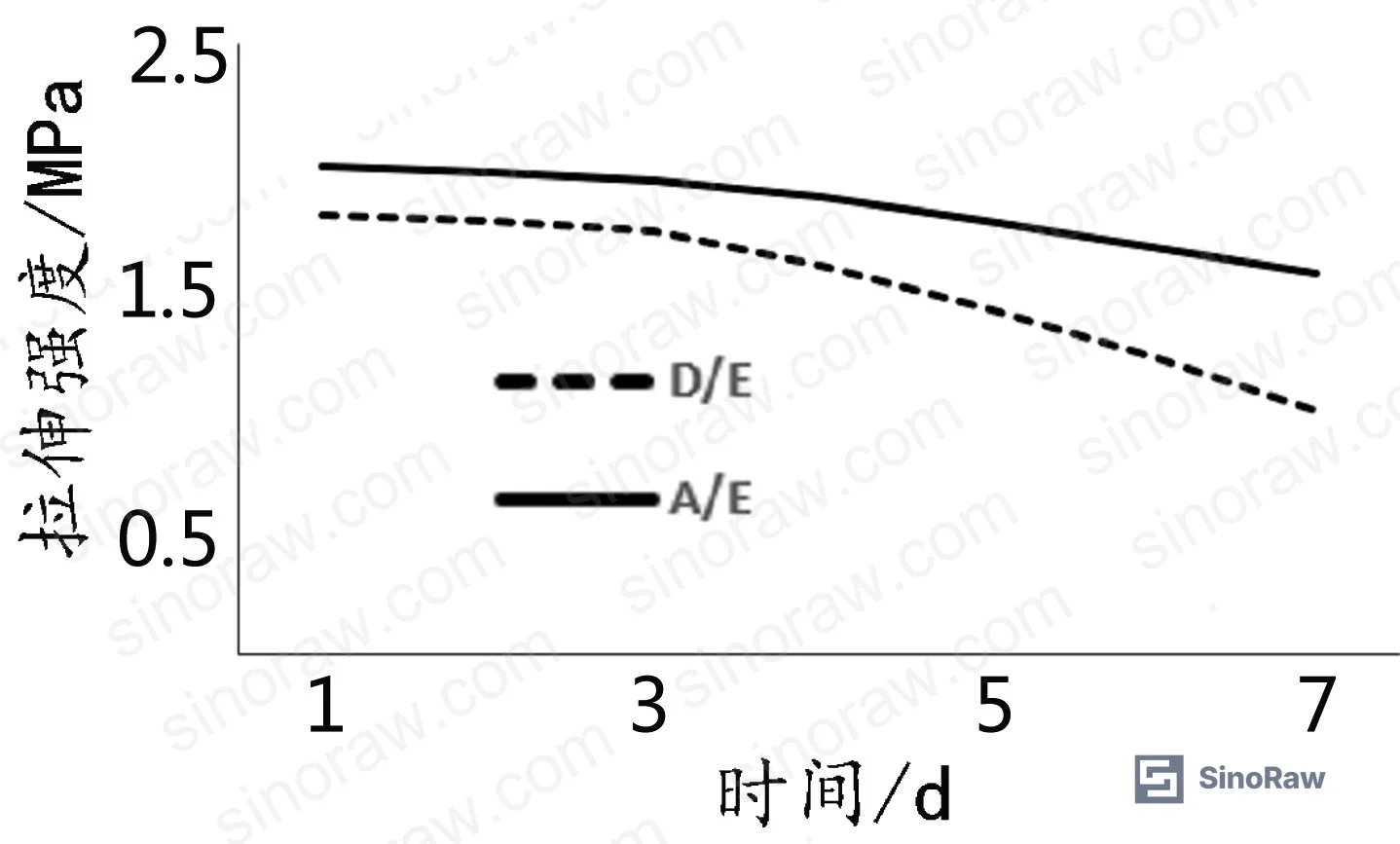
Key observations from the thermal aging data:
- At short exposure durations, both A/E and D/E formulations showed minimal tensile strength decline at 250°C. The Si-O backbone bond energy of 460 kJ/mol — significantly higher than C-C at 345 kJ/mol — is the primary reason silicone outperforms organic elastomers in thermal retention.
- Shear strength told a different story: the A/E 1:3 system showed markedly slower shear strength degradation than D/E 1:3 at 250°C. The isocyanate silane in the A/E blend contributes directly to bondline integrity under shear at elevated temperature.
- At temperatures above 200°C sustained for extended periods, the 50% ionic character of the Si-O bond becomes a degradation driver — mechanical properties decline at an accelerating rate. This is not a formulation deficiency; it’s a fundamental chemistry boundary for all PDMS-based systems. Buyers specifying service temperatures consistently above 200°C should be evaluating high-phenyl silicone or methylphenyl silicone systems instead.
For sealant applications on specialty polymers and adhesive systems where thermal cycling is part of the service environment, the coupling agent chemistry — not just the silicone polymer grade — needs to be part of the thermal qualification conversation.
The Si-C bond energy of 318 kJ/mol, while lower than C-C, remains thermally stable due to conjugation effects in the polymer network. This is why PDMS-based sealants retain meaningful mechanical properties at temperatures that would cause complete failure in polyurethane or acrylic sealant systems.
Practical Guidance for Buyers #
If you’re issuing an RFQ for two-part RTV silicone sealant for appliance, electronics enclosure, or industrial sealing applications, don’t just specify hardness and tack-free time — those are baseline metrics that every competent manufacturer will pass. The differentiation is in three areas: substrate adhesion protocol, B-component storage stability under thermal stress, and post-cure gloss for any visible surface application.
Request that suppliers submit B-component samples for 70°C/7-day accelerated aging before mixing and adhesion testing. Specify your actual substrate materials — if you’re bonding to powder-coated panels, say so explicitly, and require lap-shear peel data on that specific surface rather than accepting generic glass or aluminum results.
For coupling agent chemistry, the isocyanate silane / KH-540 composite (A/E, 1:3 mass ratio) represents the most balanced profile for difficult low-energy substrates: 41-minute working time, good gloss, and adhesion stability through accelerated aging. If cure speed is the priority and substrate surface energy is less challenging, amino silane blends can push working time below 25 minutes.
At SinoRaw, we work with procurement engineers and sourcing managers across Guangzhou’s manufacturing supply base to identify and pre-qualify Chinese silicone manufacturers before RFQs are issued — helping you get to a short-list of technically capable suppliers rather than discovering adhesion or stability failures after a trial order. Verify that any shortlisted supplier can demonstrate compliance with ISO 11600 for building and construction sealants, and cross-reference against REACH and RoHS substance lists if your end product enters EU markets.
Frequently Asked Questions #
What is the difference between RTV-1 and RTV-2 silicone sealant for industrial applications?
RTV-1 is a single-component system that cures by moisture absorption from the atmosphere — which limits cure depth and makes it impractical for thick bondlines or closed assemblies. RTV-2 is a two-part system where A and B components are mixed at point of application, enabling deep-section cure, controlled working time, and more consistent mechanical properties. For industrial assembly with defined bondline geometry and substrate specifications, RTV-2 is almost always the right choice.
Why does adhesion to powder-coated surfaces fail with standard coupling agents like KH-560 or KH-550?
Powder coating processes significantly reduce substrate surface energy, removing the polar functional groups that most silane coupling agents rely on for chemical bonding. KH-560 (epoxy silane) and standard KH-550 (amino silane) were both evaluated here and showed essentially no useful adhesion to powder-coated aluminum and stainless steel — peeling off without measurable resistance. Isocyanate-functional silanes interact differently with the coating chemistry and produce reliable adhesion to these surfaces, which is why the A/E composite system is recommended for appliance and coated-metal applications.
What mixing ratio should I specify for two-part RTV-2 silicone?
The formulation evaluated here uses a 10:1 A-to-B mass ratio. Mixing ratio isn’t universal — it varies by formulation and affects pot life, cure speed, and mechanical outcome. Always confirm the manufacturer’s specified ratio and verify it experimentally; off-ratio mixing is one of the most common causes of under-cure or adhesion failure in field applications.
How should I evaluate B-component shelf life when qualifying a supplier?
Use the 70°C/7-day accelerated aging protocol on the B component in isolation. After aging, mix with fresh A component at the specified ratio and run tack-free time, working time, and adhesion peel tests on your target substrates. This simulates more than 180 days of ambient storage and will reveal catalytic degradation or coupling agent decomposition that a simple viscosity check will miss entirely.
At what temperature does RTV-2 silicone sealant performance begin to degrade significantly?
Mechanical properties remain relatively stable below 200°C for standard PDMS-based RTV-2 systems. Above 200°C in sustained service, the ionic character of the Si-O bond begins to drive accelerating degradation — tensile and shear strength decline more rapidly with exposure time. For applications with sustained service temperatures above 200°C, specify a high-phenyl content silicone system rather than standard dimethyl silicone, and require extended thermal aging data (minimum 7 days at temperature) rather than short-duration exposure results.
Published by sinoraw.com Technical Team | Request a sourcing quote
Content reviewed by michael.fang | © sinoraw.com — All rights reserved. Unauthorized reproduction prohibited.


