

TL;DR #
If you’re specifying an RTV silicone sealant for a multi-material assembly and your selection criteria stop at “passes shear test under standard conditions,” you’re leaving serious field risk on the table. The substrate combination matters. The bondline thickness matters. And the aging environment matters more than most procurement specs acknowledge.
This article draws on structured qualification testing of a two-component RTV silicone sealant across four substrate pairings — aluminum alloy/aluminum alloy, aluminum alloy/carbon fiber, carbon fiber/PMMA (acrylic), and carbon fiber/carbon fiber — evaluated under three accelerated aging regimes: salt spray, elevated temperature, and damp heat. The data tells a clear story about where silicone sealants hold and where they don’t.
Two-Component RTV Silicone Sealant Performance Across Substrate Combinations #
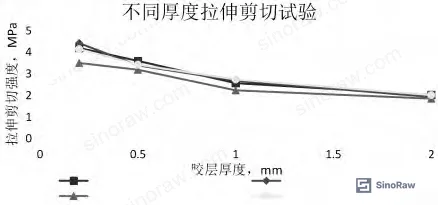
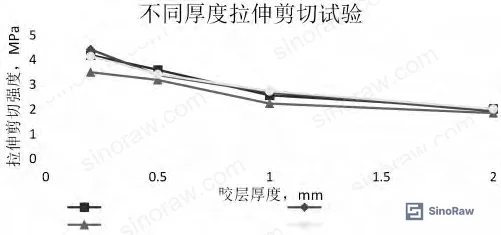
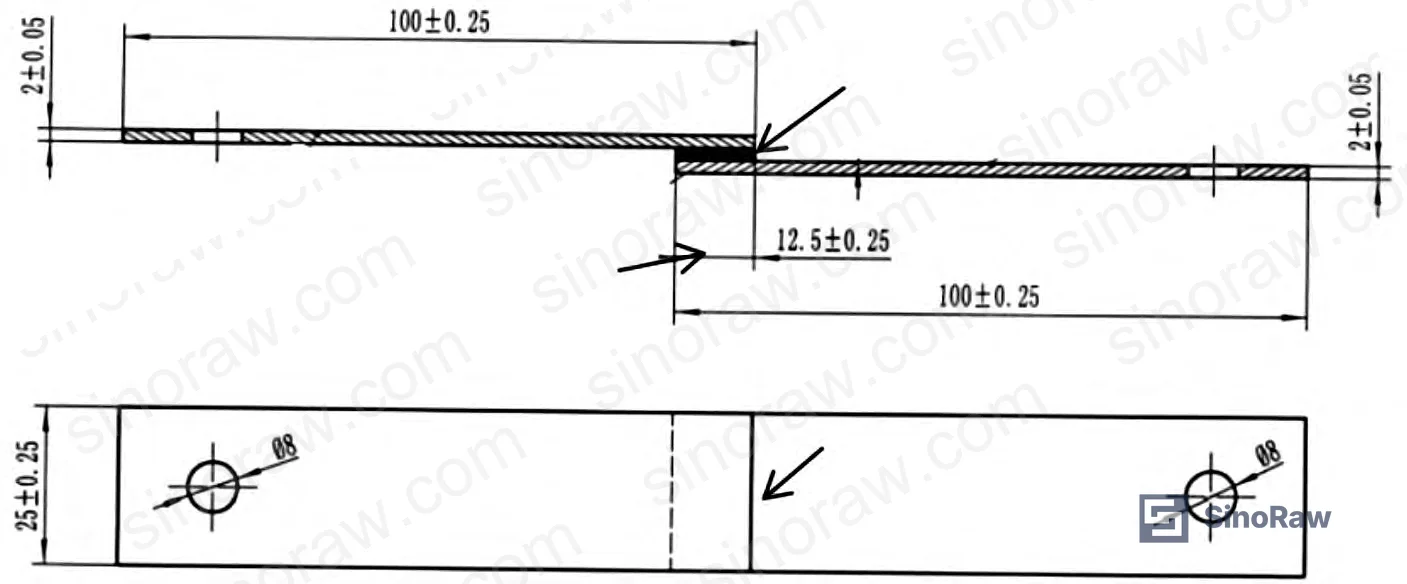
Bondline geometry is the first variable most buyers underestimate. Test specimens were prepared per GB/T 7124—2008 (tensile shear strength of adhesives), with adhesive layer thicknesses of 0.2, 0.5, 1.0, and 2.0 mm. Substrate thickness was held at 2.0 ± 0.05 mm throughout. All specimens were cured under standard conditions (23 ± 2 °C, 50 ± 5% RH) for a minimum of 7 days before any mechanical testing.
Honestly, most buyers over-specify adhesive layer thickness assuming more material means more strength. The data shows the opposite. Across all four substrate combinations, tensile shear strength is negatively correlated with bondline thickness throughout the tested range. A thicker bondline shifts internal stress away from the centerline, generating peel forces at the interface — and it accumulates more internal voids, both of which drive cohesive strength down. Keep your bondline tight.
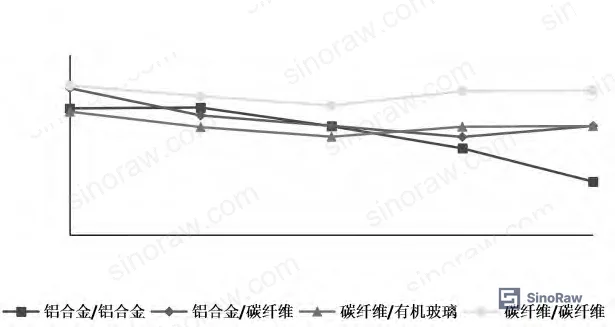
Under standard conditions, all four substrate pairings failed cohesively — meaning the sealant body fractured before the substrate interface separated. That’s the result you want to see, and it confirms baseline compatibility across all tested materials.
Aging Performance Comparison Table #
| Aging Condition | Test Standard | Duration | Most Affected Substrate | Strength Retention (worst case) | Failure Mode |
|---|---|---|---|---|---|
| Salt Spray | GJB 150.11A—2009 | 960 h | Aluminum alloy/aluminum alloy | 42% | Interfacial (adhesive) failure |
| Damp Heat (60 °C / 95% RH) | GJB 150.9A—2009 | 960 h | Carbon fiber/PMMA, CF/CF, Al/CF | 68–69% | Cohesive failure retained |
| High Temperature (70 °C) | GJB 150.3A—2009 | 1,000 h | Aluminum alloy/aluminum alloy | ~72–73% | Cohesive failure retained |
The ranking of aging severity — damp heat > salt spray > high temperature, when no interfacial failure occurs — is a direct result of moisture participation. Water at elevated humidity simultaneously drives additional crosslinking and hydrolytic chain scission in the silicone network. At 60 °C and 95% RH, the degradation reaction outpaces the crosslinking, and net strength falls. High temperature alone (dry, 70 °C) produces comparatively minor and often reversible property shifts.
Salt Spray Aging and Substrate-Dependent Bonding Failure in Industrial Sealing #
This is where the qualification data gets procurement-relevant fast.
After 960 hours of salt spray aging per GJB 150.11A, tensile shear strength retention across the four pairings broke down as follows:
- Aluminum alloy / aluminum alloy: 42% retention — significant interfacial failure
- Aluminum alloy / carbon fiber: 67% retention — partial interfacial failure
- Carbon fiber / PMMA: 80% retention — cohesive failure maintained
- Carbon fiber / carbon fiber: 97% retention — cohesive failure maintained
The aluminum-containing assemblies started showing measurable interfacial failure at 480 hours. By 720 hours, adhesive failure area on the aluminum/aluminum specimens had reached 25%, climbing to 45% at 960 hours. The aluminum/carbon fiber pairing showed 15% interfacial failure area at 960 hours.
In supplier qualification, we saw the same failure pattern repeat across multiple sample sets: the sealant itself remained intact, but the aluminum oxide passive layer was penetrated by chloride ions, corroding the alloy surface beneath the bondline. Once the substrate corrodes, the interface fails regardless of the sealant’s bulk properties. The fix is not a better sealant — it’s anodizing or other surface pretreatment on the aluminum before bonding.
Carbon fiber substrates showed no interfacial failure under any aging condition tested. The sealant bonds well to the CFRP surface and the interface is not susceptible to the same electrochemical attack as aluminum.
Damp Heat and High-Temperature Aging: Mechanical Property Retention Data #
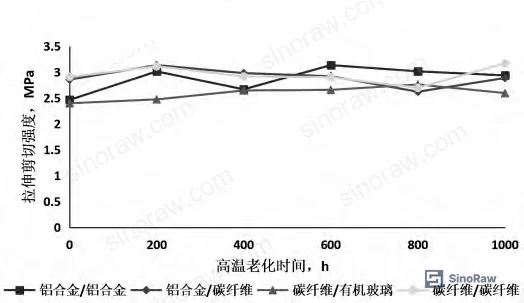
Most procurement teams don’t realize that damp heat aging — not high-temperature exposure — is typically the governing degradation mechanism for silicone sealants in real service. Dry heat at 70 °C for 1,000 hours produced only modest property changes across all substrate combinations:
- Aluminum/aluminum: strength variation of 8.3% to 27.2%
- Aluminum/carbon fiber: 9.2% to 9.8% variation
- Carbon fiber/PMMA: 3.1% to 15.1% variation
- Carbon fiber/carbon fiber: -9.3% to +8.9% (slight increase at some intervals, then stabilization)
All high-temperature specimens retained cohesive failure mode through 1,000 hours at 70 °C. The sealant’s Si–O–Si backbone gives it genuine thermal stability that organic polymer sealants simply can’t match at this exposure duration.
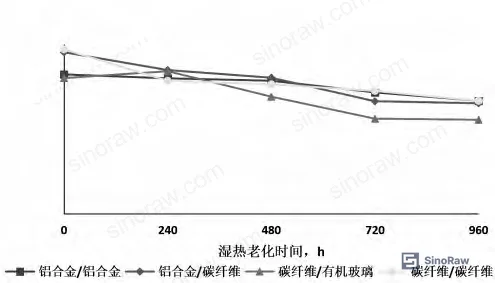
Damp heat (60 °C / 95% RH) is a different story. At 960 hours, strength retention was:
- Aluminum/aluminum: 81.1% — still cohesive failure, best performer under damp heat
- Aluminum/carbon fiber: 68.4% — cohesive failure
- Carbon fiber/PMMA: 69.3% — cohesive failure
- Carbon fiber/carbon fiber: 68.7% — cohesive failure, strength retention 73.5% at peak aging
The degradation mechanism under damp heat is dual-pathway: moisture promotes additional crosslink formation initially, but sustained high humidity drives hydrolysis of the siloxane network. The net effect at 960 hours is a 19–32% strength reduction depending on substrate pairing. Critically, all tested specimens maintained cohesive failure — the adhesion to every substrate remained intact. That’s a meaningful distinction for structural sealing applications: the material is weakening uniformly, not delaminating.
For applications governed by ISO 11431 (weathering and adhesion of sealants) or ASTM C793 (effects of laboratory accelerated weathering), the damp heat threshold is the design-limiting condition. Spec it accordingly.
Internal crosslinks to support your sourcing process: Silicone & RTV Sealant category | Structural UV Adhesives category
Practical Guidance for Buyers #
If you’re sourcing two-component RTV silicone sealants for mixed-substrate assemblies — particularly anything combining aluminum alloy with composite structures — the aging environment must drive your qualification test matrix, not just your application temperature.
For salt spray environments, do not rely on sealant performance alone to protect aluminum bondlines. Specify anodized or chemically conversion-coated aluminum substrates as a procurement requirement. The sealant will outlast the substrate surface if you don’t. Request supplier qualification data at minimum 720-hour salt spray exposure with interfacial failure area reported, not just bulk shear strength.
For damp heat environments (tropical enclosures, marine interiors, HVAC-adjacent assemblies), specify shear strength retention ≥ 65% at 960 hours under 60 °C / 95% RH as a minimum acceptance threshold. Carbon fiber and PMMA bondlines hold cohesive failure well past this point.
Keep your bondline between 0.2 and 0.5 mm wherever geometry allows. Thicker bondlines don’t improve load transfer — they reduce it and introduce void defect risk.
At sinoraw.com, we work directly with verified Chinese manufacturers of two-component silicone sealants and help overseas procurement engineers structure their technical requirements before issuing RFQs to Chinese suppliers. If you’re qualifying a new sealant source for aerospace, rail, or industrial enclosure applications, we can help you benchmark supplier test data against the acceptance criteria outlined here. Request a sourcing consultation.
Frequently Asked Questions #
Q: What is the minimum cure time before aging or mechanical testing of two-component RTV silicone sealants?
All test specimens in this evaluation were cured at standard conditions (23 ± 2 °C, 50 ± 5% RH) for a minimum of 7 days before any aging exposure or mechanical testing. Many buyers test at 3–4 days and wonder why results are inconsistent. Seven days is the floor for two-component silicone systems; some high-crosslink-density formulations benefit from 10–14 days full cure before qualification testing.
Q: Why does salt spray aging affect aluminum-bonded joints so much more severely than carbon fiber joints?
The mechanism is electrochemical, not chemical adhesion failure. Chloride ions from the salt solution penetrate aluminum’s passive oxide layer and attack the alloy surface beneath the bondline. The sealant-to-aluminum interface breaks down as the substrate corrodes, not because the sealant lost adhesion. Carbon fiber substrates don’t undergo this electrochemical attack, which is why CF/CF specimens retained 97% shear strength at 960 hours while Al/Al dropped to 42%.
Q: Should I always minimize adhesive layer thickness for maximum shear strength?
Yes, within the range tested (0.2–2.0 mm), thinner is stronger. The negative correlation between bondline thickness and tensile shear strength is consistent across all substrate combinations. However, practical joint design also needs to account for gap tolerance, thermal expansion differential, and assembly process control. A 0.2 mm bondline is mechanically optimal but may be difficult to hold in production. Balance mechanical performance against manufacturing capability.
Q: Which aging condition should govern my qualification test specification?
Damp heat. When no interfacial failure occurs, damp heat at 60 °C / 95% RH produces the greatest strength reduction — consistently worse than dry heat at 70 °C or salt spray on non-aluminum substrates. If your application sees any combination of elevated temperature and humidity, damp heat aging per GJB 150.9A or equivalent ISO 9142 conditioning should be your primary qualification driver.
Q: Can this sealant be used to bond PMMA (acrylic/organic glass) without damaging the substrate?
Yes. Post-cure and after all three aging regimes (salt spray 960 h, high temperature 1,000 h at 70 °C, damp heat 960 h at 60 °C/95% RH), the carbon fiber/PMMA specimens all showed cohesive failure with no visible effect on the PMMA substrate surface or bulk properties. The sealant is compatible with PMMA and does not cause stress cracking or surface degradation under the tested conditions.
Published by sinoraw.com Technical Team | Request a sourcing quote
Content reviewed by michael.fang | © sinoraw.com — All rights reserved. Unauthorized reproduction prohibited.


