

TL;DR #
If you’re specifying RTV silicone sealant for high-rise curtain wall or structural glazing applications and you’re selecting purely on tensile strength at ambient conditions — you’re missing the point. The real failure mode isn’t initial bond strength. It’s retention after 2,000-plus hours of combined UV exposure, salt-laden moisture, and thermal cycling. That’s where most sealant specs fall apart, and that’s exactly where crosslinker concentration becomes the deciding variable.
This article breaks down qualification data from controlled aging trials on three RTV silicone sealant formulations — identical base chemistry, differentiated only by crosslinker (methyltrimethoxysilane, methanol-reacted) loading at 2%, 4%, and 6% by mass. The findings are directly applicable to procurement decisions in construction sealing, facade engineering, and high-performance weatherproofing for industrial enclosures.
RTV Silicone Sealant Crosslinker Concentration: Aging Performance Comparison #
The three formulations — designated X-1 (2% crosslinker), X-2 (4% crosslinker), and X-3 (6% crosslinker) — were built on a consistent base: α,ω-dihydroxypolydimethylsiloxane at 40% by mass (dynamic viscosity 20,000 mPa·s), fumed silica A-150 at 20%, vinyltrimethoxysilane at 5%, titanate compound at 3%, and a custom coupling agent blend (γ-aminopropyltriethoxysilane, γ-glycidoxypropyltrimethoxysilane, and N-(β-aminoethyl)-γ-aminopropyltrimethoxysilane). The tin catalyst system combined dibutyltin dilaurate with polyethyl silicate.
Physical and chemical baseline properties were tested per the GB/T 13477 series — the Chinese national test series for building sealants. All three formulations passed entry-level requirements. Surface dry times ranged from 5.1 to 5.6 hours (specification ceiling: 24 hours), density held at 1.3 Mg·m⁻³ across all variants (target range 1.2–1.4), elastic recovery reached 92–94% against a ≥70% requirement, and usable pot life was 2.4 hours for all three. On baseline properties alone, you’d struggle to differentiate them.
The divergence shows up under accelerated aging — and it’s significant.
Salt Mist Aging: Test Method and Results #
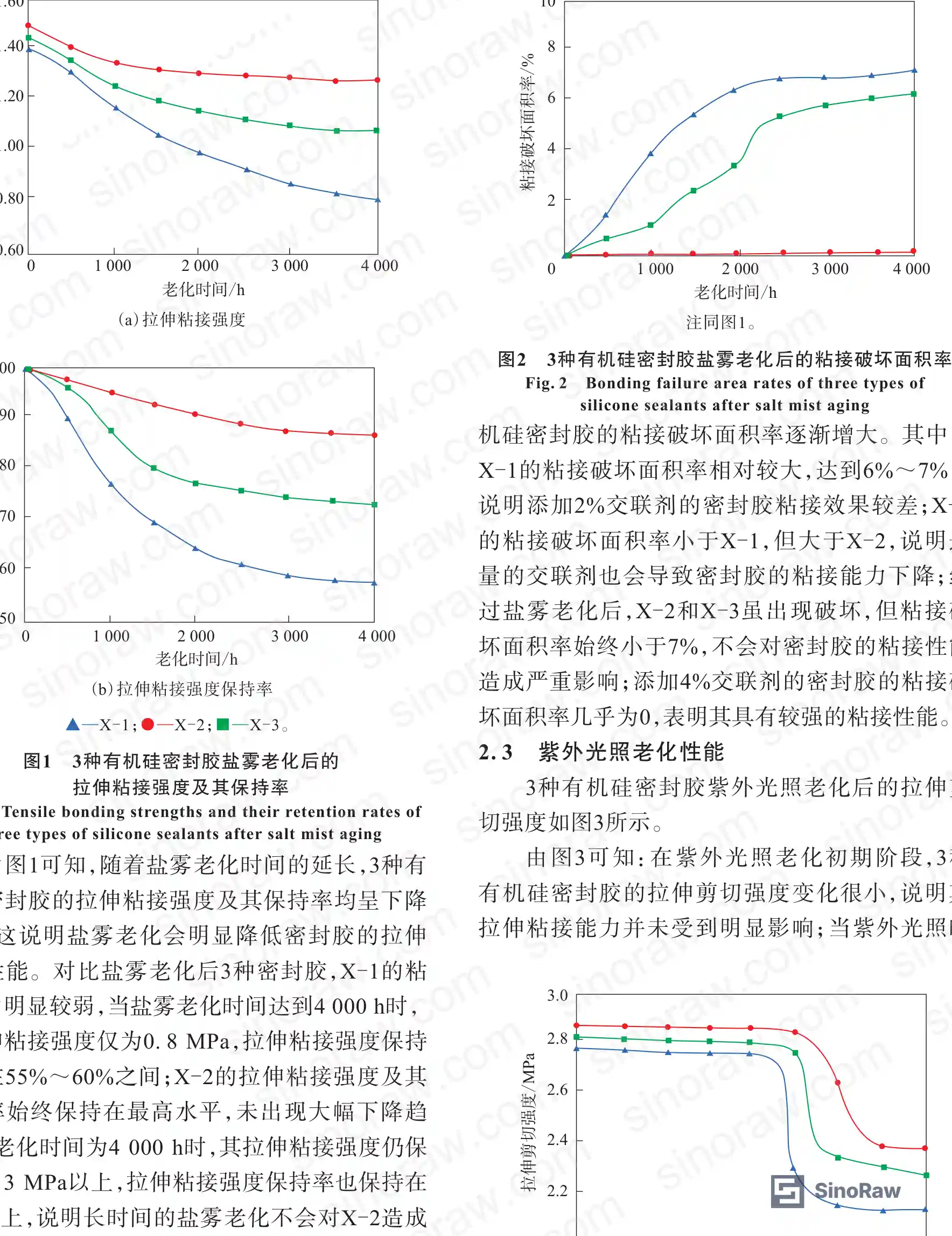
Salt mist aging was conducted per GB/T 10125–2021, ASTM C1184–2018, and GB 16776–2005, with exposure extended to 4,000 hours. Tensile bond strength was calculated from failure force divided by specimen cross-section (width × thickness).
At 4,000 hours of salt mist exposure:
- X-1 (2% crosslinker): tensile bond strength fell to 0.8 MPa, with retention rate between 55–60%. Bonding failure area rate reached 6–7%.
- X-2 (4% crosslinker): tensile bond strength remained above 1.3 MPa, retention rate held above 80%, bonding failure area rate was essentially 0%.
- X-3 (6% crosslinker): intermediate performance — better than X-1, meaningfully worse than X-2.
The over-crosslinked formulation (X-3) is the more counterintuitive finding. More crosslinker creates a stiffer network that becomes brittle under the cumulative stress of salt mist cycling. The 4% optimum reflects a crosslink density that maintains flexibility while resisting hydrolytic attack at the polymer–substrate interface.
Multi-Condition Aging Performance Summary #
| Test Condition | X-1 (2% Crosslinker) | X-2 (4% Crosslinker) | X-3 (6% Crosslinker) |
|---|---|---|---|
| Salt mist 4,000 h — tensile bond strength | 0.8 MPa | ≥1.3 MPa | Intermediate |
| Salt mist 4,000 h — bond retention rate | 55–60% | ≥80% | <80%, >60% |
| UV aging 8 h — tensile shear strength | 2.1–2.2 MPa | ≥2.3 MPa | 2.2–2.3 MPa |
| UV aging 8 h — residual torque | <1.0 N·m | ≥1.5 N·m | <1.0 N·m |
| Heat aging 80°C / 24 h — min. tear strength | 3.4 kN·m⁻¹ | 5.2 kN·m⁻¹ | 4.2 kN·m⁻¹ |
| Bond failure area rate (salt mist) | 6–7% | ~0% | <7%, >0% |
X-2 leads across every condition tested. The gap between X-2 and X-3 at the 80°C thermal aging endpoint — 5.2 vs. 4.2 kN·m⁻¹ minimum tear strength — is a 24% difference in residual structural integrity. That matters in facade engineering where thermal cycling induces real mechanical fatigue.
UV and Thermal Aging Resistance of Structural Silicone Sealant #
Ultraviolet Exposure Performance #
UV aging was run per GB/T 7124–2008 (tensile shear bond testing), with specimens accelerated in a UV aging cabinet simulating long-term outdoor irradiation. Tests measured both tensile shear strength and torque — the latter being a good proxy for cohesive integrity under rotational stress, which matters at glazing joints that experience panel movement.
In the first 4 hours of UV exposure, all three formulations showed minimal shear strength change. Beyond 4 hours, the curves diverge sharply. X-1 dropped to 2.1–2.2 MPa. X-3 reached 2.2–2.3 MPa. X-2 held above 2.3 MPa throughout. More telling: at 8 hours of continuous UV, X-2 torque remained above 1.5 N·m while both X-1 and X-3 fell below 1.0 N·m. That’s a 50%+ gap in rotational bond resistance between the optimal and sub-optimal formulations — after the same UV dose.
Honestly, most procurement teams don’t test for torque retention under UV and just rely on tensile shear. That’s a reasonable simplification for many applications, but if your sealant is on a mechanically active joint — curtain wall panels, rooftop equipment housings, or anywhere with differential thermal expansion — torque retention tells you things that tensile shear alone does not.
Thermal Aging: Viscosity and Tear Strength #
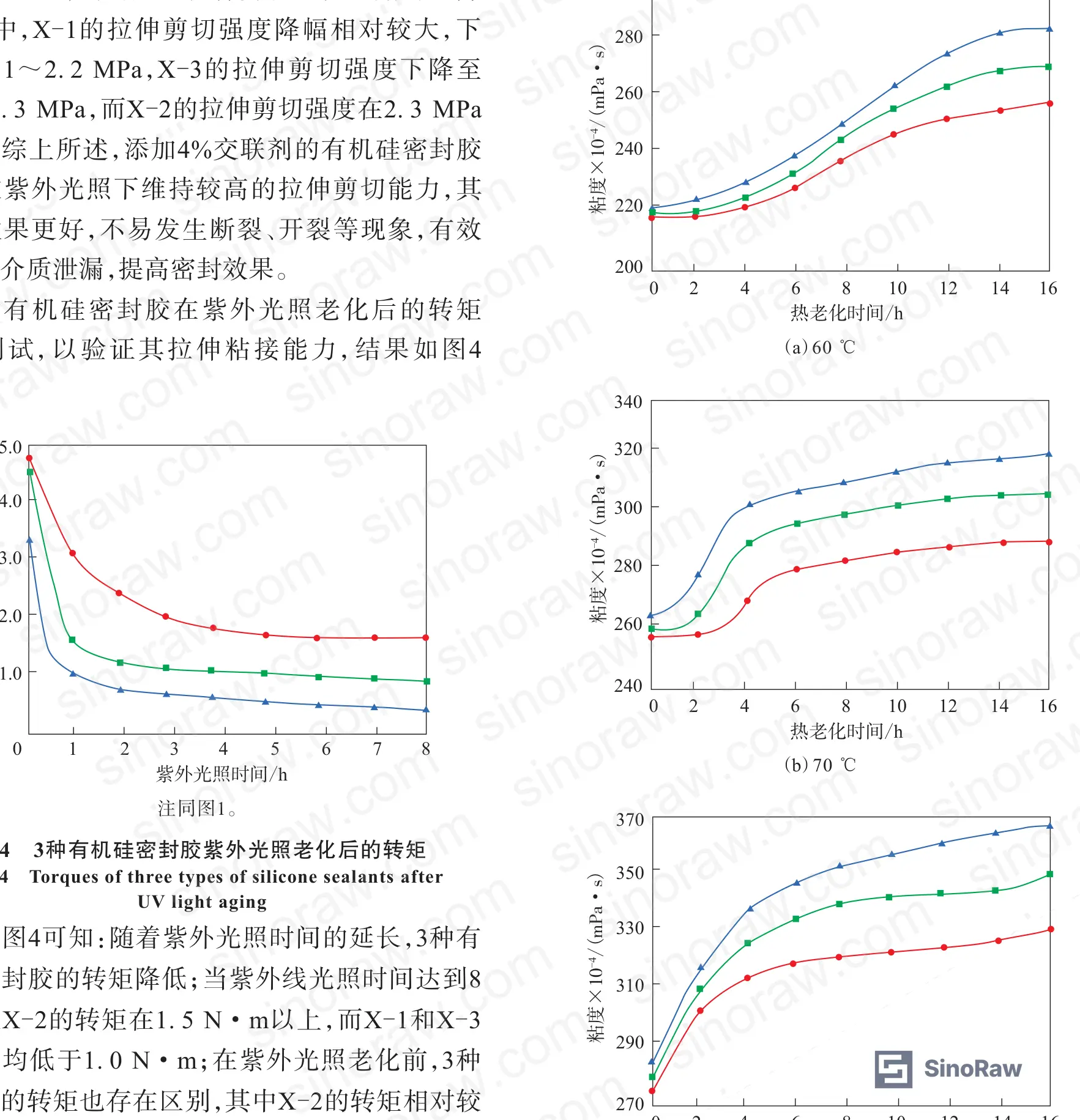
Thermal aging was conducted in a heated aging chamber at 60°C, 70°C, and 80°C over 24 hours, with viscosity tracked via rotational viscometer and tear strength per GB/T 529–2008. Viscosity increase under thermal exposure is a proxy for crosslink density drift and flow resistance — high viscosity gain means the sealant is losing its ability to accommodate joint movement, which ultimately leads to adhesive failure at the bead edges.
X-2 consistently showed the lowest viscosity increase across all three temperature conditions. X-1 and X-3 both climbed higher, indicating network instability in opposite directions — under-crosslinked X-1 continues to react and densify, while over-crosslinked X-3 undergoes partial chain scission under sustained heat.
At 80°C initial tear strength: X-2 started at 9.8 kN·m⁻¹ and declined to 5.2 kN·m⁻¹ at 24 hours. X-1 started at 6.4 kN·m⁻¹ and fell to 3.4 kN·m⁻¹ — a drop of nearly 47%. X-3 dropped from 7.3 to 4.2 kN·m⁻¹ (42% decline). X-2’s decline was 47% as well numerically, but its absolute floor — 5.2 kN·m⁻¹ — remains above the starting values for X-1 at that same temperature. That residual margin is what keeps the joint functional rather than failed.
Most procurement teams don’t realize that the revised ISO 11600 classification framework for building sealants now places greater emphasis on combined weathering resistance rather than standalone tensile tests — yet many Chinese domestic supplier datasheets still lead with ambient tensile data only. If a supplier cannot provide multi-condition aging curves, that’s a qualification gap worth flagging.
Practical Guidance for Buyers #
For procurement engineers specifying RTV silicone sealant for high-rise facade, industrial enclosure, or structural sealing applications: the 4% crosslinker loading is not a minor formulation tweak — it’s the difference between a sealant that survives 4,000 hours of salt mist and one that loses 40–45% of its bond retention in the same window. When issuing RFQs to Chinese manufacturers, ask explicitly for salt mist aging data at or beyond 3,000 hours, UV torque retention at 8 hours, and thermal aging tear strength at 80°C. These three data points will filter out a large portion of the market quickly.
At SinoRaw, we work with global procurement engineers and sourcing managers to identify and pre-qualify Chinese silicone sealant manufacturers before RFQs are issued — evaluating not just datasheet claims but actual test protocol documentation and batch consistency records. If you’re consolidating your sealing material supply chain or qualifying a new source, contact our technical sourcing team to initiate a structured evaluation.
For related technical content, see our guides on structural silicone and RTV sealant selection and adhesive and bonding material sourcing for industrial applications.
Specify the crosslinker content range (3.5–4.5%) as a procurement parameter on your material spec sheet. Require third-party aging test reports, not just manufacturer datasheets. And if a supplier can only provide ambient-condition data, treat that as a disqualifying gap for any application with meaningful environmental exposure.
Frequently Asked Questions #
What crosslinker content should I specify for RTV silicone sealant in exterior building applications?
Based on controlled aging data across salt mist, UV, and thermal conditions, 4% methyltrimethoxysilane-based crosslinker by mass delivers consistently superior performance. At 2%, bond retention under prolonged salt mist exposure falls below 60%. At 6%, over-crosslinking creates brittleness that shows up in UV torque tests and thermal tear strength. Specifying a 3.5–4.5% tolerance band gives manufacturers reasonable process latitude while keeping you in the performance-validated window.
How do salt mist test results translate to real-world facade performance?
Salt mist testing per GB/T 10125 and ASTM C1184 uses accelerated exposure to simulate long-term coastal or industrial atmospheric corrosion. A 4,000-hour salt mist exposure is commonly treated as analogous to several years of real-world outdoor exposure in moderate-to-harsh environments. The key metric isn’t peak bond strength — it’s retention rate. A sealant that starts at 1.5 MPa but drops to 0.8 MPa (53% retention) after 4,000 hours is a different product from one holding at 1.3 MPa (80%+ retention) under the same conditions.
Can I use standard RTV silicone sealant for applications above 80°C continuous service?
At 80°C, even the best-performing formulation in this evaluation (X-2) showed tear strength declining from 9.8 to 5.2 kN·m⁻¹ over 24 hours. For applications with sustained service above 80°C, standard condensation-cure RTV silicones are likely not appropriate — consider high-temperature addition-cure silicone systems or two-component structural sealants with verified HT aging data.
What does “bonding failure area rate” mean and why does it matter in sealant qualification?
Bonding failure area rate measures the proportion of the bonded surface area that has delaminated or cohesively failed after an aging test. In practice, even a small failure area on a facade joint creates a pathway for water ingress that expands over time through thermal cycling. The fact that X-2 maintained a failure area rate of essentially 0% through 4,000 hours of salt mist is arguably more significant than its absolute tensile strength retention — it indicates interface integrity, not just bulk material survival.
What standards should I require suppliers to test against when sourcing RTV silicone sealant for structural or high-rise applications?
At minimum: GB/T 13477 series for physical and chemical properties, ASTM C1184 for structural silicone sealant qualification, ISO 11600 for building sealant classification, and salt mist aging per GB/T 10125. For UV resistance, GB/T 7124 shear testing after accelerated irradiation is the minimum. Thermal aging per GB/T 529 at 80°C with tear strength measurement is a strong differentiator that many suppliers won’t proactively provide — ask for it.
Published by sinoraw.com Technical Team | Request a sourcing quote
Content reviewed by michael.fang | © sinoraw.com — All rights reserved. Unauthorized reproduction prohibited.


