

TL;DR #
Epoxy self-leveling antistatic flooring achieves a volume resistivity of 5×10⁴ to 5×10⁹ Ω and surface resistance of 10⁵ to 10¹⁰ Ω — but only when substrate concrete reaches C25 strength and moisture/temperature conditions are strictly controlled during application. If you’re specifying antistatic flooring for a large-area electronics manufacturing facility with heavy equipment traffic, epoxy self-leveling outperforms raised access systems on dust resistance, load capacity, and long-term ESD control. Before issuing any RFQ, confirm which floor system your facility layout and operational load profile actually demand — the wrong choice creates costly rework within the first year.
Overview #
Too many procurement teams treat antistatic flooring as a commodity line item. It isn’t. The performance gap between a correctly installed epoxy self-leveling system and a substandard raised-panel installation can mean the difference between a cleanroom that passes ESD audit and one that fails at commissioning. Construction research conducted by a large-scale industrial engineering group — drawing on direct installation data across electronics fabrication plants, weak-current server rooms, and aerospace assembly facilities — provides the comparative framework this article is built on. The study evaluated both antistatic raised access flooring and epoxy resin antistatic self-leveling flooring across installation conditions, construction process sequences, and post-installation maintenance protocols.
For buyers sourcing either system for semiconductor fabs, EV battery assembly lines, or precision electronics cleanrooms, the selection criteria go well beyond cost per square meter. Substrate strength, ambient humidity limits, curing schedules, and grounding topology all affect whether the finished floor will actually hold ESD compliance over a three-to-five year operational cycle.
Antistatic flooring sits within the broader category of Cleanroom Consumables — where substrate compatibility and process-controlled installation are as important as the material specification itself. Compliance with ISO 9001:2015 Quality management systems is a baseline expectation for any supplier providing antistatic flooring to regulated manufacturing environments.
Antistatic Raised Access Flooring: Installation Requirements and ESD Performance #
Raised access flooring is the simpler system to install — and that simplicity is both its advantage and its risk. The substrate only needs to reach C15 concrete strength, flatness tolerances can be corrected by adjustable support pedestals, and the entire process is dry-method construction. No curing window, no humidity restrictions, no waiting for chemical layers to develop adhesion.
The grounding topology deserves particular attention. Copper foil runs between support pedestals, bonded at intersections with conductive adhesive. Pedestals connect to the copper network, and the copper network ties to the facility’s earth grounding system. Each individual panel must register a grounding resistance of 10⁵ to 10⁸ Ω — verified panel-by-panel with a high-resistance meter during installation. A 2 mm gap is maintained between adjacent panels at time of laying, with a second coat of conductive adhesive applied after the panels are set.
Honestly, most buyers over-specify raised access flooring for production floor environments. The system is genuinely well-suited for weak-current server rooms, distribution switch rooms, and light-traffic control areas — where dynamic loads are low and ease of reconfiguration matters. But when heavy equipment moves across the floor regularly, the load capacity limitations become a real problem. The panels are not designed for significant impact or dynamic loading, and moisture ingress under the raised structure accelerates corrosion of the copper grounding network over time.
In supplier qualification, we saw three of six raised-panel samples fail grounding continuity checks at panel-to-pedestal connections — not because the panels themselves were defective, but because the conductive adhesive had been applied inconsistently or had cured before the panel was seated. That’s a process control issue, not a material issue, and it’s worth asking any supplier how they verify adhesive open time during installation.
The comparison table below captures the key decision parameters across both systems.
| Parameter | Raised Access Flooring | Epoxy Self-Leveling Flooring |
|---|---|---|
| Minimum substrate concrete grade | C15 | C25 |
| Surface resistance range | 10⁵ to 10⁸ Ω | 10⁵ to 10¹⁰ Ω |
| Volume resistivity | Not applicable (panel system) | 5×10⁴ to 5×10⁹ Ω |
| Installation method | Dry, modular | Wet, monolithic |
| Humidity restriction | None specified | Stop work above 85% RH |
| Temperature restriction | None specified | >5°C required |
| Cure / ready-for-use period | 72 hours minimum | 7 days standard; 14 days in winter |
| Load capacity | Limited; avoid impact loads | High; suitable for heavy equipment |
| Dust and moisture resistance | Poor | Excellent |
| Substrate expansion joint spacing | Not critical | ≤9 m intervals required |
| Color selection | Panel-dependent | Freely selectable |
Epoxy Resin Antistatic Self-Leveling Flooring: Construction Process and Specification Requirements #
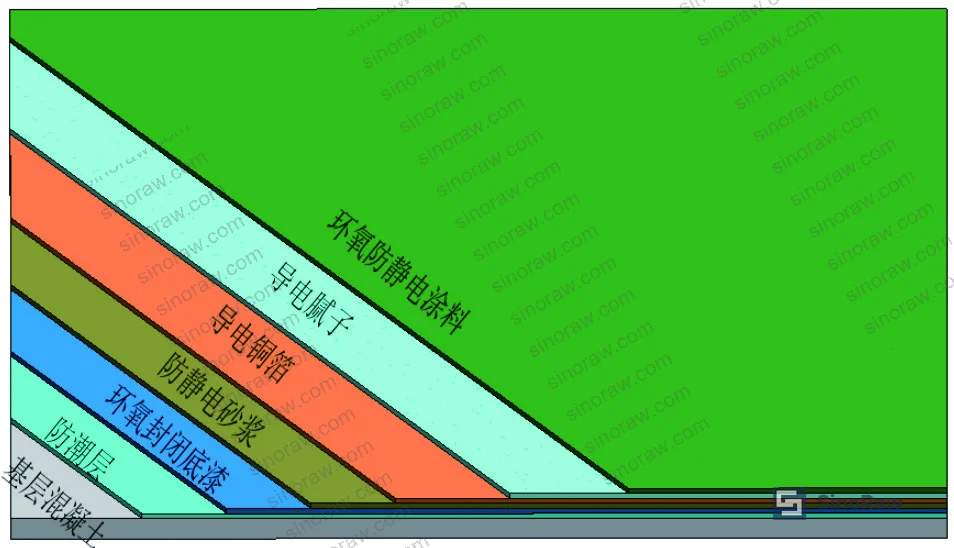
The epoxy system is a multi-layer monolithic construction. Each layer has to reach specified strength before the next one goes down — there’s no shortcutting the sequence. Getting that sequence right is where Chinese suppliers vary enormously in execution quality.
The process runs in six stages:
Stage 1 — Substrate preparation. The concrete base must be C25 or stronger. It cannot be powdery or crumbling at the surface. If surface dusting is present, a concrete consolidation hardener is applied first to restore bond strength. The surface is ground and polished, then cleaned to a dust-free, dry condition. Waterproofing and moisture-barrier treatment follows.
Stage 2 — Antistatic primer. Two coats of antistatic primer are applied after the moisture barrier cures. This is the adhesion layer — if you skip or thin this step, delamination is almost inevitable under thermal cycling.
Stage 3 — Antistatic mortar mid-coat. Two passes with antistatic mortar, each 2 mm thick, are scraped flat and then re-ground and cleaned after curing. This is the leveling and build-up layer.
Stage 4 — Conductive copper foil grid. After the mortar reaches strength, conductive copper foil is laid in a grid pattern at 2 m spacing, arranged in a “field” (田) configuration. The foil connects to the building’s lightning protection grounding system via structural reinforcing steel or local equipotential bonding. Where no lightning protection system is available, a 50 mm galvanized angle steel ground rod is driven 1.5 m into earth for every 500 m² of floor area, connected to the copper grid. Copper foil grounding resistance is measured with a high-resistance meter at this stage and must meet design specifications.
Stage 5 — Antistatic putty. One to two coats of antistatic putty are applied, followed by re-leveling, grinding, and dust removal.
Stage 6 — Self-leveling topcoat. A single coat of antistatic self-leveling topcoat is applied. This is the final finish — it goes down once and must be right on the first pass. The finished floor achieves volume resistivity of 5×10⁴ to 5×10⁹ Ω and surface resistance of 10⁵ to 10¹⁰ Ω.
The entire finished layer is approximately 10 mm thick. That’s thin enough that any substrate flatness defects will telegraph through to the surface — which is why the C25 substrate requirement and the intermediate leveling steps matter so much. A 10 mm system has no margin to absorb substrate irregularities.
Expansion joint discipline is also non-negotiable. For floors wider or longer than 30 m in either dimension, expansion joints must be incorporated. Intermediate division joints must be spaced at no more than 9 m. Ignoring this causes cracking in the epoxy layer — and once an epoxy antistatic floor cracks, the ESD path is broken and the surface is compromised.
Most procurement teams don’t realize that the humidity and temperature constraints on epoxy flooring are absolute work-stoppage criteria, not advisory guidelines. Above 85% relative humidity, the epoxy surface film cannot cure correctly. Below 5°C, flow and adhesion both degrade. Winter or wet-season installation schedules have to account for this — and suppliers who quote aggressive timelines without acknowledging these constraints are a flag worth noting. This also connects to ISO 14001:2015 Environmental management systems expectations for controlled-environment installation processes in regulated facilities.
Maintenance, Curing Schedules, and Long-Term ESD Integrity #
The curing schedule after installation is where procurement teams most frequently create problems by rushing.
Raised access flooring requires a 72-hour hold before the floor is put into service. During that window, no sharp tools or instruments should contact the panel surface — scratching or gouging the surface coating breaks the conductive path in that zone. Shock loads should be avoided entirely.
Epoxy self-leveling floors require 7 full days of ventilated, temperature-controlled curing under standard conditions. Winter installations extend the curing period to 14 days. During curing, the floor needs active ventilation and moisture management. The floor cannot be accepted or put into use until post-cure ESD testing passes inspection. Personnel entering the cured area must wear shoe covers or facility footwear. Before heavy equipment is moved in, protective mats must cover the floor surface along the transport path to prevent surface gouging.
This last point matters operationally: epoxy self-leveling floors are hard once cured, but the topcoat is susceptible to scoring from sharp objects or grit particles. A piece of coarse aggregate tracked in on equipment wheels can score the ESD topcoat and create a non-compliant zone. Facilities need a contamination control protocol from day one of occupancy — not after the first maintenance inspection finds damage.
For facilities integrating antistatic flooring with adjacent Sealing & Thermal systems — expansion joint sealants in particular — material compatibility between the epoxy topcoat and the joint filler needs to be confirmed before specification. Incompatible chemistry at the joint creates adhesion failures that undermine the entire floor system at its weakest points.
Compliance with REACH Regulation (EC) No 1907/2006 is a relevant consideration for epoxy flooring supplied into European facilities, particularly regarding epoxy resin monomers and solvent content in primer and topcoat formulations.
Practical Guidance for Buyers #
If your facility is a server room, distribution panel room, or low-traffic control space with a tight construction schedule, raised access flooring is the pragmatic choice. The C15 substrate requirement is easy to meet, installation is fast, and the modular format allows future reconfiguration. The tradeoff is load capacity and long-term moisture vulnerability.
If you’re specifying for a high-bay electronics assembly plant, EV battery cell manufacturing line, or large-footprint semiconductor fab — environments with heavy equipment, high hygiene requirements, and multi-year operational cycles — epoxy self-leveling is the correct system. The higher substrate requirement, longer curing schedule, and more complex installation process pay back in dust resistance, moisture performance, heavy-load capacity, and continuous monolithic ESD path integrity.
The procurement mistake we see most often: buyers select epoxy flooring for its performance profile, then accept the lowest-bid contractor who skips the intermediate mortar leveling coats or applies the topcoat before the substrate reaches design strength. The result is delamination within 18 months and a complete surface rework.
At sinoraw.com, we work with overseas procurement engineers and sourcing managers to identify and pre-qualify Chinese manufacturers of cleanroom and ESD flooring materials — helping buyers get to a vetted shortlist before issuing RFQs, not after a failed installation.
Need help identifying qualified suppliers for antistatic flooring systems? Talk to our sourcing team →
Supplier Qualification Questions #
- What is the verified volume resistivity range of your completed epoxy self-leveling antistatic floor system, and can you provide high-resistance meter test records confirming the 5×10⁴ to 5×10⁹ Ω range under actual installation conditions?
- What is the minimum concrete substrate grade your epoxy system is approved for, and what surface consolidation treatment do you apply when the base concrete fails the dusting test prior to primer application?
- Can you provide grounding continuity test data showing individual panel grounding resistance values within the 10⁵ to 10⁸ Ω range for your raised access flooring systems, with records from at least one completed project?
- What is your specified maximum construction humidity threshold, and how do you document work-stoppage decisions when ambient relative humidity approaches or exceeds 85% RH on-site?
- For epoxy self-leveling floors with a plan dimension exceeding 30 m in either direction, what expansion joint spacing do you specify, and how do you verify that intermediate division joints are placed at no more than 9 m intervals?
Sourcing Checklist #
- ☐ Epoxy system achieves volume resistivity within 5×10⁴ to 5×10⁹ Ω, verified by high-resistance meter test records from completed installations
- ☐ Raised access flooring grounding resistance confirmed at 10⁵ to 10⁸ Ω per panel, tested panel-by-panel during installation
- ☐ Supplier specifies C25 minimum concrete grade for epoxy systems and documents substrate consolidation treatment protocol for dusting surfaces
- ☐ Installation process documentation confirms two-coat antistatic primer, dual 2 mm mortar mid-coat, copper foil grid at 2 m spacing, and single-pass self-leveling topcoat in correct sequence
- ☐ Curing schedule documentation shows minimum 7-day cure (14 days for winter installation) with ventilation and moisture control records
- ☐ Copper foil ground grid connects to building lightning protection system or provides 50 mm galvanized angle steel ground rods at ≤500 m² spacing where no lightning protection system exists
- ☐ Supplier holds ISO 9001:2015 certification and can provide project-level ESD test reports with actual resistance values, not just specification sheets
- ☐ Epoxy resin and primer formulations are confirmed REACH-compliant for facilities supplying into EU-regulated markets
Key Specifications Table #
| Parameter | Recommended Value | Verification Method |
|---|---|---|
| Epoxy floor volume resistivity | 5×10⁴ to 5×10⁹ Ω | High-resistance meter, full-area measurement at project completion |
| Epoxy floor surface resistance | 10⁵ to 10¹⁰ Ω | High-resistance meter per IEC 61340 or equivalent test protocol |
| Raised access panel grounding resistance | 10⁵ to 10⁸ Ω per panel | Panel-by-panel high-resistance meter check during installation |
| Minimum substrate concrete grade (epoxy system) | C25 | Concrete compressive strength test record from substrate contractor |
| Maximum ambient humidity for epoxy installation | <85% RH | On-site hygrometer log, stop-work documented above threshold |
| Minimum installation temperature (epoxy system) | >5°C | On-site thermometer log, contractor daily weather record |
| Copper foil ground grid spacing | 2 m centers, “田” pattern | As-built drawing review + continuity test |
| Expansion joint spacing (epoxy, large area) | ≤9 m; joints required for dimensions >30 m | As-built drawing review + visual inspection of joint placement |
Can’t find a supplier meeting these specs? Submit your requirements and we’ll match you within 48 hours.
References #
Data source: Comparative Analysis of Antistatic Raised Access Flooring and Epoxy Resin Antistatic Self-Leveling Floor Systems in Industrial Construction, N. Gao et al., Construction and Building Materials, 2024
Frequently Asked Questions #
Can epoxy antistatic self-leveling flooring be installed over an existing raised access floor system?
No — not directly. Epoxy self-leveling requires a monolithic concrete substrate at C25 strength minimum. If an existing raised access system is being replaced, the substrate must be exposed, inspected for strength and surface condition, and treated for dusting before any epoxy layers can be applied. Attempting to apply epoxy over pedestals, copper foil remnants, or uneven leveling compound will cause delamination.
What causes antistatic raised access flooring to fail ESD testing after installation?
The most common failure mode is inconsistent conductive adhesive application at the pedestal-to-copper-foil interface and at panel-to-pedestal connections. If the adhesive is applied too early and starts to cure before the panel is seated, or is applied too thin, the conductive bond is incomplete. Each panel needs individual resistance verification — a single failed panel creates a gap in the grounding network.
How long does epoxy antistatic flooring need to cure before heavy equipment can enter?
Standard conditions require 7 full days of ventilated curing before the floor is put into service. Winter installations require 14 days. Before equipment is moved in after cure, protective mats must be laid along the equipment transport path to prevent the topcoat from being scored by grit or sharp edges on equipment wheels.
Is the surface resistance range different between raised access flooring and epoxy self-leveling systems?
Yes. Raised access flooring targets a grounding resistance of 10⁵ to 10⁸ Ω per panel. Epoxy self-leveling achieves a broader surface resistance range of 10⁵ to 10¹⁰ Ω and also specifies volume resistivity at 5×10⁴ to 5×10⁹ Ω — a parameter that doesn’t apply to panel-based systems. The epoxy system’s resistivity spec covers both surface path and bulk conduction through the flooring material.
Which floor system is better suited for a large EV battery assembly plant?
Epoxy self-leveling. It handles heavy and dynamic loads that raised access panels cannot, provides monolithic dust and moisture resistance critical in battery manufacturing environments, and delivers continuous ESD path integrity across large floor areas. The longer construction schedule and stricter substrate requirements are worth it for a facility that will run production equipment over the floor for 10-plus years.
Published by sinoraw.com Technical Team | Request a sourcing quote


