

TL;DR #
If you’re sourcing two-component condensation-cure RTV silicone sealant for automated dispensing lines — automotive lighting, new energy enclosures, or curtain wall assembly — the mixing ratio of your A and B components is probably causing more process failures than your quality team has formally attributed to it. Most procurement teams treat mix ratio as a fixed spec and move on. Field data says otherwise.
Condensation-cure RTV-2 silicone sealants cure through internal crosslinking when both components are combined, without relying on atmospheric moisture. That makes them genuinely suited for thick-section sealing and high-throughput production. But the version of this technology that dominates the current market — with A:B ratios ranging from 4:1 to 20:1 — carries a structural vulnerability that becomes obvious the moment you move from hand-dispensing to automated metering equipment.
This article documents the performance behavior of equal-ratio (1:1) condensation-cure RTV-2 silicone sealant, including how it compares to conventional ratio formulations under simulated dispensing variance, nine-month shelf stability data, and 100-sample continuous equipment trials. If you’re qualifying a supplier for production-scale sealing applications, the data here will change what you ask for in your RFQ.
RTV-2 Silicone Mix Ratio Tolerance: Why Conventional Formulations Fail Automated Lines #
The core problem with standard condensation-cure RTV-2 products is mix ratio sensitivity. Commercial products currently on the market use A:B ratios between 4:1 and 20:1. At first glance, this looks like a minor process variable. In practice, it’s a liability.
Here’s what the test data shows when B-component dosing deviates from target across different ratio formulations:
Table 1: Effect of A:B Mix Ratio and B-Component Variance on RTV-2 Sealant Performance
| A:B Mix Ratio | B Variance (%) | Pot Life (min) | Tack-Free Time (min) | Tensile Strength (MPa) | Elongation at Break (%) |
|---|---|---|---|---|---|
| 20:1 | 0 | 40 | 45 | 2.32 | 261 |
| 20:1 | +5 | 21 | 27 | 2.44 | 233 |
| 20:1 | −5 | 64 | 78 | 2.13 | 298 |
| 10:1 | 0 | 45 | 48 | 2.29 | 279 |
| 10:1 | +15 | 10 | 16 | 2.65 | 242 |
| 10:1 | −15 | 82 | 97 | 1.94 | 314 |
| 4:1 | 0 | 30 | 38 | 2.24 | 263 |
| 4:1 | ±20 | 42–73 | 53–84 | 1.96–2.00 | 292–297 |
| 1:1 (equal ratio) | ±30 | 25–35 | 30–44 | 1.90–2.11 | 264–295 |
At a 20:1 ratio, a B-component deviation of just 5% is enough to push pot life from 40 minutes to either 21 or 64 minutes — a spread of more than 3×. For any production line running a fixed cure window, that’s an immediate quality risk. At 10:1, performance stays stable only within roughly ±10% B variance. Once you move to ±15%, pot life swings from 10 to 82 minutes.
The equal-ratio formulation (1:1) tolerates B-component variance up to ±30% while maintaining relatively stable cure behavior. Pot life stays within 25–35 minutes. Tack-free time holds between 30 and 44 minutes. Tensile strength ranges 1.90–2.11 MPa and elongation 264–295% across the full ±30% window — far tighter than what the high-ratio formulations deliver even within ±10% variance.
Honestly, most buyers over-specify tensile strength for general industrial sealing while under-specifying mix ratio tolerance. The 1:1 formulation doesn’t deliver the highest peak tensile (2.65 MPa at 10:1 with +15% B excess), but it delivers consistent, in-spec performance across the realistic variance range of production dispensing equipment. That’s what matters on a line running 24/7.
The technical reason equal-ratio works better here comes down to polymer chemistry. Conventional B-component formulations use either hydroxyl-terminated PDMS (HO-PDMS) or dimethyl-terminated PDMS (Me-PDMS) as the base polymer. HO-PDMS introduces excess hydroxyl groups that complicate crosslinker compatibility; Me-PDMS shows poor compatibility with the crosslinking package. Neither lends itself to a stable 1:1 formulation. The equal-ratio approach uses multialkoxy-terminated PDMS (MO-PDMS) — synthesized by reacting HO-PDMS with vinyltrimethoxysilane (VTMO) and methyltrimethoxysilane (MTMO) at 120°C for 4–6 hours — as the B-component base polymer. The end-capping reaction eliminates most free hydroxyl groups and produces a stable, viscosity-controlled polymer that remains compatible with the crosslinker package at 1:1 ratios.
Shelf Life and Application Stability of Equal-Ratio Condensation RTV-2 Sealant #
Storage stability is where a lot of silicone sealant specifications fall apart at the procurement stage. Buyers confirm initial performance against datasheets and then discover that batch-to-batch consistency degrades as warehouse inventory ages. With condensation-cure RTV-2, the B component is especially vulnerable — crosslinker activity and catalyst reactivity can shift over time, and if your metering equipment is calibrated to a fresh-batch viscosity, a six-month-old drum will dispense differently.
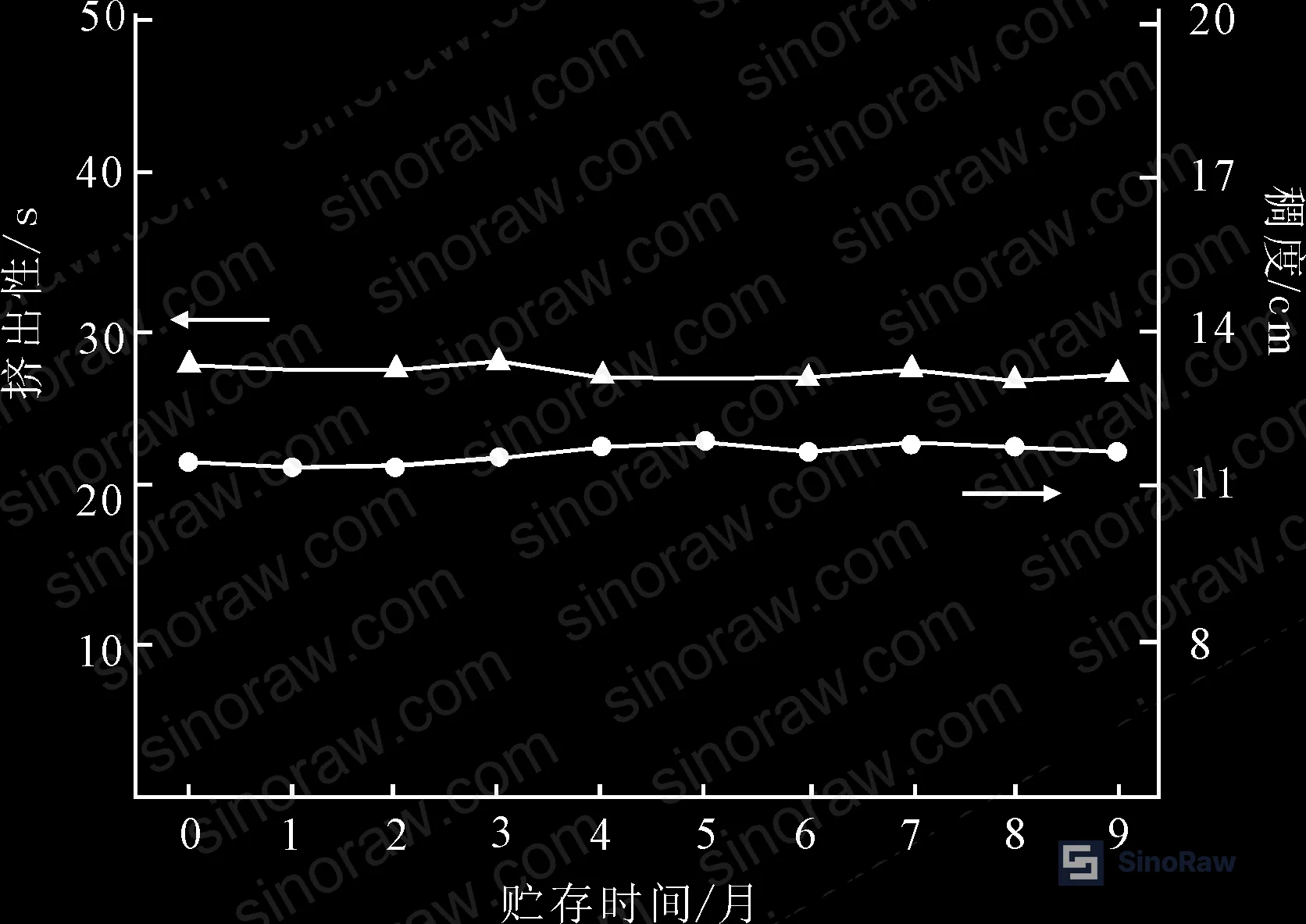
The equal-ratio formulation shows strong stability through nine months of ambient storage. Consistency in both extrudability and slump (consistency/sag resistance) remained stable with no significant drift across the full 9-month observation window, tested per GB/T 16776 using a polyethylene cartridge, 6 mm nozzle, and 0.340 MPa application pressure. This is the practical floor for qualification — if a supplier can’t demonstrate 9-month stability on both components, don’t sign the supply agreement.
The A-component formulation is relatively straightforward: 100 parts HO-PDMS plus 100 parts nano-activated calcium carbonate, mixed in a planetary disperser. Calcium carbonate particle size (40–80 nm) matters here — coarser filler shifts viscosity and affects extrudability without improving mechanical performance. The B component is more sensitive: it contains MO-PDMS, fumed silica (particle size 150 nm, 10 parts), nano-calcium carbonate, the dual-component silicone vulcanizing agent, and catalyst. The fumed silica contributes reinforcement and thixotropic behavior; the MO-PDMS base polymer provides the alkoxy end-groups needed for condensation crosslinking.
Extrudability and consistency (tested per GB/T 1749) showed no significant change across storage. This is worth noting because most competing 1:1 silicone formats in the market use addition-cure chemistry to achieve equal-ratio mixing, which brings its own inhibition sensitivity issues. The condensation-cure route described here avoids platinum catalyst inhibition entirely — relevant for applications involving sulfur-containing adhesives, tin-based coatings, or certain plastics.
Most procurement teams don’t realize that the shift toward equal-ratio condensation-cure RTV-2 is relatively recent in the Chinese industrial sealant market. For years, the technical consensus held that stable 1:1 condensation formulations were difficult to achieve without sacrificing storage life or mechanical performance. The MO-PDMS synthesis route — specifically the alkoxy end-capping that replaces reactive hydroxyl groups — resolved the compatibility problem that previously made 1:1 condensation RTV-2 impractical. This development has direct implications for automated production across automotive and new energy manufacturing sectors, where addition-cure alternatives were often the default precisely because of the mix ratio stability concern.
Dispensing Equipment Trials: 100-Sample Stability Tracking #
This is where theoretical formulation advantage becomes operational procurement argument.
To evaluate real-world dispensing stability, 100 samples were collected at irregular intervals from an automated dispensing machine running both 10:1 and 1:1 formulations under continuous production conditions. Each sample was tested for pot life and tack-free time per GB/T 29595-2013 and GB/T 13477.5-2002 respectively.
In supplier qualification, we saw this pattern clearly in the 10:1 formulation data: out of 100 samples collected from the automated line, 5 collection points showed distinct anomalies. Pot life swung from the nominal 45 minutes down to 30 minutes at one extreme and up to 60 minutes at the other. Tack-free time ranged from 37 minutes to 76 minutes — nearly a 2× spread — across those outlier samples. The remaining 95 samples were within acceptable range, but in a production context, a 5% anomaly rate means roughly 1 in 20 dispensing cycles is producing out-of-spec material. For automotive lighting or new energy battery enclosures, that’s not an acceptable process capability number.
The 1:1 equal-ratio samples showed no such anomalies across the full 100-sample set. Pot life and tack-free time held stable throughout the trial with no significant deviation. The mechanical performance data from the controlled mix-ratio study supports why: at 1:1 with ±30% B-component variance, tensile strength stays within 1.90–2.11 MPa and elongation within 264–295%. The equal-ratio formulation simply has a wider process window that absorbs the minor metering fluctuations inherent to automated equipment.
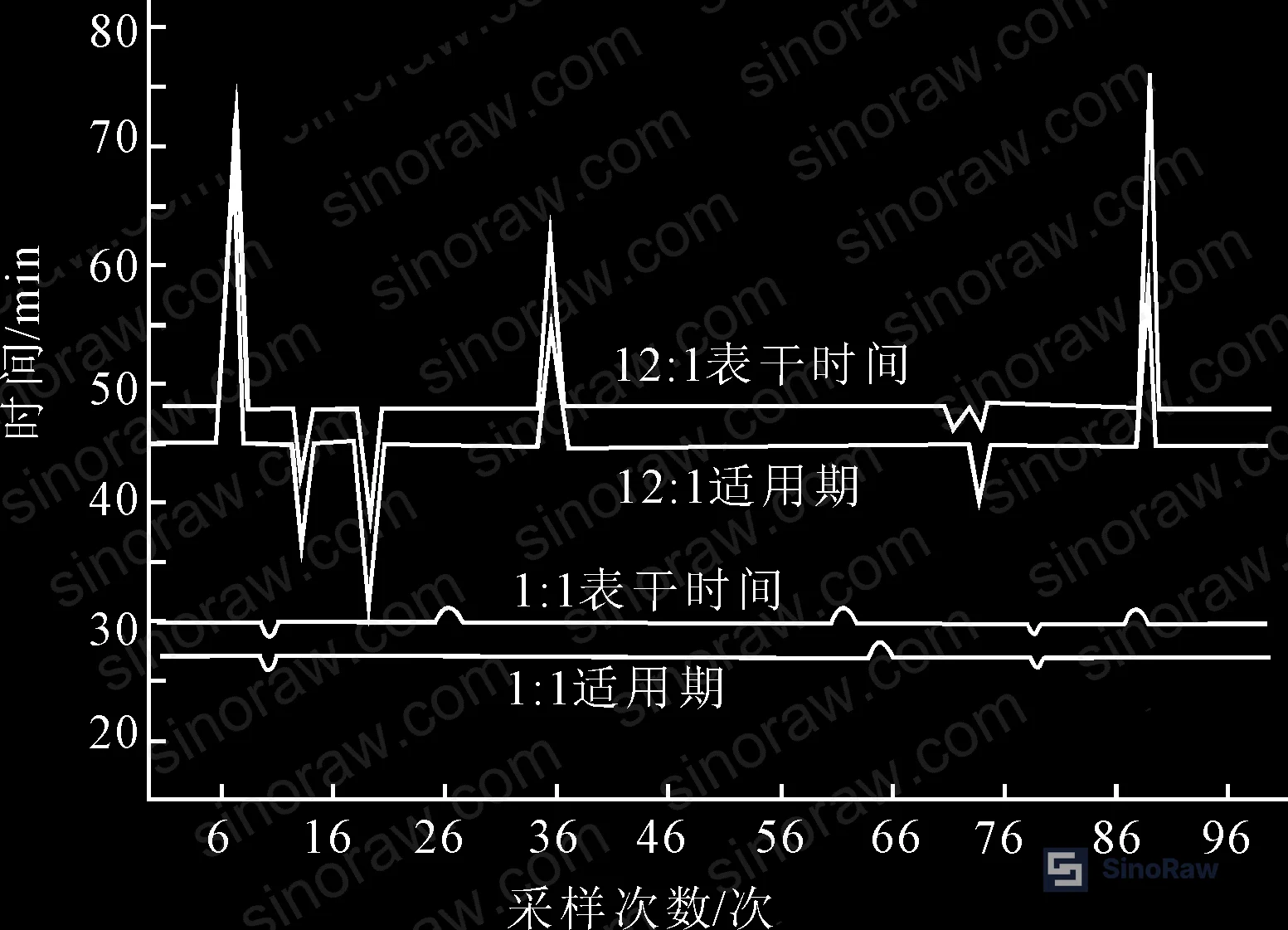
Honestly, the 5% failure rate on the 10:1 formulation is probably conservative for real-world Chinese production lines where metering equipment calibration isn’t always maintained on a strict schedule. Buyers specifying high-ratio RTV-2 for automated application without understanding the equipment variance sensitivity are accepting process risk they may not have formally quantified.
Practical Guidance for Buyers #
If you’re evaluating condensation-cure RTV-2 silicone sealant for continuous automated production — automotive lighting assemblies, new energy battery enclosures, or architectural glazing — your first qualification question should be mix ratio, not tensile strength.
Specify 1:1 (equal-ratio) mixing explicitly in your technical requirements. Require suppliers to demonstrate ±30% B-component variance tolerance in cure performance testing, not just nominal-ratio data. Ask for 9-month shelf stability data on both components, tested per GB/T 16776, with extrudability and consistency documented, not just a shelf-life claim on the TDS.
For the B component, confirm the base polymer is MO-PDMS (alkoxy-terminated) rather than HO-PDMS or Me-PDMS. The end-capping chemistry is what makes equal-ratio condensation cure stable — if a supplier can’t describe the polymer architecture, that’s a qualification flag.
At sinoraw.com, our role is to help overseas procurement engineers and sourcing managers identify and pre-qualify Chinese sealant manufacturers before they issue RFQs — we’re a Guangzhou-based B2B sourcing service covering industrial adhesives, sealants, and advanced materials, not a manufacturer ourselves. If you’re ready to identify verified suppliers for equal-ratio RTV-2 silicone sealants, the silicone and RTV sealant category is a practical starting point, or contact us directly to scope your requirements.
For broader adhesive and bonding technology context, the industrial adhesives and bonding section covers complementary technologies including structural UV adhesives for applications where cure-on-demand is preferable to condensation cure.
Frequently Asked Questions #
What is the key advantage of equal-ratio (1:1) RTV-2 silicone sealant over 10:1 or 20:1 formulations in automated production?
The main advantage is process stability under metering variance. At a 20:1 ratio, a 5% deviation in B-component dosing pushes pot life from 40 minutes to either 21 or 64 minutes — a range that breaks any fixed-window cure process. The 1:1 formulation tolerates ±30% B-component variance while keeping pot life within 25–35 minutes and tack-free time within 30–44 minutes. On a continuous automated line, that difference translates directly to reduced scrap rates and more reliable QC outcomes.
How do I verify that a supplier is using alkoxy-terminated (MO-PDMS) rather than hydroxyl-terminated polymer in the B component?
Request the synthesis data or polymer characterization report for the B-component base polymer. A straightforward in-house verification method is the titanate ester test: mix the B-component base polymer with tetraisopropyl titanate (TIPT) at 100:5 mass ratio. If alkoxy end-capping is complete, no significant viscosity peak appears. A clear viscosity spike indicates residual hydroxyl groups — meaning the end-capping reaction was incomplete and the polymer may not deliver stable 1:1 mixing performance.
Does condensation-cure RTV-2 require moisture to cure?
No — that’s one of the practical advantages over single-component condensation silicones. Two-component condensation RTV-2 cures through internal crosslinking when the two components are mixed. It does not depend on atmospheric moisture, so cure depth is not limited by section thickness. This makes it suitable for thick-section encapsulation and enclosed joint applications where moisture-cure products would remain uncured in the interior.
What mechanical performance should I expect from a qualified equal-ratio condensation RTV-2 sealant?
Based on controlled mix-ratio testing across the ±30% B-component variance window: tensile strength 1.90–2.11 MPa, elongation at break 264–295%. At nominal ratio (0% variance), the equal-ratio formulation delivers tensile strength of approximately 2.01 MPa and elongation of 271%. These values reflect stable, production-representative performance rather than best-case nominal-ratio conditions.
Which test standards should I require in a supplier’s TDS or qualification package for RTV-2 silicone sealant?
At minimum: extrudability per GB/T 16776, consistency per GB/T 1749, pot life per GB/T 29595, tack-free time per GB/T 13477.5, and tensile strength/elongation per GB/T 528. For applications involving coated glass or anodized aluminum substrates, also request adhesion data on those specific substrates — condensation RTV-2 shows reasonable adhesion to spray-coated aluminum and coated glass, but bond performance varies with surface preparation and primer use.
Published by sinoraw.com Technical Team | Request a sourcing quote
Content reviewed by michael.fang | © sinoraw.com — All rights reserved. Unauthorized reproduction prohibited.


