

TL;DR #
If you’re specifying a ketoxime-cure RTV-1 silicone for any application involving copper busbars, PCB ground contacts, or polycarbonate enclosures, and your supplier hasn’t mentioned corrosion inhibition — stop the RFQ process right there. This is the single most common specification gap I see when qualifying Chinese RTV-1 suppliers for electronics and solar assembly buyers, and it costs procurement teams weeks in field failure investigation after the fact.
Ketoxime-cure (oxime-release) RTV-1 silicone is a well-established sealant chemistry: single-component, moisture-cured, fast surface dry, and broadly compatible across metals, glass, and plastics. But the crosslinker — methyl(or vinyl)tributanone oximosilane — releases methyl ethyl ketoxime (MEKO) during cure. MEKO in the presence of moisture becomes mildly alkaline, with a pH above 7. That’s enough to initiate oxidation on copper substrates and stress-crack polycarbonate. The industry has largely moved past this problem with additive packages, but a disturbing number of supplier datasheets still don’t disclose whether or how they’ve addressed it.
This article walks through the technical basis for corrosion inhibition in oxime-cure RTV-1, the formulation parameters that actually matter, and how to structure your incoming qualification tests before committing to a supply agreement.
Ketoxime RTV-1 Corrosion Mechanism: Why Copper and PC Are the Vulnerable Substrates #
The core chemistry problem is straightforward. During ambient-humidity cure, the oxime crosslinker hydrolyzes and releases MEKO as a byproduct. MEKO is an organic solvent with pH > 7 in aqueous conditions — weakly alkaline. In contact with copper, this creates conditions for cuprite and malachite formation: the substrate surface progresses from slight discoloration to deep brown oxidation, with up to 100% of the contact area affected over extended exposure at ambient conditions.
Polycarbonate is vulnerable through a different pathway. The ester linkages in PC’s molecular backbone are susceptible to alkaline hydrolysis and chain scission. The practical result is surface yellowing within the first cure cycle, followed by visible cracking — and in severe cases, localized swelling of the substrate material itself.
Two additive approaches are used in combination to neutralize this mechanism:
Active nano-magnesium silicate adsorbent — particle size 100 nm, functions by physically adsorbing MEKO during cure, reducing the concentration available for hydrolysis. Used alone at 0.5–2 phr, bench data shows copper substrate discoloration limited to approximately 30% of contact area.
Ketoxime scavenger — a reactive chemical (ester-type, ≥99.9% purity) that reacts directly and rapidly with MEKO to chemically neutralize it. Used alone at 0.5–3 phr, this reduces the copper corrosion contact area to approximately 50% — somewhat less effective than the adsorbent used alone, because it competes kinetically with hydrolysis rather than removing MEKO physically before it can react.
The combination of both additives is where the real result appears. Test results using a 50 mm × 5 mm × 2 mm copper coupon immersion protocol (observation at defined intervals, rated on a 0–5 corrosion grade scale per contact area percentage) showed near-zero surface change with the dual additive system — corrosion grade effectively 0.
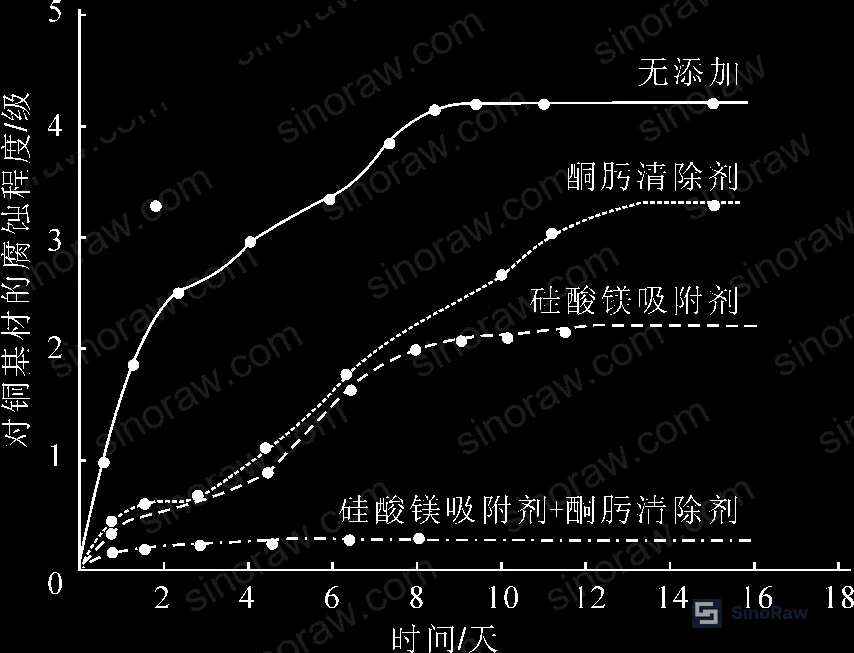
The corrosion scale used in the qualification protocol:
| Corrosion Grade | Surface Change Area (%) | Practical Interpretation |
|---|---|---|
| 0 | 0–5% | Acceptable for copper contact — no functional impact |
| 1 | 6–20% | Minor discoloration — cosmetic concern, monitor for progression |
| 2 | 21–40% | Moderate oxidation — unacceptable for electrical contacts |
| 3 | 41–60% | Significant corrosion — copper conductivity at risk |
| 4 | 61–80% | Severe corrosion — substrate integrity compromised |
| 5 | 81–100% | Complete corrosion — sealant disqualified for this substrate |
Standard sealant (no additive) tracks from Grade 1 toward Grade 3–4 over the test duration. Grade 0 is achievable with the dual additive system. That’s not a marginal improvement — it’s the difference between a qualified and a disqualified formulation for copper-contact applications.
RTV-1 Oxime Cure Performance: Depth of Cure, Tack-Free Time, and Mechanical Properties Under Additive Loading #
Honestly, most procurement engineers over-specify cure speed and under-specify cure depth. Tack-free time is easy to measure and ends up dominating the datasheet conversation, but what matters in most gasketing and potting applications is how far the sealant actually cures through in a defined timeframe — especially in deep joints or overlapping assemblies.
Cure performance data under test conditions of 25°C / 50% RH, measured per GB/T 13477—2002:
| Additive Configuration | Cure Depth at 24h (mm) | Tack-Free Time (min) |
|---|---|---|
| No additive (baseline) | 3.5 | 12 |
| Nano-magnesium silicate only | 4.2 | 15 |
| Ketoxime scavenger only | 4.6 | 15 |
| Both additives combined | 6.0 | 15 |
The combined system achieves a 24-hour cure depth of 6 mm — a 71% improvement over the uninhibited baseline. Tack-free time increases modestly from 12 to 15 minutes across all additive configurations. That 3-minute delta is functionally irrelevant for almost any assembly process, but the cure depth improvement is significant for joints thicker than 4 mm.
Mechanical property impact with the dual additive system:
| Additive Configuration | Tensile Strength (MPa) | Elongation at Break (%) |
|---|---|---|
| No additive (baseline) | 1.0 | 250 |
| Nano-magnesium silicate only | 1.1 | 230 |
| Ketoxime scavenger only | 1.2 | 210 |
| Both additives combined | 1.18 | 223 |
Tensile strength increases slightly with additive loading — from 1.0 MPa baseline to 1.18 MPa with the combined system. Elongation at break decreases modestly, from 250% to 223%. Neither change is outside typical lot-to-lot variation for production-grade RTV-1, and neither represents a performance concern for standard sealing applications. The additive system does not meaningfully compromise mechanical properties.
The formulation basis that achieves these results: 100 parts hydroxyl-terminated polydimethylsiloxane (PDMS, viscosity 20,000 mPa·s at 25°C), 100 parts nano-calcium carbonate (50 nm, stearic acid surface treatment), 3 parts methyl(or vinyl)tributanonoximosilane crosslinker, 0.5–2 parts nano-magnesium silicate adsorbent (100 nm), 0.5–3 parts oxime scavenger, 0.5 parts γ-aminopropyltriethoxysilane adhesion promoter, and 0.1 parts dibutyltin dilaurate catalyst. Mixed under vacuum to remove entrapped air and low-boiling volatiles, then packaged in sealed cartridges.
Substrate Compatibility and Chemistry Classification Relative to Other RTV-1 Types #
It’s worth positioning ketoxime-cure correctly within the RTV-1 landscape, because buyers frequently conflate cure chemistry types when comparing supplier datasheets — and the corrosion profiles are completely different.
Current industry data shows four primary RTV-1 cure chemistries in commercial production: acetic acid-release (acetoxy), amine-release, oxime-release (ketoxime), and alcohol-release (alkoxy). Their relative profiles:
- Acetoxy cure: Releases acetic acid — highly corrosive to metals and carbonates, but fast-curing and low-cost. Largely displaced in electronics applications.
- Amine cure: Releases amines — corrosive to copper and some non-ferrous metals, with a distinct odor. Still used in some construction and HVAC applications.
- Oxime cure: Releases MEKO — moderate corrosivity, addressable with additive systems as described. Good adhesion, fast tack-free time, favorable storage stability.
- Alkoxy cure: Releases alcohol — lowest inherent corrosivity, but slower cure rate and relatively reduced storage stability compared to oxime type.
Most procurement teams don’t realize that classification under ISO 11600 for construction sealants and IEC 60601 for electronics-grade materials actually requires the manufacturer to declare cure byproduct type — yet many Chinese supplier datasheets omit this entirely. When qualifying a new oxime-cure source, ask specifically for the corrosion inhibition additive disclosure and the copper contact test protocol before reviewing any other datasheet parameters.
For applications covered under REACH Regulation (EC) No 1907/2006, note that MEKO (CAS 96-29-7) was previously subject to SVHC scrutiny — its status in your target market’s regulatory framework is worth verifying as part of supplier qualification, particularly for EU-destined assemblies.
For polycarbonate compatibility specifically: test per the PC cracking protocol described above (50 mm × 100 mm PC panels, 5 mm sealant bead, 25°C / 50% RH / 7 days) before any production approval. Surface yellowing after 7 days is a disqualification criterion. Cracking is an automatic fail.
Practical Guidance for Buyers #
When you’re sourcing oxime-cure RTV-1 from Chinese manufacturers, the specification conversation needs to go deeper than Shore A hardness and tack-free time. The corrosion inhibition system — whether it uses a magnesium silicate adsorbent, an oxime scavenger, or both — is the decisive variable for copper and polycarbonate applications, and most standard datasheets won’t tell you what’s in it.
At SinoRaw, we work as a B2B sourcing and supplier qualification intermediary connecting overseas procurement teams with verified Chinese manufacturers across industrial chemistry categories — so when a buyer tells us they’re sourcing RTV-1 for an electronics assembly application, the first thing we do is push for additive package disclosure and substrate corrosion test data before the RFQ goes out.
Request these four test deliverables as a minimum for any new RTV-1 supplier qualification: copper coupon corrosion grade (0–5 scale, immersion method), PC cracking test (7-day ambient cure), 24-hour cure depth measurement, and tensile strength/elongation per GB/T 13477—2002. A supplier who can’t provide all four in 5 business days probably isn’t running them routinely. That’s a qualification risk, not a minor gap.
For buyers sourcing into solar panel assembly or automotive ECU sealing — two high-growth application segments for this chemistry — also check whether the formulation has been qualified against ISO 4892-2 UV weathering conditions. It won’t appear in a standard RTV-1 datasheet, but field durability in outdoor thermal cycling is a different conversation from lab cure data.
Explore our silicone and RTV sealant sourcing resources or browse related industrial adhesives and bonding content for additional selection guidance.
Frequently Asked Questions #
Q: What is the practical difference between using a magnesium silicate adsorbent alone versus a ketoxime scavenger alone for copper corrosion control?
A: Based on controlled bench testing using copper coupons rated on a 0–5 corrosion grade scale: the magnesium silicate adsorbent (100 nm particle size, 0.5–2 phr loading) limits copper surface discoloration to approximately 30% of contact area by physically trapping MEKO during cure. The ketoxime scavenger (reactive ester type, 99.9% purity) reduces discoloration to approximately 50% of contact area by chemically neutralizing MEKO — but its effectiveness depends on reaction kinetics competing against hydrolysis, so it’s slightly less efficient when used alone. Neither additive alone achieves Grade 0 corrosion performance. The combination of both, at optimized loading, effectively eliminates measurable copper corrosion and is the only configuration that passes a rigorous copper contact qualification.
Q: Will these corrosion inhibitor additives significantly affect cure time or mechanical properties?
A: No — tack-free time increases by approximately 3 minutes (12 to 15 minutes) across all additive configurations, which is negligible for any practical assembly process. Tensile strength improves modestly from 1.0 to 1.18 MPa. Elongation at break decreases from 250% to 223%. Neither mechanical property change falls outside normal production variation, and cure depth actually improves significantly — from 3.5 mm to 6.0 mm at 24 hours with the dual additive system.
Q: How does oxime-cure RTV-1 compare to alkoxy (alcohol-release) cure in terms of substrate safety?
A: Alkoxy-cure RTV-1 has lower inherent corrosivity because it releases alcohol rather than MEKO, but trades off with slower cure rate and reduced storage stability. Oxime-cure with a proper dual additive system can match alkoxy-cure in copper corrosion performance while retaining faster tack-free time and better storage stability. For most electronics assembly buyers, inhibited oxime-cure is the more practical choice unless the application involves extended open-time requirements or highly corrosion-sensitive substrates where no additive system provides sufficient margin.
Q: Is MEKO (methyl ethyl ketoxime) a regulatory concern for EU-bound products?
A: MEKO (CAS 96-29-7) has been subject to regulatory review under REACH. Buyers sourcing RTV-1 for EU-destined assemblies should verify the current SVHC status and any applicable concentration thresholds with their chemical compliance team before finalizing supplier selection.
Q: What substrate types is non-corrosive oxime-cure RTV-1 suitable for?
A: With a properly formulated dual additive system, this chemistry is qualified for copper, polycarbonate, glass, most engineering plastics, and standard structural metals. It is not recommended for bare aluminum in continuously wet environments without additional primer, and should be tested case-by-case on painted surfaces with water-based topcoats.
Published by sinoraw.com Technical Team | Request a sourcing quote
Content reviewed by michael.fang | © sinoraw.com — All rights reserved. Unauthorized reproduction prohibited.


