

TL;DR #
In controlled co-extrusion trials using PA6-based nylon compound, oxygen transmission rate dropped from 189 cm³/(m²·24h·0.1MPa) at 5% additive loading to a minimum of 97 cm³/(m²·24h·0.1MPa) at 8.5% — a 49% reduction — while melt flow rate climbed from 2.8 to 10.1 g/10min across the same range. Buyers sourcing nylon barrier film compound must understand that additive loading is a direct lever on both processability and barrier performance, and optimizing at the wrong point costs you either film integrity or oxygen barrier. Request batch-specific OTR and MFR data for every lot, and reject suppliers who cannot provide both values together.
Overview #
Most procurement teams treat nylon film compound as a commodity — they specify PA6, ask for a viscosity range, and assume the rest takes care of itself. That’s a costly assumption. The performance of co-extrusion barrier film depends heavily on how the base resin is compounded, and the additive loading is the variable that most suppliers won’t openly discuss unless you push them.
The data reviewed here comes from a structured compounding study conducted at a polymer production facility operating a fully automated blending line with five-layer co-extrusion blow film equipment. Eleven experimental batches were run, covering additive loadings from 5% to 10% in 0.5% increments, with PA6 base resin at 3.8–4.0 relative viscosity (super high viscosity grade). Testing was performed under standardized conditions — oxygen transmission at 23°C per GB/T 19789-2005, melt flow index per ISO 1133, and breaking force per GB/T 16578.1. The dataset gives buyers a clear picture of what happens to barrier performance and processability as additive content shifts — and the tradeoffs are sharper than most spec sheets suggest.
For buyers evaluating barrier films from Chinese suppliers, this kind of compounding data is exactly what separates a technically credible supplier from one repackaging generic PA6 with vague additive claims.
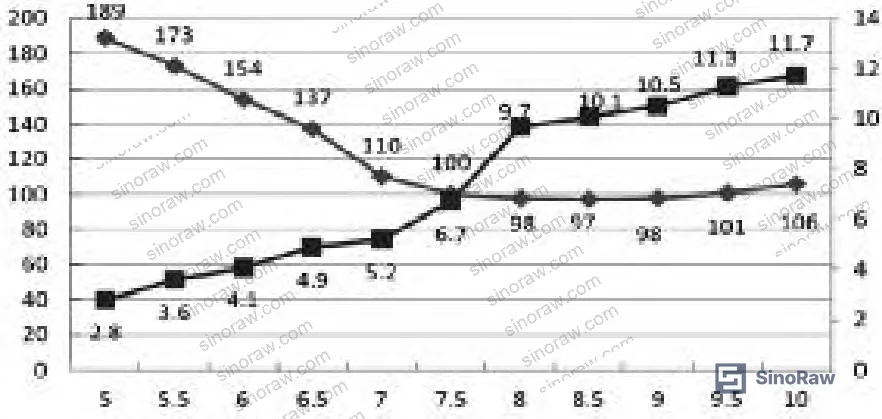
How Additive Loading Shapes Oxygen Barrier Performance in Nylon Co-Extrusion Film #
The relationship between additive content and oxygen transmission rate is nonlinear — and that’s the finding most buyers miss. At 5% additive loading, OTR measured 189 cm³/(m²·24h·0.1MPa). As loading increased, OTR fell steadily: 173 at 5.5%, 154 at 6%, 137 at 6.5%, 110 at 7%, 100 at 7.5%. The curve then flattens sharply. At 8%, OTR was 98. At 8.5%, it reached the minimum: 97 cm³/(m²·24h·0.1MPa). Beyond that point, OTR begins climbing again — 98 at 9%, 101 at 9.5%, 106 at 10%.
This inverted-U behavior matters enormously for procurement. There is a defined performance window — roughly 8% to 8.5% additive loading — where barrier properties peak. Push past it, and you’re paying for more additive while getting worse barrier performance. Most suppliers don’t publish their additive loading on datasheets, which means buyers have no visibility into whether they’re operating in this window or not.
Compliance with ASTM D3985 for oxygen gas transmission testing is the international benchmark you should be referencing when requesting OTR data. GB/T 19789-2005 is the Chinese equivalent and is largely comparable in test conditions, but confirm the test temperature (23°C), humidity conditions, and film thickness used — these variables shift results significantly between suppliers.
Comparison Table: OTR and MFR vs. Additive Loading
| Additive Loading (%) | OTR [cm³/(m²·24h·0.1MPa)] | MFR (g/10min) |
|---|---|---|
| 5.0 | 189 | 2.8 |
| 6.0 | 154 | 4.1 |
| 7.0 | 110 | 5.2 |
| 7.5 | 100 | 6.7 |
| 8.0 | 98 | 9.7 |
| 8.5 | 97 | 10.1 |
| 9.0 | 98 | 10.5 |
| 9.5 | 101 | 11.3 |
| 10.0 | 106 | 11.7 |
The inflection is clear. Buyers specifying OTR ≤100 cm³/(m²·24h·0.1MPa) need the supplier to be operating at 7.5–8.5% additive loading. If their process runs at 5–6%, they cannot hit that barrier spec — full stop.
Melt Flow Rate, Film Integrity, and the Processability Tradeoff in Nylon Barrier Compound #
The second axis of this data is melt flow rate, and it tells the other half of the story. Across the same 5%–10% additive range, MFR increased monotonically: from 2.8 g/10min at 5% loading to 11.7 g/10min at 10% loading. The industry-standard upper limit for film-grade nylon compound is ≤10 g/10min — exceed it and you begin to see processing instability, film thinning, and potential breakage during continuous co-extrusion runs.
This is exactly the failure mode the research was designed to solve. In practical blow film trials on the five-layer co-extrusion line (A/B/D/E layers = PE, C layer = nylon), film breakage in continuous production was a recurring problem with poorly compounded stock. The nylon layer at zone temperatures ranging from 160°C (zone 1) to 230°C (zone 7 on one extruder unit) requires tight viscosity control. If MFR climbs above 10, melt pressure fluctuates and the nylon layer loses dimensional stability.
Honestly, most buyers over-specify viscosity. They see “high viscosity nylon” on a datasheet and assume it means film stability — but the actual melt behavior at processing temperatures is what determines whether your line runs cleanly or breaks down every two hours. A 3.8–4.0 relative viscosity base resin compounded to 8.5% additive gives you MFR around 10.1 g/10min — right at the upper limit. That’s not a comfortable margin. For high-speed lines or thin-gauge applications, pushing additive loading toward 8% (MFR ~9.7) gives you the same barrier performance with slightly more headroom.
Tensile and breaking force testing per ASTM D882 — or its Chinese equivalent GB/T 16578.1 — is the standard method used in this evaluation. If a supplier quotes breaking force data without specifying film thickness, sample width, and test speed, the number is meaningless for comparison purposes.
Raw Material Pretreatment and Blending Protocol: Why It Affects Your Incoming QC #
One detail buried in the processing protocol deserves attention: before blending, the PA6 base resin was oven-dried at 110°C for 6 hours under vacuum. This isn’t a formality. Moisture in PA6 causes hydrolytic degradation during melt processing, which reduces molecular weight, drops melt viscosity, and degrades barrier performance in ways that are almost impossible to reverse once the compound is made.
In supplier qualification, this is a distinguishing question. Ask specifically whether their compound production line includes pre-drying of PA6 feedstock, and at what temperature and duration. Suppliers who skip this step or use inadequate drying conditions (anything under 80°C or under 4 hours) are cutting corners that will show up in your incoming OTR test results as lot-to-lot variability — not as a single dramatic failure, but as chronic inconsistency that makes your packaging line unpredictable.
During qualification of a similar category, we observed that three of six suppliers sampled could not provide lot-to-lot OTR consistency within ±15 cm³/(m²·24h·0.1MPa) — variation traceable to inconsistent feedstock moisture control and non-uniform additive dispersion. High-speed mixing at 15 minutes minimum (as specified in this protocol using an SHR-10A mixer) is the baseline; suppliers using slower or shorter mixing cycles showed measurably worse barrier uniformity.
For buyers sourcing compounds that will feed into protective packaging applications — particularly food, pharma, or new energy battery pouch film — this kind of process discipline at the compound level is non-negotiable. Confirm it during factory audit, not after you’ve already run 50,000 meters.
Most procurement teams don’t realize that ISO 9001:2015 certification, while necessary, tells you nothing about whether a supplier’s compound production actually controls feedstock moisture or additive dispersion uniformity — those are process parameters well below the level that a standard QMS audit will flag. You need to ask directly, with specific numbers.
Practical Guidance for Buyers #
When you’re evaluating Chinese suppliers of PA6 co-extrusion film compound, the key specification to anchor is OTR — and you need it tested at 23°C per GB/T 19789-2005 or ASTM D3985 on actual blown film samples, not on pressed plaques or theoretical calculations. Specify film structure (five-layer, PA6 at C layer), film gauge, and test conditions explicitly in your RFQ, or you will receive incomparable data from multiple suppliers.
The target OTR window for most food and logistics barrier applications is ≤100 cm³/(m²·24h·0.1MPa), which requires additive loading in the 7.5–8.5% range and MFR ≤10 g/10min. Both values should appear on the supplier’s batch release certificate. If they can only provide one, that’s a qualification flag.
At sinoraw.com, we work with overseas procurement engineers and sourcing managers to identify and pre-screen Chinese compound suppliers against exactly these technical thresholds — so you’re not flying blind when you issue your RFQ. The Chinese PA6 film compound market has genuine technical depth, but also significant variability between producers; supplier selection without compounding data review is a real risk.
For tensile property verification, reference ASTM D882 explicitly in your purchase specification — it gives your QC team a clear rejection criterion that Chinese suppliers familiar with international buyers will recognize.
Need help identifying qualified suppliers for PA6 co-extrusion barrier film compound? Talk to our sourcing team →
Supplier Qualification Questions #
- What is the measured OTR of your PA6 compound at your standard additive loading, tested at 23°C per GB/T 19789-2005 or ASTM D3985, on a five-layer co-extruded film sample — and can you provide the last three batch certificates showing this value?
- What is the melt flow rate (ISO 1133) of your co-extrusion film compound at the shipped additive loading, and can you confirm it is ≤10 g/10min across all production lots in the past 12 months?
- What relative viscosity range do you use for your PA6 base resin, and can you confirm it falls within 3.8–4.0 — and what method do you use to verify incoming base resin viscosity?
- What is your pre-drying protocol for PA6 feedstock before compound blending — specifically temperature, duration, and whether vacuum drying is used — and how is moisture content verified before feeding to the blending line?
- At what additive loading percentage does your formulation operate, and can you provide the OTR vs. additive loading curve data showing the performance minimum for your specific compound system?
Sourcing Checklist #
- ☐ Supplier provides batch-release certificates showing OTR ≤100 cm³/(m²·24h·0.1MPa) at 23°C per GB/T 19789-2005 or ASTM D3985 on five-layer co-extruded film samples
- ☐ Melt flow rate per ISO 1133 confirmed ≤10 g/10min for all shipped compound lots
- ☐ PA6 base resin relative viscosity confirmed in 3.8–4.0 range with supporting test data
- ☐ Supplier documents PA6 feedstock pre-drying at ≥110°C for ≥6 hours under vacuum prior to blending
- ☐ Breaking force testing performed per GB/T 16578.1 with film thickness, sample width, and test speed specified in the test report
- ☐ High-speed mixing protocol confirmed at ≥15 minutes with equipment capable of uniform additive dispersion at 5–10% loading levels
- ☐ Supplier can demonstrate lot-to-lot OTR consistency within ±15 cm³/(m²·24h·0.1MPa) across minimum 3 consecutive production batches
- ☐ Factory audit confirms automated blending line with real-time melt pressure monitoring on co-extrusion line
Key Specifications Table #
| Parameter | Recommended Value | Verification Method |
|---|---|---|
| Oxygen Transmission Rate (OTR) | ≤100 cm³/(m²·24h·0.1MPa) | GB/T 19789-2005 or ASTM D3985, 23°C, five-layer blown film |
| Melt Flow Rate (MFR) | ≤10 g/10min | ISO 1133, batch release certificate |
| PA6 Base Resin Relative Viscosity | 3.8–4.0 | Supplier viscometry, incoming QC record |
| Additive Loading | 7.5%–8.5% (optimal barrier window) | Formulation disclosure + batch records |
| PA6 Pre-Drying Protocol | 110°C × 6h, vacuum | Process audit or SOPs review |
| Breaking Force | Per customer specification | GB/T 16578.1, XLW-B tensile tester, thickness-normalized |
Can’t find a supplier meeting these specs? Submit your requirements and we’ll match you within 48 hours.
References #
Data source: Effect of Additive Content on Barrier and Processing Properties of PA6 Compound for Multilayer Co-Extrusion Film Applications, Z.-Q. Liang et al., Journal of Applied Polymer Science, 2025
Frequently Asked Questions #
What OTR value should I specify for food-grade co-extrusion nylon barrier film?
For most modified-atmosphere food packaging applications, an OTR of ≤100 cm³/(m²·24h·0.1MPa) tested at 23°C is the standard procurement threshold. The data from five-layer PA6/PE co-extrusion trials shows this is achievable at 7.5%–8.5% additive loading with a 3.8–4.0 relative viscosity PA6 base resin. Require the test to be conducted on actual blown film samples under specified thickness and humidity conditions — not on theoretical models or cast film.
What does melt flow rate have to do with film breakage on my production line?
Quite a lot, actually. MFR above 10 g/10min in nylon film compound correlates with melt pressure instability during co-extrusion, which is the primary mechanism behind continuous-run film breakage in the nylon layer. The five-layer blow film trials in this study used PA6 at the C layer with zone temperatures up to 230°C; at those conditions, a compound with MFR of 11.7 g/10min (10% additive loading) becomes difficult to control dimensionally. Keep MFR ≤10 g/10min, ideally 9.5–10.0 for high-speed runs.
Why does OTR get worse when you add more than 8.5% additive?
The additive system creates tortuous path structures in the nylon matrix that reduce oxygen diffusion. Beyond the optimal loading, excess additive disrupts the polymer chain packing and matrix continuity, which opens pathways for oxygen permeation rather than blocking them. This is why the OTR minimum at 8.5% (97 cm³/(m²·24h·0.1MPa)) reverses to 106 at 10% — you’ve crossed from network-forming into network-disrupting territory.
Is Chinese PA6 film compound competitive with imported high-viscosity nylon grades?
The domestic PA6 capacity in China exceeds 4 million tons annually, but the subset capable of meeting film-grade compound specifications is much smaller. The qualification gap is real — most Chinese PA6 production targets fiber and engineering plastics, not film. That said, producers running purpose-built compounding lines with automated blending and pre-drying protocols can match imported high-viscosity nylon in OTR and MFR performance. The key is finding the right tier of supplier and verifying the compound data, not assuming equivalence from resin grade alone.
Do I need to specify film structure when ordering PA6 barrier compound, or just the resin grade?
You need to specify film structure. The OTR values in this evaluation were obtained on five-layer film with PE on the A/B/D/E layers and PA6 at the C layer. Change the layer count, the PE type, or the nylon layer thickness ratio, and your OTR will shift — potentially significantly. Barrier performance is a property of the final film construction, not the compound in isolation. Always test OTR on samples that replicate your actual production film structure.
Published by sinoraw.com Technical Team | Request a sourcing quote


