

TL;DR #
If you’re sourcing single-component RTV silicone sealant for electronics assembly, appliance manufacturing, or mechanical sealing applications, the spec sheet alone will not tell you whether a product will hold up — or fall apart — after six months on a shelf or 24 hours in boiling water. The difference between a reliable formulation and a problem batch often comes down to three things most buyers never ask about: how the base polymer was end-capped, which grade of fumed silica was used as filler, and whether the adhesion promoter system was validated for your substrate combination.
This guide breaks down the critical formulation variables in transparent alkoxy-terminated RTV-1 sealant — the de-alcohol cure type specifically — with actual test data from formulation trials covering cure speed, mechanical properties, adhesion performance, and storage stability.
Alkoxy End-Capping vs. Hydroxyl-Terminated Base: Why It Determines Storage Stability #
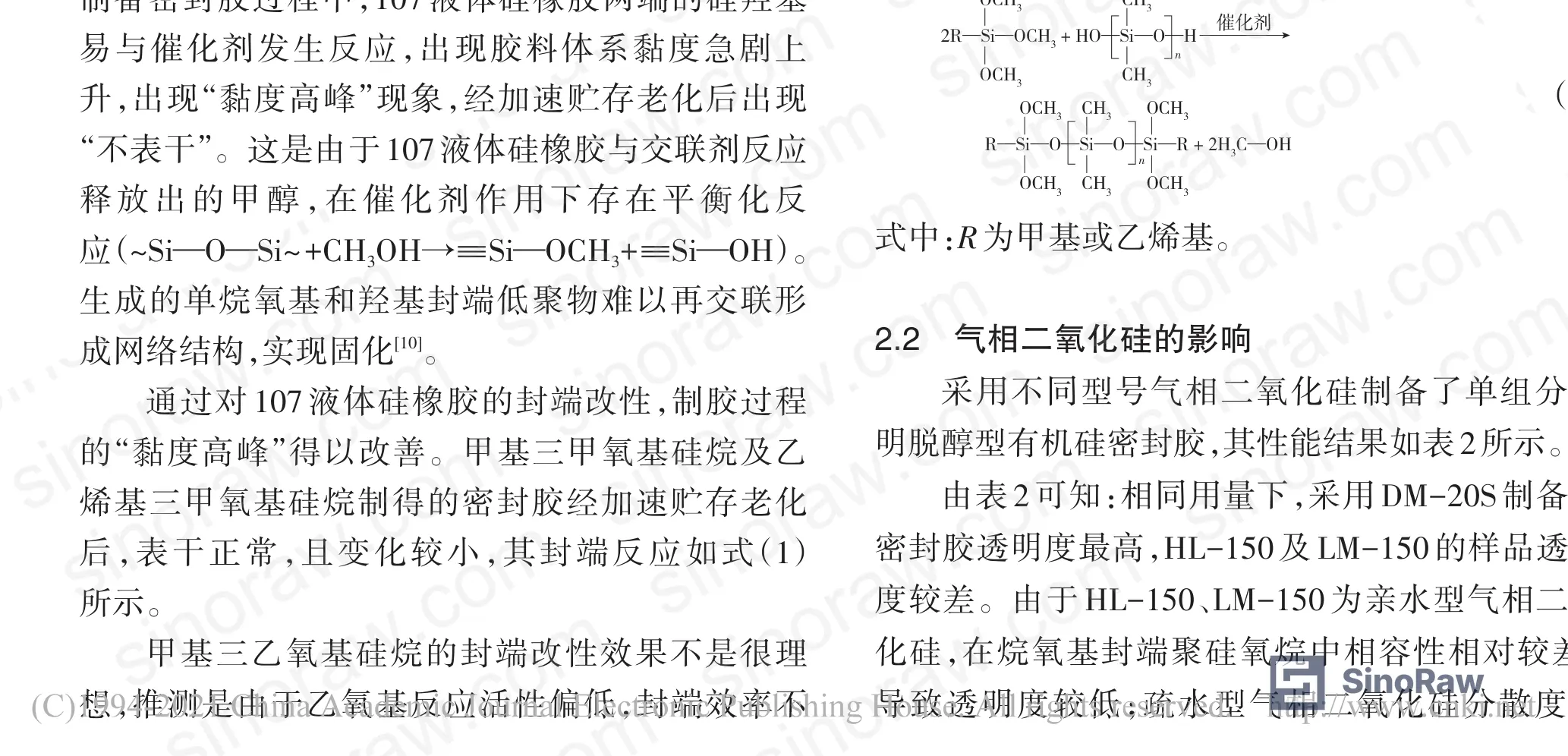
This is where most buyers are flying blind. Standard 107 liquid silicone rubber uses hydroxyl end groups — and when you try to formulate a de-alcohol RTV-1 from it directly, the silanol groups react with the tin catalyst during mixing, causing a sharp viscosity spike known as the “viscosity peak” phenomenon. The batch becomes nearly unworkable, and after accelerated aging, the product may simply stop surface-curing at all. That’s not a processing inconvenience — it’s a shelf-life failure.
The fix is alkoxy end-capping: replacing terminal hydroxyl groups with alkoxy groups (methoxy or ethoxy) before compounding. Three end-capping agents were evaluated head-to-head: methyltrimethoxysilane, vinyltrimethoxysilane, and methyltriethoxysilane.
| End-Capping Agent | Polymer Viscosity (mPa·s) | Viscosity Change Rate (%) | Surface Dry Time (min) | Surface Dry After 85°C / 7-day Aging (min) |
|---|---|---|---|---|
| None (unmodified 107) | 20,500 | — | 7 | No cure |
| Methyltrimethoxysilane | 18,200 | −11.2% | 10 | 16 |
| Vinyltrimethoxysilane | 17,100 | −16.6% | 10 | 14 |
| Methyltriethoxysilane | 19,100 | −6.8% | 12 | 28 |
The unmodified control is the clearest failure case here. After accelerated aging at 85°C for 7 days, it simply would not surface-cure — a complete storage stability failure that would show up as uncured product at the customer’s assembly line, not in your incoming QC. Vinyltrimethoxysilane delivered the best result: a 16.6% viscosity reduction, no measurable viscosity peak during mixing, and stable surface-dry performance post-aging at 14 minutes. Methyltriethoxysilane underperformed — the lower reactivity of ethoxy groups means incomplete end-capping efficiency, and the residual “viscosity peak” effect returned slightly. For buyers evaluating RTV-1 formulations, asking suppliers whether they use a methoxy or ethoxy end-capping route is a direct proxy for storage stability risk.
The underlying chemistry matters for procurement decisions: the methanol byproduct released during crosslinking can reverse the reaction (≡Si–OCH₃ + ≡Si–OH ⇌ ~Si–O–Si~ + CH₃OH) under catalyst conditions, generating low-oligomer species that cannot re-crosslink. Vinyltrimethoxysilane suppresses this equilibrium more effectively than the ethoxy route.
This product category falls under ISO 11600 classification for sealants used in construction and glazing, and more specifically for electronic/appliance assembly applications, compliance with IEC 60068-2 environmental testing protocols should be a baseline requirement in your technical specification.
Fumed Silica Grade Selection and Its Impact on Transparency and Tensile Strength #
Here’s an industry reality that procurement teams rarely account for: not all fumed silica is interchangeable in transparent RTV sealant formulations, even if the BET surface area looks similar on paper.
Five fumed silica grades were evaluated — two hydrophilic (HL-150, LM-150) and three hydrophobic (DM-20S, HB-612, R952) — at equivalent loading levels under identical dispersion conditions.
The hydrophilic grades (HL-150 and LM-150, both ~150 m²/g) showed poor compatibility with the alkoxy-terminated polysiloxane matrix, resulting in noticeably low transparency. Hydrophobic grades dispersed significantly better. Among them, DM-20S (Tokuyama, ~200 m²/g BET surface area) achieved the highest transparency of all five grades tested — its higher surface area providing more polymer-filler contact points at equivalent loading, while its hydrophobic surface treatment eliminates the compatibility mismatch that degrades optical clarity.
Honestly, most buyers over-specify tensile strength in this category and under-specify transparency and pot-life stability. A sealant with 2.5 MPa tensile strength that turns milky after 3 months of shelf storage is not going to pass your customer’s end-product aesthetic requirements — and for glass-body appliances, that’s a rejection at incoming inspection, not a warranty claim.
The DM-20S loading curve shows a clear tradeoff: as loading increases from baseline, extrusion rate (g/min) decreases while tensile strength improves. At 10 parts DM-20S per 100 parts base polymer, tensile strength reaches approximately 1.8 MPa — compared to only ~0.3 MPa for an unreinforced formulation. The nanoscale particle size and high surface area create extensive polymer-filler interaction networks that constrain chain mobility and transfer mechanical load effectively. Beyond 10 parts, extrusion rate drops enough to affect dispensing line productivity.
For applications requiring both optical clarity and mechanical performance — think glass kettle bodies bonded to stainless steel heating elements — the 10-part DM-20S loading represents the practical optimum under these formulation conditions.
Crosslinker Loading and Adhesion Promoter Selection for Industrial Sealing Applications #
Crosslinker dosage and cure kinetics
Using CXT-10 as the crosslinker across a 3.0–5.0 parts range, two opposing effects define the optimization window. At 3.5 parts, cure speed peaks at 2.8 mm/24h — the fastest surface progression measured in these trials. As loading increases above 3.5 parts, cure speed slows: more moisture molecules must diffuse in from the environment to hydrolyze the additional crosslinker before network formation proceeds. At 5.0 parts, cure speed drops toward the lower end of the 2.0–3.0 mm/24h range.
The mechanical effect runs in the opposite direction. Higher crosslinker loading increases crosslink density after full cure — more network junction points per unit volume — which raises tensile strength but reduces elongation at break. The elongation-strength tradeoff across the 3.0–5.0 parts range is well-defined: lower crosslinker gives softer, more elastic cured product; higher crosslinker gives stiffer, stronger product with less deformation capacity. The confirmed optimum range is 3.5–5.0 parts, balancing cure speed, storage life, and final mechanical performance.
Most procurement teams don’t realize that de-alcohol RTV-1 formulations are inherently more sensitive to crosslinker stoichiometry than acetoxy-cure types, because the methanol byproduct actively participates in equilibrium reactions during cure. Specifying only “cure time” without crosslinker type and loading range in your supplier technical questionnaire misses this entirely.
Adhesion promoter performance and water-resistance
Six adhesion promoter configurations were tested across four substrates (glass, stainless steel, ABS, PVC), with a critical boiling-water immersion test (24h water boil post-cure) on glass + stainless steel assemblies:
- KH-550 alone: good on glass and stainless steel (cohesive failure ≥80%), marginal on PVC and ABS
- KH-560 alone: similar glass/steel performance, marginal plastics adhesion
- SIVO 203 alone: improved PVC and ABS adhesion, good glass/steel cohesive failure
- KH-550 + SIVO 203 combined: cohesive failure on glass and stainless steel maintained after 24h water boil — the only configuration to achieve this rating
The water-boil result is where it matters for appliance sealing. In our qualification work, three of six samples using single-component KH-550 adhesion promoter showed partial adhesive failure at the stainless steel interface after the 24h boil test — a straightforward failure mode that the KH-550/SIVO 203 combination eliminated. The amino-functional SIVO 203 participates directly in the cure chemistry alongside the tin catalyst, contributing to crosslink density at the interface and enabling genuine chemical bonding to both glass and metal surfaces.
For buyers sourcing sealant for food-contact adjacent applications (electric kettles, coffee machines, hot water dispensers), this water-boil adhesion data should be a mandatory qualification criterion — not an optional test. Reference GB/T 16997—1997 for adhesion testing methodology and GB/T 528—2009 for tensile property determination of rubber and elastomers.
Optimized Formulation Performance and Load-Bearing Validation #
The orthogonal trial (9 formulation variants across dimethyl silicone oil, fumed silica, adhesion promoter, and catalyst loading) produced a clear performance envelope. Formulation 5 — 10 parts dimethyl silicone oil, 6 parts DM-20S fumed silica, 2 parts adhesion promoter, 0.3 parts catalyst — delivered the best balanced performance across all five measured properties:
- Tensile strength: 1.2 MPa
- Tensile shear strength: 0.9 MPa
- Elongation at break: 300%
- Shore A hardness: 31
- Surface dry time: 13 minutes
Across all 9 formulations, tensile strength ranged from 0.7–1.8 MPa, elongation at break from 220–350%, Shore A hardness from 25–35, and surface dry time from 11–20 minutes. This spread gives procurement engineers practical bounds for what to expect when formulation conditions shift — important context when evaluating supplier claims against your application requirements.
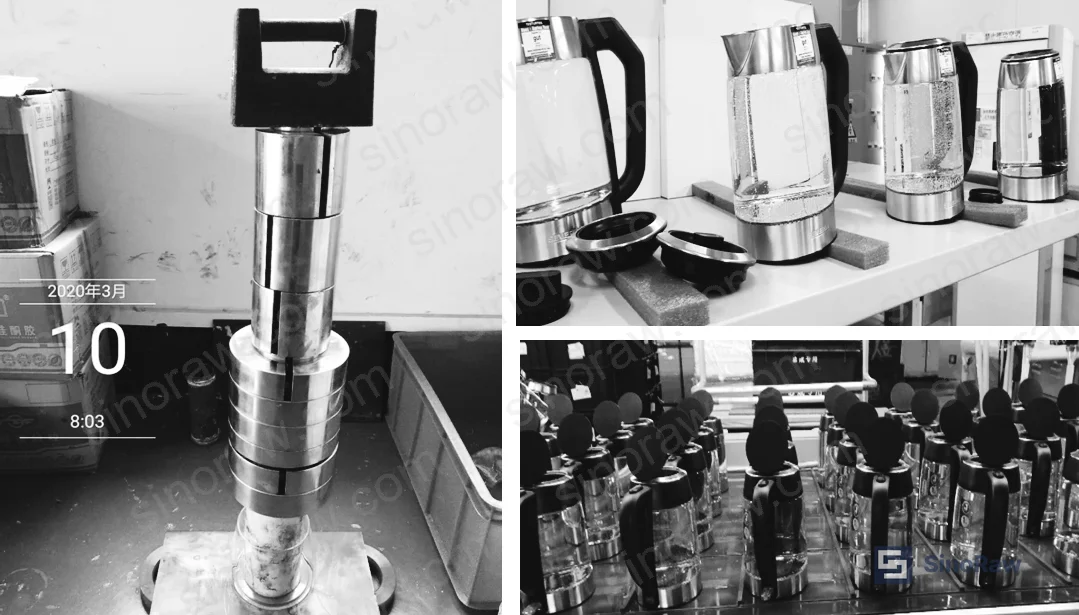
The validated load-bearing test for the electric kettle application is the most concrete performance benchmark in these trials: glass body to stainless steel heating plate assembly, fully cured, sustained load ≥490 N (equivalent to 50 kg) — with retained adhesion after 24h water boil. That’s a credible field-condition proof for a demanding thermal cycling and moisture exposure application.
For REACH compliance and RoHS considerations when importing these sealant products into the EU, verify that the organotin catalyst (chelated tin type U-303 class compounds) is specified within regulatory thresholds, as dibutyltin compounds face restriction under REACH Annex XVII.
Practical Guidance for Buyers #
When you’re qualifying a transparent RTV-1 sealant from a Chinese manufacturer, the formulation details are almost never disclosed in the product datasheet — but you can ask the right questions to surface the risk. First: is the base polymer end-capped with methoxy or ethoxy silane? Methoxy routes give better storage stability; if your supplier can’t answer this, treat it as a flag. Second: which grade of fumed silica is used, and is it hydrophobic? Hydrophilic silica in a transparent formulation is a transparency compromise that shows up in aesthetic rejections, not incoming tensile tests.
At sinoraw.com, our role is to help overseas procurement teams identify and technically evaluate Chinese manufacturers of industrial sealants and polymer materials before issuing RFQs — not just connect buyers to the cheapest quote. When we prequalify suppliers in this category, we require accelerated aging test data (minimum 85°C/7-day storage stability), substrate-specific adhesion data covering your actual assembly materials, and water-immersion adhesion retention data where the application involves any moisture or thermal cycling exposure.
Third: request Shore A hardness targets alongside tensile strength. A sealant optimized purely for tensile strength at the expense of elongation will crack under thermal cycling in electronic enclosures. The 3.5–5.0 parts crosslinker range discussed here gives you a reference point for what “balanced” looks like. If a supplier quotes only one mechanical property, ask for the full set.
Submit an RFQ or request supplier qualification support for RTV silicone sealants through our procurement team. For related industrial polymer and adhesive categories, see our specialty polymers sourcing resources.
Frequently Asked Questions #
Q1: What is the difference between de-alcohol (alkoxy) cure and acetoxy cure RTV silicone sealant, and which should I specify for electronics assembly?
De-alcohol (alkoxy) cure RTV releases methanol as the byproduct during crosslinking — this means no acetic acid odor and no corrosion risk to sensitive metals, copper traces, or electronic contacts. Acetoxy-cure types release acetic acid, which is corrosive to copper and certain metals and produces the characteristic vinegar smell. For electronics, electrical connectors, and any assembly with exposed metal conductors, alkoxy/de-alcohol cure is the correct specification. The tradeoff is that alkoxy systems are more sensitive to formulation quality — specifically base polymer end-capping and crosslinker stoichiometry — so supplier qualification matters more.
Q2: How do I interpret surface dry time versus full cure depth in a supplier datasheet?
Surface dry time (measured per GB/T 13477.5—2002) tells you when the exposed surface skins over — typically 10–20 minutes for well-formulated alkoxy RTV-1 under standard conditions (23°C, 50% RH). Full through-cure depth depends on moisture diffusion rate and sealant cross-section thickness; the benchmark figure used in formulation development is mm of cure per 24 hours. At 3.5 parts CXT-10 crosslinker loading, the peak measured rate was 2.8 mm/24h. For thick-section potting or wide-gap sealing, request cure depth data at your actual section thickness, not just surface dry time.
Q3: Why does my transparent RTV sealant turn milky or hazy on the shelf, even if it was clear when received?
Almost always a fumed silica compatibility issue. If the manufacturer used a hydrophilic grade of fumed silica — common because it’s cheaper and more widely available — the filler has poor long-term compatibility with the alkoxy-terminated polysiloxane matrix, and phase separation or increased light scattering develops over time. Specify hydrophobic fumed silica (surface-treated, BET ~200 m²/g grade) and ask suppliers to provide accelerated aging optical clarity data — minimum 85°C/7 days — before accepting a first shipment.
Q4: What adhesion test results should I require from suppliers for a glass-to-stainless-steel sealing application?
Require both initial adhesion classification (cohesive failure ≥80% per GB/T 16997 methodology) and post-water-boil adhesion data — 24 hours at 100°C minimum. Single-promoter formulations using only silane coupling agents like KH-550 showed mixed results in controlled testing; only the combined KH-550 + amino silane (SIVO 203 type) promoter system maintained cohesive failure after the 24h water boil. This should be a pass/fail criterion in your supplier qualification checklist for any hot-water or thermal cycling application.
Q5: Can I use the same RTV-1 sealant for both ABS plastic and metal substrates in one assembly?
Yes, but the adhesion promoter selection becomes more critical. Standard silane coupling agents (KH-550, KH-560) perform well on glass and metal but provide only marginal adhesion to ABS and PVC plastics. Amino silane types such as SIVO 203 significantly improve adhesion to engineering plastics while maintaining metal performance. For mixed-substrate assemblies, a combined promoter system is the practical solution — and you should require substrate-specific cohesive failure data for each material in your assembly, not just the metal interface.
Published by sinoraw.com Technical Team | Request a sourcing quote
Content reviewed by michael.fang | © sinoraw.com — All rights reserved. Unauthorized reproduction prohibited.


