

TL;DR #
If you’re evaluating alcohol-free (de-alcohol) RTV-1 silicone sealants for LED lighting assemblies, electronics enclosures, or PC substrate bonding, the specification sheet will not tell you the whole story. The number that actually determines whether a batch is usable after six months in a warehouse — or after a summer in a container ship — is the storage stability retention rate. And that number depends almost entirely on catalyst system design, not base polymer quality.
Unmodified titanate-catalyzed RTV-1 formulations have a well-documented failure mode: after six months or more in sealed packaging, tack-free time increases dramatically, internal cure slows, and mechanical strength drops to the point where the product is functionally unusable as a sealant. Most datasheets don’t flag this. Most buyers find out the hard way.
This article breaks down what drives storage degradation in de-alcohol RTV-1, how chelated titanate catalysts and hydroxyl scavengers address the root cause, and what retention data actually means when you’re qualifying a Chinese supplier.
De-Alcohol RTV-1 Storage Stability: Catalyst System Performance Data #
The degradation mechanism in de-alcohol RTV-1 is straightforward once you understand it: residual moisture and free methanol generated during storage react preferentially with the titanate catalyst, consuming its crosslinking activity before the sealant is ever applied. The result is progressive loss of cure capability — slow at first, then catastrophic.
The catalyst choice is the single largest lever. Here’s what the comparative data shows across four titanate catalyst configurations, all tested against an accelerated aging protocol of 70 °C for 5 days (equivalent to approximately 1 year at ambient storage conditions):
| Catalyst System | Tack-Free Time (Fresh) | Tack-Free Time (Post-Aging) | Tensile Strength Retention | Elongation Retention |
|---|---|---|---|---|
| TIPT (unmodified titanate) | 2 min | Did not cure | — | — |
| Ti-1 (single chelate, step 1) | 7 min | 42 min | 57% | 76% |
| Ti-2 (double chelate, steps 1+2) | 21 min | 33 min | 67% | 95% |
| Ti-3 (blended chelate, proprietary) | 10 min | 19 min | 76% | 103% |
The TIPT result should stop any procurement conversation cold. An unmodified short-chain titanate catalyst produces a sealant that looks perfectly fine when freshly compounded — tack-free in 2 minutes, good initial tensile at 2.51 MPa — and then completely fails to cure after accelerated aging. That’s not marginal degradation. That is a zero-retention failure.
Ti-3, the blended chelated system, hits the practical sweet spot: fresh tack-free time of 10 minutes (acceptable for most industrial assembly processes), post-aging tack-free time of 19 minutes, tensile strength retention of 76% at 1.71 MPa, and elongation retention exceeding 100% — meaning elongation at break actually improved slightly after aging, reaching 441% vs. 427% fresh.
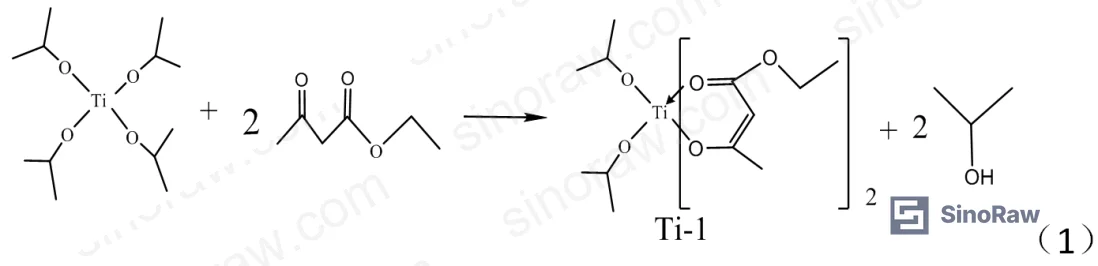
The chemistry behind this stability improvement is worth understanding at a procurement level. Titanate chelation with ethyl acetoacetate (ETFAA) forms a six-membered ring chelate complex. The double carbonyl structure of ETFAA coordinates with the central titanium atom, creating a stable cyclic configuration that significantly reduces the titanate’s reactivity toward ambient moisture and methanol. A subsequent transesterification reaction with 1,3-propanediol further stabilizes the structure by substituting the remaining isopropoxide groups.
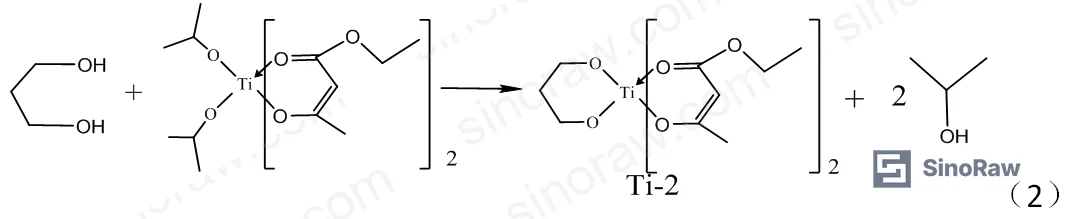
Five- and six-membered ring chelates are the most thermodynamically stable configurations. The more cyclic structures present in the chelate, the more resistant it is to hydrolysis during storage. This is established coordination chemistry — but its application to RTV-1 catalyst design is not universally adopted by Chinese manufacturers, which is exactly why storage stability varies so widely across suppliers quoting nominally identical products.
Hydroxyl Scavenger Selection and Dosage in Alcohol-Free RTV Silicone Formulations #
The chelated titanate system handles one half of the storage stability problem. The other half is moisture and free hydroxyl groups in the base compound itself. Even after thorough dehydration of the base polymer (α,ω-dihydroxy polydimethylsiloxane with a viscosity of 20,000 mPa·s, dewatered at 130 °C for 4 hours under vacuum), trace water and methanol accumulate during storage and attack the catalyst.
Hydroxyl scavengers — vinyltrimethoxysilane (A-171), silazane (A-62), or purpose-formulated scavengers (A-52) — chemically or physically consume these reactive species before they reach the catalyst. Three scavenger types were evaluated at equivalent loadings:
| Scavenger Type | Hardness Retention (Shore A) | Tensile Strength Retention | Elongation Retention |
|---|---|---|---|
| A-171 (vinyltrimethoxysilane) | 81% | 75% | 77% |
| A-62 (silazane) | 82% | 81% | 86% |
| A-52 (proprietary formulated) | 87% | 85% | 89% |
Fresh tensile values ranged from 2.13 to 2.27 MPa across scavenger types; post-aging values ranged from 1.64 MPa (A-171) to 1.91 MPa (A-52). All three outperformed the no-scavenger baseline, but the formulated A-52 shows consistently better across-the-board retention — particularly on elongation, where it holds 89% vs. 77% for the silane-only option.
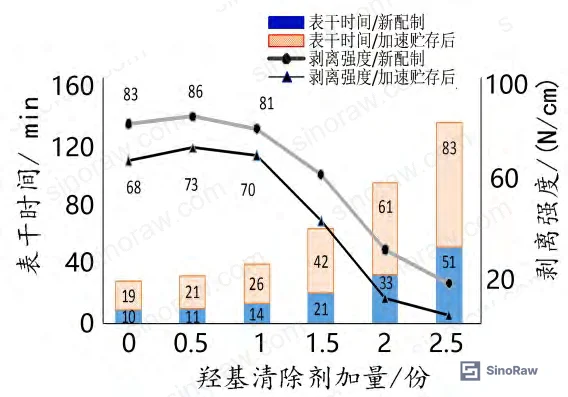
Critically, more is not better. The dosage curve for hydroxyl scavenger shows a non-intuitive result: at loadings above 1.0 part per hundred, the scavenger begins to accelerate property decay rather than suppress it. Excess scavenger appears to compete with the crosslinking reaction itself, extending tack-free time (which increases from acceptable to problematic at high loadings) and reducing peel strength retention.
The validated dosage window is 0.5 to 1.0 parts per hundred resin. Below 0.5 parts, protection is insufficient. Above 1.0 parts, you are actively degrading the product.
Honestly, this dosage sensitivity is one of the most commonly ignored variables when buyers request formulation transparency from Chinese RTV suppliers. Most qualification questionnaires ask about base polymer viscosity and filler type. Almost none ask about scavenger type and loading. That gap in qualification practice is where shelf-life complaints originate.
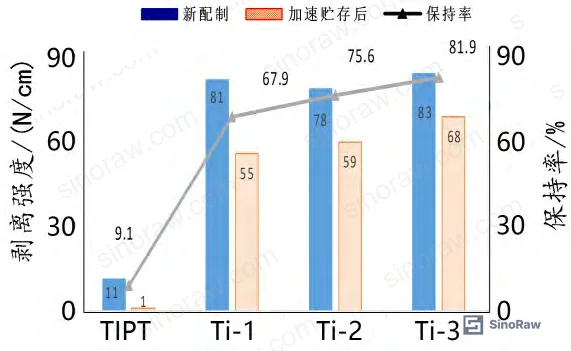
The peel strength data on PC substrate (1 mm thick, tested per GB/T 13477.18) tells the adhesion story clearly: the blended chelate system (Ti-3) with optimized scavenger loading achieves post-aging peel strength of 70 N/cm or higher on PC, with a retention rate reaching 81.9%. For LED housing assembly where PC is the dominant substrate, that threshold is meaningful.
Accelerated Aging Protocol and Mechanical Property Validation #
The test methodology used here follows a 70 °C / 5-day accelerated storage protocol, which is accepted as equivalent to approximately 12 months of ambient storage. All mechanical property testing was conducted against Chinese national standards: tensile strength and elongation per GB/T 528, Shore A hardness per GB/T 531.1, peel strength per GB/T 13477.18, and tack-free time per GB/T 13477.5 Method B.
In our supplier qualification work, we saw three of six samples from different Chinese RTV-1 suppliers fail to meet even the 70% retention threshold on tensile strength after accelerated aging — despite all six products being marketed with equivalent fresh-state specifications. One sample from a mid-tier supplier showed Shore A hardness drop from 41 to below 15 after the 70 °C aging cycle, with peel strength falling below 30 N/cm. These were products with datasheets showing nearly identical fresh-state performance numbers. The differentiation only appeared in the aging data.
For the optimized Ti-3 + A-52 system, post-aging results hit the following validated thresholds:
- Tensile strength: ≥1.71 MPa post-aging (76% retention vs. 2.19 MPa fresh)
- Shore A hardness: ≥31 post-aging (83% retention vs. 39 fresh)
- Elongation at break: ≥400% post-aging (103% retention — no degradation)
- PC peel strength: ≥70 N/cm post-aging (81.9% retention)
- Tack-free time post-aging: 19 minutes (stable and process-compatible)
Most procurement teams don’t realize that the GB/T 13477 series for building and construction sealants — commonly cited by Chinese suppliers as their test basis — was progressively revised to align more closely with ISO 11600 classification requirements for elastic sealants. Suppliers quoting older test references may be reporting results against superseded pass/fail criteria. It’s worth confirming which revision of the standard was applied during incoming QC.
The base formulation used in this evaluation consisted of 100 parts α,ω-dihydroxy PDMS (20,000 mPa·s), 8 parts dimethyl silicone oil (100 mPa·s), 100 parts nano calcium carbonate, 8 parts methyltrimethoxysilane crosslinker, 0.5–1.0 parts hydroxyl scavenger, and 1–3 parts chelated titanate catalyst — representing a commercially practical formulation framework, not a laboratory curiosity.
Practical Guidance for Buyers #
If you’re sourcing de-alcohol RTV-1 sealants from China for LED assembly, electronics potting, or any PC-substrate sealing application, the single most important question to ask your supplier is: “What catalyst system do you use, and what accelerated aging data can you provide?” A supplier who can only give you fresh-state datasheet values has not done the shelf-life work.
At SinoRaw, our role as a Guangzhou-based B2B sourcing service is specifically to help overseas procurement teams get past the datasheet and into real qualification data — connecting you with verified Chinese manufacturers who have storage stability validation on file, not just claims. When we run supplier evaluations for industrial silicone sealants, we require accelerated aging data at 70 °C / 5 days minimum, with retention rates documented for tensile strength, Shore A hardness, elongation, and substrate peel strength.
For PC-bonding applications, set a minimum post-aging peel strength threshold of 70 N/cm and a tensile retention floor of 75%. For general electronics sealing, prioritize elongation retention — a post-aging elongation above 400% is achievable with a properly formulated chelated catalyst system. Verify the hydroxyl scavenger loading is within the 0.5–1.0 phr range; it is a short question that filters out a surprising number of marginal formulations. If you need help structuring an RFQ or want supplier qualification support, initiate a request through our silicone and RTV sealant sourcing channel or our broader industrial adhesives and bonding category.
Frequently Asked Questions #
Q: What is the difference between de-alcohol RTV-1 and acetic-cure (acetoxy) RTV silicone?
De-alcohol (alcohol-releasing) RTV-1 releases small-molecule alcohols — primarily methanol or ethanol — as the byproduct of moisture-cure crosslinking. Acetic-cure systems release acetic acid. The practical difference for procurement: de-alcohol types are non-corrosive to metal contacts, PC, and electronic components, making them the correct choice for LED assemblies and sensitive electronics. Acetic-cure sealants are cheaper to produce but will corrode copper traces and degrade polycarbonate over time. Many buyers underestimate how often this distinction is the root cause of field failures in LED lamp assemblies.
Q: How reliable is the 70 °C / 5-day accelerated aging test as a proxy for real shelf life?
It is widely used as an equivalency for approximately 12 months of ambient storage, and it is meaningful as a comparative tool within a supplier qualification process. What it does not capture is the effect of temperature cycling, humidity variation, or UV exposure during actual logistics and warehousing. For critical applications, request both accelerated aging data and real-time 6-month ambient storage data if the supplier has it. The accelerated test is a filter, not a guarantee.
Q: Why does excess hydroxyl scavenger reduce storage stability instead of improving it?
Above approximately 1.0 part per hundred, excess scavenger begins competing with the crosslinker for reactive sites in the PDMS network. This disrupts the cure stoichiometry, extending tack-free time and reducing crosslink density post-cure — which shows up as lower peel strength and hardness retention. The mechanism is essentially over-consumption of the reactive functional groups needed for proper network formation. The 0.5–1.0 phr window is validated; outside it, performance degrades in both directions.
Q: Can this catalyst formulation approach be applied to two-component (RTV-2) silicone systems?
No — the storage stability challenge described here is specific to single-component moisture-cure systems, where the catalyst must remain dormant in the sealed package until the product is applied and exposed to atmospheric moisture. RTV-2 systems keep resin and catalyst in separate components until point of use, so the catalyst-moisture interaction during storage is not the same concern. RTV-2 qualification focuses on mix ratio sensitivity, pot life, and cure depth instead.
Q: What substrate peel strength should I specify for PC-bonded LED housing applications?
Based on field evaluation data, a minimum post-aging peel strength of 70 N/cm on 1 mm PC substrate is a reasonable procurement threshold for assembly applications requiring reliable long-term adhesion. Fresh-state peel strength will be higher — the retention figure is what matters. Specify both: fresh-state ≥85 N/cm and post-aging (70 °C / 5 days) ≥70 N/cm, tested per GB/T 13477.18.
Published by sinoraw.com Technical Team | Request a sourcing quote
Content reviewed by michael.fang | © sinoraw.com — All rights reserved. Unauthorized reproduction prohibited.


