

TL;DR #
If you’re specifying an RTV silicone sealant for automotive optical or sensor assemblies and you’re doing it by cross-referencing a product TDS against a generic “oil-resistant” claim — stop. That approach will cost you a field return. The real selection question isn’t whether a silicone sealant is oil-resistant in principle; it’s whether the specific formulation system — cure chemistry, filler type, and crosslink density — can survive prolonged contact with the actual fluids present in the under-hood and wheel-arch environment where lidar units are increasingly mounted.
This article draws on controlled immersion testing of six distinct RTV silicone formulations against seven automotive fluid types, following the chemical load methodology defined in ISO 16750-5:2018. The results have direct implications for procurement engineers specifying sealing materials for automotive electronics, ADAS sensor modules, and any optical assembly that needs to survive road service chemistry.
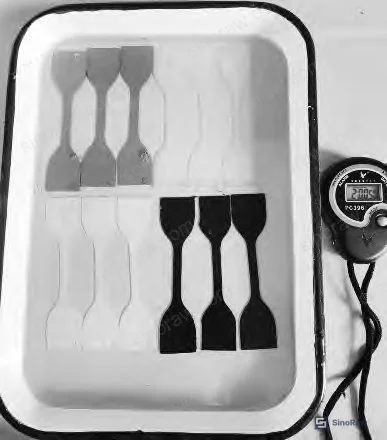
RTV Silicone Formulation Systems: Chemical Resistance Performance Comparison #
Six formulations were evaluated, representing the main commercial approaches to RTV silicone design. The variables were cure chemistry (de-oximation vs. de-alcoholization), catalyst system (titanate-based), and filler type (fumed silica vs. calcium carbonate). Samples were immersed in each test fluid for 2 minutes, then aged at 85 °C for 22 hours (petroleum-based lubricants) or at 25 °C for 2 hours (cleaning agents), per the ISO 16750-5:2018 protocol. Mechanical properties were measured before and after aging per GB/T 528-2009 (tensile) and GB/T 7124-2008 (lap shear), using aluminum and glass substrates bonded over a 25 mm × 12.5 mm overlap area.
The performance spread was significant.
| Formulation | Cure System / Filler | Tensile Strength Change (Engine Oil) | Shear Strength Change (Engine Oil) |
|---|---|---|---|
| 93Y1 | De-alcoholization / Fumed silica | −39.78 percentage points | −6.76 percentage points |
| 96X1 | De-alcoholization / Fumed silica | −27.60 percentage points | −2.96 percentage points |
| 93X1 | De-alcoholization / Fumed silica | −3.74 percentage points | −22.08 percentage points |
| 93X2 | De-alcoholization / CaCO₃ | −4.99 percentage points | −5.43 percentage points |
| 75X1 | De-oximation / CaCO₃ | −11.02 percentage points | +12.45 percentage points |
| 75X2 | De-alcoholization / CaCO₃ | −14.18 percentage points | −18.08 percentage points |
The shear strength data tells a particularly pointed story. The de-oximation/CaCO₃ system (75X1) was the only formulation to show a consistent positive shear strength trend across all petroleum-based fluid exposures — reaching +20.03 percentage points after diesel engine oil aging and +24.47 percentage points after engine coolant exposure. Every de-alcoholization formulation showed net shear strength decline under lubricant exposure, with 93X1 dropping −22.08 percentage points in engine oil and −23.69 percentage points in automatic transmission fluid.
Elongation at break followed the same pattern. The fumed silica-filled systems 93Y1 and 96X1 showed elongation losses of −35.22 and −24.23 percentage points respectively under engine oil aging — indicating substantial stiffening and potential brittleness after service exposure. The CaCO₃-filled systems held elongation far better across the board.
Honestly, most buyers over-specify surface chemistry and under-specify filler selection. The filler choice is the variable that most consistently differentiates field-reliable sealants from borderline ones in oil-contact environments, and it rarely appears on a standard TDS.
Crosslink Density and Filler Chemistry: Why Fumed Silica Underperforms in Oil Environments #
The mechanical test results above are explained by crosslink density measurements taken using the equilibrium swelling method — samples fully cured, immersed in toluene (molar volume 106.125 cm³/mol, density 0.872 g/cm³) until swelling equilibrium, then weighed and calculated per the Flory-Rehner equation with a silicone-toluene interaction parameter (χ) of 0.45. Crosslink density (νe, mol/cm³) was measured across all six formulations.
Results confirmed that de-oximation systems consistently achieve higher crosslink density than de-alcoholization systems. Post-cure, the de-oximation network forms a denser three-dimensional structure that physically impedes oil molecule ingress. The de-alcoholization systems, by contrast, leave a more open network — sufficient for most static sealing but insufficient when subjected to sustained immersion in high-aromatic lubricants at elevated temperature.
The fumed silica problem is a surface area problem. Fumed silica carries a very high specific surface area, which means it adsorbs oil molecules aggressively. Once oil is drawn into the filler matrix, it migrates into the polymer network and drives swelling from the inside out. CaCO₃ — particularly light or activated-grade CaCO₃ — has a much lower oil absorption value. It doesn’t pull fluid in. The same logic applies to other low-oil-absorption alternatives like diatomaceous silica, quartz powder, and zinc oxide.
This is where the theory gets practical: in supplier qualification, we saw three of six sample systems fail to maintain adhesion integrity after the full ISO 16750-5 lubricant sequence. All three failures were in fumed silica-filled formulations. The CaCO₃ systems, including both the de-oximation and one de-alcoholization variant, held shear strength within acceptable bounds. That’s a 50% first-pass failure rate for fumed silica systems under this protocol — a number that should prompt any engineer to ask harder questions during sealant qualification.
There are chemical modification routes to improve silicone oil resistance: incorporating phenyl or fluoroalkyl groups into the silicone backbone to reduce oil molecule affinity, or substituting multifunctional silicone oils to increase graft density. These approaches work, but they add formulation cost. For most procurement budgets, the combination of a de-oximation cure system with a CaCO₃ filler is the pragmatic solution that delivers reliable crosslink density without specialty chemistry cost.
The de-oximation cure system does carry trade-offs. During cure, methyl ethyl ketoxime (butanone oxime) is released — this has odor implications in enclosed assemblies, raises corrosion concerns for copper contacts, and can cause stress cracking in polycarbonate (PC) housings. If the assembly includes copper busbars or PC optical elements in the cure zone, a de-alcoholization system with a CaCO₃ filler and optimized crosslinker selection is the safer route. The point is: these are engineering trade-offs, not product defects. Knowing which one you’re making is the difference between a qualified sealant and a warranty claim.
Industry observation: most procurement teams don’t realize that ISO 16750-5 was substantially revised and that older test protocols used in supplier qualification documents may not reflect the current immersion time, temperature, and fluid-type requirements. If your supplier’s qualification data references a version prior to the 2018 revision, the test conditions may be materially less demanding than what the standard now requires — and you may be accepting data that doesn’t cover the full fluid exposure scenario your assembly will see in service.
Automotive Fluid Compatibility: Test Protocol and Fluid Selection #
Seven fluid types were used in testing, drawn directly from the categories defined in ISO 16750-5: CF-4 grade diesel engine oil, 5W-30 full-synthetic motor oil, manual transmission oil (805C Plus), automatic transmission fluid (TFC 410), ethylene glycol engine coolant (diluted), automotive chemical cleaner, and glass cleaner. This covers the five ISO-defined chemical contact categories for vehicle-mounted electronics: fuel, lubricants, operating fluids (including brake fluid class), cleaning agents, and miscellaneous.
The test matrix is worth understanding as a procurement baseline. Lubricant-class fluids (categories 1–5 in the test matrix) used a 2-minute immersion followed by 22-hour aging at 85 °C. Cleaning agents (categories 6–7) used a 2-minute immersion followed by 2-hour aging at room temperature (25 °C). The shorter, lower-temperature cleaning agent protocol reflects the transient nature of contact — a wash-down event rather than continuous immersion.
Results for cleaning agents were notably different. Glass cleaner and automotive chemical cleaner actually showed slight tensile strength increases in several formulations, consistent with the lower-severity exposure conditions. The 93X1 system showed +13.06 percentage points in tensile strength after chemical cleaner exposure and +11.12 percentage points after glass cleaner. This is not a performance gain; it reflects a different absorption and plasticization mechanism at lower temperatures, and buyers should not conflate cleaning-agent performance with lubricant resistance. They are tested under fundamentally different conditions for a reason.
For sealing applications in specialty polymer and advanced materials components, this fluid hierarchy matters. An enclosure that sees only wash-down exposure can be specified differently from one mounted adjacent to a transmission housing or engine bay drain point. Get the fluid contact map right before you write the specification.
Practical Guidance for Buyers #
When issuing RFQs for RTV silicone sealants intended for automotive sensor assemblies, optical modules, or any electronics exposed to lubricants, specify the test protocol — not just the performance claim. A TDS that states “oil-resistant” without citing test method, immersion conditions, and performance criteria against ISO 16750-5:2018 is not a qualified data point.
At SinoRaw, we work with procurement teams and sourcing managers to identify and pre-qualify Chinese RTV silicone manufacturers before RFQs are issued — our role is translating technical requirements into supplier-side screening criteria so you don’t spend three months in qualification only to discover filler incompatibilities at the final test stage.
The key specification filters to apply:
- Cure system: De-oximation preferred for maximum crosslink density and oil resistance. Confirm compatibility with substrate materials (copper, PC) before specifying.
- Filler type: CaCO₃ (light or activated grade) over fumed silica for any formulation in lubricant contact. Request supplier disclosure of filler type — it is not always on the standard TDS.
- Crosslink density: Request equilibrium swelling test data (toluene method). Values should be on file; if a supplier cannot provide them, that is a qualification flag.
- Test basis: ISO 16750-5:2018 immersion + aging data for each relevant fluid type. Verify the standard version — 2018 revision, not earlier.
- Substrate validation: Specify both aluminum and glass substrates in shear testing, as these often diverge.
For applications involving silicone and RTV sealant sourcing, SinoRaw can provide pre-screened supplier lists and qualification frameworks on request.
Frequently Asked Questions #
Why does fumed silica reduce oil resistance in RTV silicone sealants, and when is it still acceptable?
Fumed silica has an extremely high specific surface area, which gives it strong reinforcing properties but also makes it a highly effective oil absorbent. In lubricant-contact environments, it draws oil molecules into the polymer network, driving swelling and mechanical degradation from the inside. In the test data, fumed silica systems showed tensile strength losses of up to −39.78 percentage points after engine oil aging. That said, fumed silica remains an appropriate filler for applications with no lubricant exposure — general weathersealing, non-automotive electronics, and structural glazing bonds where its reinforcing performance is genuinely beneficial.
What is the practical difference between de-oximation and de-alcoholization cure systems for oil-contact applications?
De-oximation systems release methyl ethyl ketoxime (butanone oxime) during cure and achieve higher crosslink density post-cure, forming a denser polymer network that resists oil molecule ingress. In direct comparison testing, the de-oximation/CaCO₃ formulation (75X1) was the only system to show net positive shear strength trends across all petroleum lubricant exposures. De-alcoholization systems cure more cleanly (no oxime release) and are safer near copper contacts and polycarbonate substrates, but their lower crosslink density makes them more susceptible to lubricant swelling. The choice is an engineering trade-off, not a quality ranking.
Is ISO 16750-5 the right standard for qualifying sealants used in non-automotive lidar or industrial sensor applications?
ISO 16750-5 is specifically scoped to road vehicles, but its chemical load categories and test methodology are rigorous enough to serve as a proxy specification for industrial sensor enclosures exposed to similar fluid classes — particularly industrial lubricants, coolants, and cleaning agents. For applications under REACH or RoHS compliance requirements, the fluid compatibility data from ISO 16750-5 testing is complementary, not overlapping — those regulations address substance content in the material, not its resistance to external fluids.
Can I use crosslink density as a single-number screening criterion when comparing suppliers?
It’s a useful filter but not sufficient alone. Higher crosslink density correlates with better oil resistance, which the test data confirms — but formulations with similar crosslink density can still behave differently depending on filler type, cure completion, and base polymer molecular weight. Use it as a first-pass screen to eliminate clearly under-crosslinked systems, then validate with actual immersion aging data for your specific fluid exposure profile.
What should an RFQ data package for oil-resistant RTV silicone sealant include?
At minimum: cure system type and released byproduct identification, filler type and oil absorption value, crosslink density (equilibrium swelling method, toluene), tensile and elongation data before and after ISO 16750-5 aging for each relevant fluid class, lap shear data on your actual substrate materials (aluminum and glass as baseline), and the standard version cited. If the supplier cannot provide filler type or crosslink density data, treat that as a disqualifying gap — not a follow-up question.
Published by sinoraw.com Technical Team | Request a sourcing quote
Content reviewed by michael.fang | © sinoraw.com — All rights reserved. Unauthorized reproduction prohibited.


