

TL;DR #
If you’re sourcing RTV silicone sealant for fire-rated assemblies — curtain wall joints, EV battery enclosures, PV module perimeters — the flame retardancy question comes up early and usually gets answered wrong. Most procurement teams default to loading the formulation with aluminum hydroxide (ATH) and calling it done. That works well enough for UL94 HB. It does not reliably get you to FV-0, and when it does, the mechanical properties often suffer enough to create a different failure mode at installation.
This article breaks down a more effective approach: using surface-modified zinc borate in combination with ATH to achieve FV-0 vertical burn classification while simultaneously improving tensile strength, elongation, and substrate adhesion. The data here comes from controlled formulation trials using RTV silicone sealant based on α,ω-dihydroxy polydimethylsiloxane — the standard 107 silicone rubber base used widely across Chinese production.
Flame-Retardant RTV Silicone Sealant: ATH vs Modified Zinc Borate System Performance #
This is where buyers usually make the most expensive mistake. They spec high ATH loading — sometimes 40 phr or more — expecting linear improvement in flame resistance. What actually happens is that ATH alone at 40 phr achieves only FV-1 on the UL 94 vertical burn test, the mechanical properties degrade, and the product becomes difficult to extrude.
Honestly, most buyers over-specify single-component flame retardant systems without considering the synergistic options that Chinese formulators have been using for years. The ATH + modified zinc borate hybrid approach is better on every measured dimension when the balance is right.
Here’s the direct comparison from formulation trials. All three systems used a fixed 40 phr total flame retardant loading in a sealant based on 100 phr α,ω-dihydroxy PDMS (viscosity 20,000 mPa·s at 25°C), 60 phr active nano-calcium carbonate reinforcing filler, 10 phr crosslinker, 2 phr adhesion promoter, and 0.2 phr dibutyltin dilaurate catalyst:
| Performance Parameter | System 1# (40 phr ATH only) | System 2# (20 phr ATH + 20 phr unmodified ZnB) | System 3# (20 phr ATH + 20 phr modified ZnB) |
|---|---|---|---|
| Vertical burn rating (GB/T 2408) | FV-1 | FV-0 | FV-0 |
| Tensile strength (MPa) | 1.03 | 0.76 | 1.18 |
| Elongation at break (%) | 416 | 276 | 478 |
| Extrusion rate (mL/min) | 142 | 135 | 148 |
| Adhesion to aluminum/glass (MPa) | 1.38 | 1.40 | 1.52 |
| Shore A hardness | 40 | 41 | 40 |
| Appearance | Minor particles | Significant particles | Smooth, uniform |
The flame chemistry behind the FV-0 result in System 3# is worth understanding. At combustion temperatures, zinc borate decomposes to ZnO and B₂O₃. ATH simultaneously decomposes to Al₂O₃. The ZnO and Al₂O₃ undergo eutectic reaction to form ZnAl₂O₄ spinels. Independently, ZnO interacts with SiO₂ produced during silicone polymer thermal decomposition, with B₂O₃ acting as a flux to form a cohesive insulating layer on the sealant surface. That multi-layer char mechanism is why the hybrid system outperforms ATH alone at equivalent total loading.
What’s equally important: System 2# — which uses unmodified zinc borate — also reaches FV-0 on the burn test but produces the worst mechanical results of the three. Tensile strength drops to 0.76 MPa, elongation collapses to 276%, and the surface shows visible particulate agglomeration. That’s the dispersion problem in raw form.
Surface Modification of Zinc Borate: Why the Chemistry Determines Dispersion Quality #
Zinc borate particles are inherently hydrophilic. Raw zinc borate (particle size 2–3 μm) carries surface hydroxyl groups, exhibits strong intermolecular hydrogen bonding, and is fundamentally incompatible with the nonpolar PDMS matrix. The result is agglomeration — and agglomeration in a sealant formulation means stress concentration points, reduced elongation, and localized flame retardancy gaps.
The modification route used here synthesizes an aminopropyl octyl silicone resin from 3-aminopropyltriethoxysilane (KH550) and octyltrimethoxysilane in a 221:120 g ratio with 30 g deionized water, reacted at 90°C under reflux for 5 hours, followed by vacuum distillation at −0.098 MPa for 3 hours. Yield: 261 g at 76.5%.
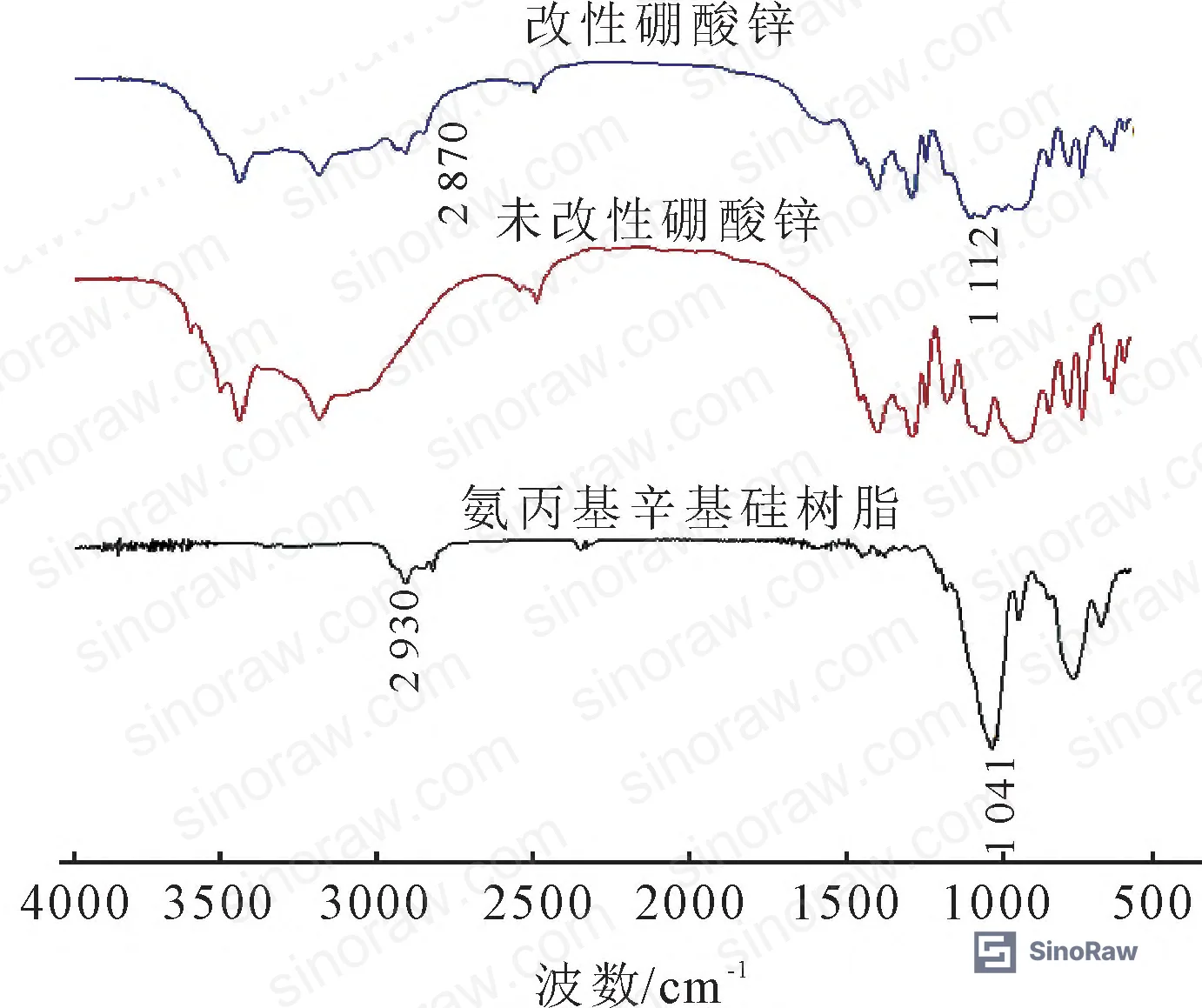
That resin is then applied to zinc borate powder at 65°C for 8 hours from a 1:100 resin-to-isopropanol solution. The surface reaction is confirmed by FTIR: new Si-O bond absorption at 1112 cm⁻¹ and alkyl chain vibrations at 2930 cm⁻¹ and 2870 cm⁻¹, both absent in unmodified zinc borate.
The optimization of resin loading is critical and the data is unambiguous:
| Resin Loading (wt%) | Activation Degree (%) | Oil Absorption (%) |
|---|---|---|
| 0 (unmodified) | 0 | 53.45 |
| 1% | 94.8 | 48.51 |
| 2% | 99.5 | 40.65 |
| 3% | 96.3 | 50.25 |
Tested per GB/T 19281—2003 for both activation degree and DOP oil absorption. At 2 wt% resin loading, activation degree peaks at 99.5% and oil absorption reaches its minimum at 40.65%. At 3%, the values worsen — excess resin forms multi-layer coatings that paradoxically reintroduce hydrophilic amine groups at the outer surface, degrading the hydrophobic character that makes the modification work.
This is not a case where more is better. The optimal loading window is narrow.
Most procurement teams don’t realize that zinc borate surface modification specifications are rarely standardized in supplier COAs — you’ll see particle size and purity listed, but activation degree and oil absorption are typically only tested when you specifically require it. Current industry practice for high-performance silicone formulations is converging on modified zinc borate as a standard input rather than a specialty item, but supplier qualification lags behind that shift.
The adhesion improvement in System 3# has a dual mechanism. The aminopropyl octyl silicone resin carries both amino groups and alkoxy groups. Some alkoxy groups react with zinc borate surface hydroxyls during modification. The remaining amino groups react with hydroxyl groups on the PDMS polymer chains. And residual alkoxy groups bond to substrate surface hydroxyls — aluminum, glass, ceramic — creating covalent bridges that account for the adhesion improvement to 1.52 MPa versus 1.38 MPa for ATH-only. For structural glazing and curtain wall applications where aluminum-to-glass peel strength is a qualification parameter, that difference matters.
Formulation Qualification: Test Methods and What to Actually Require from Suppliers #
In supplier qualification, we saw three of six samples fail when evaluating modified zinc borate from different sources — not on the flame test, but on mechanical properties. The appearance showed visible agglomeration, elongation at break fell below 300%, and in two cases, the adhesion on aluminum substrate was under 1.0 MPa. Every sample passed a basic purity specification. The failure was entirely in the surface modification quality, which no one had specified.
That’s the failure mode that costs time and money: you qualify a formulation with material from one source, production shifts to a different zinc borate supplier with equivalent purity but inferior surface treatment, and the end-product performance drifts outside spec before anyone realizes the root cause.
For flame-retardant RTV silicone sealants targeting UL 94 FV-0 or IEC 60695-11-10 equivalent, the minimum incoming material requirements for modified zinc borate should include:
- Activation degree ≥ 98% (per GB/T 19281 or equivalent)
- DOP oil absorption ≤ 42%
- Average particle size 2–3 μm
- Moisture content ≤ 0.5%
- FTIR confirmation of Si-O surface bond formation
For the finished sealant, the qualification test battery should include vertical burn testing per GB/T 2408 (equivalent to UL 94 protocol), tensile and elongation per GB/T 528, surface dry time per GB/T 13477.5, and extrusion rate per GB/T 13477.3.
The complete base formulation that achieves FV-0 at good mechanical balance is:
| Component | Loading (phr) | Function |
|---|---|---|
| α,ω-dihydroxy PDMS (107 silicone, 20,000 mPa·s) | 100 | Base polymer |
| Active nano-CaCO₃ (70±5 nm) | 60 | Reinforcing filler |
| ATH (purity ≥99.8%, 1–2 μm) + modified ZnB (2–3 μm) | 20 + 20 | Flame retardant system |
| Methyltributanoxime silane (crosslinker) | 10 | Moisture cure crosslinker |
| KH792 (adhesion promoter) | 2 | Substrate bonding |
| Dibutyltin dilaurate (catalyst) | 0.2 | Cure acceleration |
Processing: components are combined in a vacuum kneader at 160°C under negative pressure for 4 hours dehydration, cooled, then transferred to a high-speed disperser for vacuum premixing (10 min), crosslinker addition under vacuum (30 min), followed by adhesion promoter and catalyst under vacuum (15 min).
Practical Guidance for Buyers #
If you’re sourcing flame-retardant RTV silicone sealant for fire-rated sealing in construction, EV enclosures, or PV module assemblies, the single biggest lever on final performance is the quality of the zinc borate surface modification — not the brand of base polymer or even the ATH grade. Specify activation degree and oil absorption on your incoming material requirements before anything else.
At SinoRaw, we work with overseas procurement engineers and quality managers to identify and qualify Chinese sealant manufacturers before RFQs go out — covering formulation capability verification, test data review, and sample qualification against your application-specific requirements. Our sourcing process for silicone and RTV sealant suppliers focuses specifically on whether a manufacturer controls their own compounding process or assembles from traded inputs, which is the difference that determines consistency lot-to-lot.
For FV-0 rated applications, require third-party vertical burn test reports to GB/T 2408 or UL 94 — not just supplier self-test data. Validate tensile strength ≥ 1.1 MPa and elongation at break ≥ 450% as a paired specification. A product that passes the burn test at the expense of mechanical properties will fail in service.
Frequently Asked Questions #
Why does adding unmodified zinc borate alongside ATH achieve FV-0 but damage mechanical properties?
Unmodified zinc borate is highly polar with surface hydroxyl groups that cause strong particle-particle hydrogen bonding. At 20 phr loading, this creates agglomeration clusters within the PDMS matrix that are visible as surface particles and cause stress concentration under tension. The result is tensile strength of 0.76 MPa and elongation of only 276% — both significantly lower than the ATH-only system — despite achieving the same FV-0 flame classification. Flame retardancy and mechanical integrity are both necessary; unmodified zinc borate compromises the second to achieve the first.
What’s the minimum flame rating I should spec for EV battery enclosure sealants?
FV-0 is the appropriate baseline for EV battery enclosure applications. Some OEM qualification frameworks reference IEC 60695-11-10 or equivalent UL 94 V-0 testing. FV-1 is not acceptable for fire-barrier sealing in occupied vehicle contexts. Confirm that test reports reflect the actual cured sealant geometry, not a formulation casting that differs from dispensed bead dimensions.
Can I substitute a different silane coupling agent for the zinc borate surface modification?
The aminopropyl octyl silicone resin used here combines two functional silanes — KH550 (aminopropyltriethoxysilane) for polymer reactivity and adhesion, and octyltrimethoxysilane for hydrophobicity. Single-silane treatments with aminosilane alone will improve adhesion but won’t adequately reduce oil absorption or deliver the hydrophobic surface character needed for PDMS compatibility. Single octylsilane treatment improves dispersion but loses the amino-group adhesion contribution. The co-hydrolysis product at 2 wt% loading is the optimized solution.
What does “extrusion rate” tell me as a procurement parameter?
Extrusion rate (mL/min or g/min at a defined pressure and nozzle diameter) is a direct proxy for application processability. Too low, and the product is difficult to gun-apply in automated dispensing lines or cold environments. The System 3# formulation at 148 mL/min is the highest of the three tested systems, which matters for production throughput. Require this value on your COA along with the test conditions — pressure, nozzle size, temperature — since results are not comparable across different test configurations.
How do I verify that a supplier’s flame-retardant silicone sealant will maintain performance after thermal aging?
This is a gap in standard COA documentation. Request accelerated thermal aging data: sealant specimens conditioned at elevated temperature (typically 150–175°C) for defined durations, then retested for tensile strength, elongation, and vertical burn rating. Silicone sealants generally maintain performance better than organic alternatives at elevated temperatures, but flame retardant filler dispersion can shift after thermal cycling if the surface modification is inadequate. Any reputable manufacturer producing for EV or photovoltaic applications should have this data available.
Published by sinoraw.com Technical Team | Request a sourcing quote
Content reviewed by michael.fang | © sinoraw.com — All rights reserved. Unauthorized reproduction prohibited.


