

TL;DR #
NBR vulcanizate exposed to grease in the presence of air loses over 77% tensile strength and 86% elongation at break — degradation driven by oxygen-accelerated C=C double bond scission, not grease chemistry alone. This means standard immersion test results (which minimize air contact) will systematically overestimate seal performance in real bearing applications. Before qualifying any NBR oil seal supplier, require test data from open-vessel (air-contact) grease aging at 100 °C, not just closed-bottle results.
Overview #
Most procurement teams treating NBR oil seal qualification as a simple tensile-strength check are leaving a serious failure mode undetected. The critical variable — one that standard test protocols actively obscure — is whether the grease environment is aerated or oxygen-excluded during aging.
The data underpinning this article comes from accelerated aging trials conducted at an industrial polymer research facility, using NBR vulcanizate specimens immersed in lithium-soap grease at 100 °C for periods up to 28 days. The study combined NMR cross-link density measurement, DTG thermal analysis, and mechanical property tracking across both sealed-container and open-dish test configurations — giving a direct mechanistic picture of what actually happens inside a running bearing seal. The compound formulation used was a production-representative NBR recipe: 100 phr base polymer, 55 phr N234 carbon black, 30 phr N990, and a full antioxidant and accelerator package.
Baseline mechanical properties of the unaged vulcanizate: tensile strength 20.8 MPa, elongation at break 431%, Shore A hardness 70, 100% modulus 2.9 MPa, compression set (100 °C × 70 h) 10%, and low-temperature brittleness at −34 °C. Those are solid numbers for a well-compounded NBR seal compound. The question is how much of that performance survives real service conditions — and that answer depends almost entirely on grease acidity and oxygen access.
How Grease Chemistry Degrades NBR Seal Performance #
The degradation picture that emerges from comparative aging tests is more nuanced than the industry typically acknowledges. Grease aging alone, in an oxygen-excluded environment, produces relatively modest mechanical loss. Oxygen alone, in a hot-air oven, produces hardening and cross-link densification but not catastrophic strength loss at moderate temperatures. The failure event occurs specifically when NBR is simultaneously exposed to grease and atmospheric oxygen — conditions that describe virtually every bearing seal in service.
Tensile strength and elongation under hot-air aging
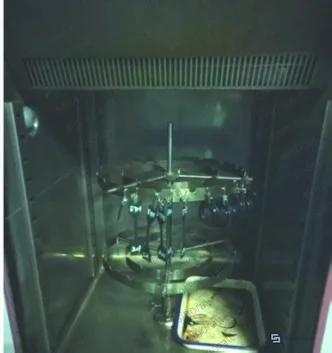
Under dry hot-air aging (no grease), tensile strength declined progressively: −5.1% at 100 °C × 336 h, −8.3% at 135 °C × 48 h, −14.9% at 135 °C × 72 h, −12.0% at 140 °C × 48 h, and −23.8% at 140 °C × 72 h. Elongation at break showed steeper losses: −27.3%, −42.7%, −53.7%, −45.1%, and −65.0% respectively across the same conditions. The mechanism here is progressive cross-link densification — excessive network nodes actually reduce the compound’s resistance to tensile loading.
Grease immersion: the air-contact variable
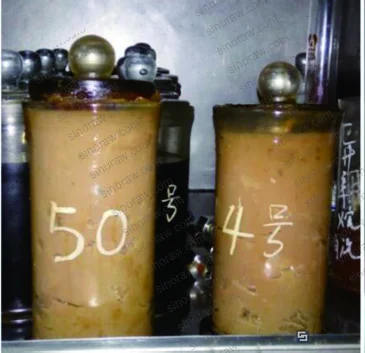
This is where the data gets important for procurement. Open-dish immersion (air contact, 100 °C × 14 days) produced a tensile strength drop of −62.8% and elongation loss of −77.4%, with visible surface cracking before fracture. The same compound immersed in a closed bottle (minimal air ingress) under identical time-temperature conditions showed only +1.5% tensile strength change and −24.9% elongation loss — no cracking, no anomaly.
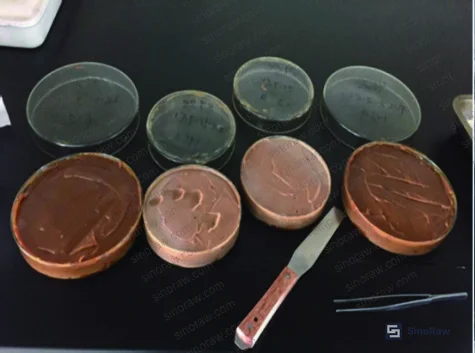
The DTG curves make the mechanism visible. Unaged NBR shows a single mass-loss rate peak at 454 °C. The air-contact grease-aged specimen develops a new peak at 432 °C — a lower-temperature decomposition event corresponding to oxidative scission of residual C=C double bonds in the polymer backbone. The oxygen-excluded specimen shows no such peak, confirming that the degradation pathway requires both grease (as a transport medium for oxygen) and free oxygen itself. Grease, in effect, concentrates oxygen at the rubber surface and accelerates bond scission that would otherwise occur more slowly in dry air.
Cross-link density confirmation
NMR cross-link density measurements confirm the molecular picture. At 21 days immersion (open-dish, air contact), the inter-crosslink molecular weight Mc dropped to 5.13 kg·mol⁻¹ — the lowest value recorded across all aging conditions — while cross-link density Dz reached 2.418 × 10⁻⁴ mol·cm⁻³, significantly higher than the 7-day value of 1.875 × 10⁻⁴ mol·cm⁻³. These are not the numbers of a compound that is simply swelling and plasticizing. Network scission and simultaneous re-cross-linking are occurring together, which is why the specimen both hardens (+5 Shore A) and catastrophically loses elongation (−86.1%) at the same time point.
| Aging Condition | Tensile Strength Change | Elongation Change | Shore A Change | Surface Condition |
|---|---|---|---|---|
| Hot air only (135 °C × 72 h) | −14.9% | −53.7% | +9 | No cracking |
| Grease, no air (100 °C × 14 d) | +1.5% | −24.9% | −3 | No cracking |
| Grease + air, open dish (100 °C × 14 d) | −62.8% | −77.4% | +5 | Cracked |
| Grease + air, 21 d immersion | −77.7% | −86.1% | +5 | Severely cracked |
Honestly, most buyers never see this failure mode because standard test protocols — including those derived from GB/T 1690 — use closed containers that minimize air exposure. The data from the sealed-bottle test will tell you the compound is fine. It isn’t.
Grease Acidity: The Overlooked Qualification Parameter for NBR Oil Seals #
Industry observation: most procurement engineers spec the grease-resistance of an NBR seal compound without ever asking for the acidity value of the lubricant it will contact. That oversight is increasingly consequential as high-performance lubricant formulations carry heavier additive packages — and more acidic degradation products.
The test grease used in the anomalous 21-day failure had an acidity of 2.3 mg(KOH)·g⁻¹. Standard neutral grease specification requires acidity below 1.0 mg(KOH)·g⁻¹. A side-by-side comparison using a low-acidity grease (0.2 mg(KOH)·g⁻¹) under identical open-dish aging (100 °C × 7 days) produced tensile strength loss of only −15.7% and elongation loss of −20.1% — no surface cracking. The high-acidity grease under the same conditions produced −58.2% and −55.2% respectively, with cracking.
The mechanism: acid in the grease accelerates attack on the C=C double bonds in the NBR backbone. Antioxidants in the compound bleed out into the grease phase during service, and once the antioxidant reservoir is depleted, the backbone is exposed. High-acidity grease depletes that reserve faster and directly catalyzes chain scission.
For buyers sourcing NBR oil seals for railway, automotive driveline, or industrial bearing applications — anywhere the seal contacts grease continuously — this means grease acidity needs to be part of your application data sheet. Suppliers who cannot tell you the acidity of their qualification test grease are not giving you meaningful aging data.
Compliance with REACH Regulation (EC) No 1907/2006 is also worth confirming for any plasticizer and antioxidant components in the NBR compound formulation, particularly for seals entering European supply chains. Additive selection directly affects oxidative stability, and REACH-compliant formulations may differ in antioxidant loadings. Separately, suppliers targeting quality-managed production environments should hold ISO 9001:2015 certification as a baseline — though certification alone says nothing about the specific compound performance discussed here.
For broader context on seal materials and compatible Pump & Valve Seals specifications, or for NBR compounds used in Sealing & Thermal applications, the qualification logic is the same: test method matters as much as the compound itself.
Practical Guidance for Buyers #
When you’re qualifying NBR oil seal suppliers, the most important question you can ask is: “Which test method did you use for grease aging data — open dish or closed bottle?” If the answer is closed bottle only, the data is not representative of service conditions. Require open-dish (surface dish) aging data at 100 °C per the actual operating conditions.
The second critical parameter is grease acidity. Ask for the acidity value — in mg(KOH)·g⁻¹ — of the qualification test grease. Anything above 1.0 mg(KOH)·g⁻¹ is outside neutral specification and may have artificially accelerated degradation in ways that mask true compound performance, or, conversely, if the buyer’s service grease is high-acidity, the supplier’s neutral-grease test data will be dangerously optimistic.
In supplier qualification, we have seen samples from otherwise certified suppliers fail open-dish aging within 14 days while passing closed-bottle tests to specification. Three of six NBR seal samples from a single supplier lot showed surface cracking under aerated grease conditions at 100 °C — all six passed the standard closed-container test. That gap is real, and it is a routine quality escape in this category.
At sinoraw.com, we work with procurement teams sourcing industrial sealing materials from Chinese manufacturers, helping buyers define the right test protocols and identify suppliers with the equipment and process control to run them. Sampling procedures should be structured per ISO 2859-1:1999 to ensure lot-representative qualification data.
Need help identifying qualified suppliers for NBR oil seals with validated open-dish grease aging data? Talk to our sourcing team →
Supplier Qualification Questions #
- What is the tensile strength retention rate of your NBR vulcanizate after open-dish (surface dish) immersion in grease at 100 °C for 14 days, and what is the acidity value [mg(KOH)·g⁻¹] of the qualification test grease?
- Can you provide NMR cross-link density data — specifically Mc (inter-crosslink molecular weight) and Dz (cross-link density) values — for your compound before and after grease aging, to confirm the absence of network scission?
- Does your standard test protocol distinguish between closed-bottle and open-dish grease aging conditions, and can you supply comparative mechanical data showing elongation at break change under both methods after 14 days at 100 °C?
- What is the baseline compression set value of your NBR vulcanizate at 100 °C × 70 h, and does it remain below 20% after accelerated grease aging?
- At what temperature does your compound show a secondary DTG decomposition peak — specifically, does a peak appear below 440 °C in specimens aged in aerated grease, indicating oxidative chain scission?
Sourcing Checklist #
- ☐ Open-dish grease aging data provided at 100 °C × 14 days showing tensile strength retention ≥ −25% (per customer spec threshold)
- ☐ Qualification test grease acidity confirmed ≤ 1.0 mg(KOH)·g⁻¹ (neutral grease specification)
- ☐ No surface cracking observed in open-dish specimens after 100 °C × 14 days grease aging
- ☐ NMR cross-link density Dz confirmed below 2.0 × 10⁻⁴ mol·cm⁻³ after standard grease aging (values above this indicate abnormal network scission)
- ☐ Elongation at break change rate confirmed within −50% after closed-bottle grease aging (100 °C × 14 days)
- ☐ Baseline tensile strength ≥ 20 MPa and elongation at break ≥ 400% on unaged compound, verified against batch release certificate
- ☐ REACH compliance documentation provided for plasticizer and antioxidant additives in the compound formulation
- ☐ ISO 9001:2015 quality management certification confirmed, with in-scope processes covering compound mixing and vulcanization
Key Specifications Table #
| Parameter | Recommended Value | Verification Method |
|---|---|---|
| Tensile strength (unaged) | ≥ 20 MPa | Electronic tensile testing per GB/T 528 |
| Elongation at break change (grease aging, closed bottle, 100 °C × 14 d) | ≤ −50% | Immersion per GB/T 1690, closed container |
| Tensile strength change (open-dish grease aging, 100 °C × 14 d) | ≤ −25% | Immersion in surface dish, aerated condition |
| Grease acidity of qualification test fluid | ≤ 1.0 mg(KOH)·g⁻¹ | Acid value titration per lubricant standard |
| Shore A hardness change after aging | 0 to +15 degrees | Shore A durometer per GB/T 531 |
| Cross-link density Dz (post-aging) | ≤ 2.0 × 10⁻⁴ mol·cm⁻³ | NMR cross-link density analyzer |
| Compression set (100 °C × 70 h) | ≤ 15% | Compression set test per GB/T 7759 |
| Volume change in grease immersion (100 °C × 28 d) | +5% to +12% | Dimensional measurement pre/post immersion |
Can’t find a supplier meeting these specs? Submit your requirements and we’ll match you within 48 hours.
References #
Data source: Oxidative Degradation Mechanisms of Nitrile-Butadiene Rubber Vulcanizates Under Combined Grease and Thermal Aging Conditions, C. Zhao et al., Polymer Degradation and Stability, 2024
Frequently Asked Questions #
What is the most critical failure mode for NBR oil seals in grease-lubricated bearing applications?
The most critical and frequently missed failure mode is oxidative chain scission — specifically, the simultaneous exposure of NBR to both grease and atmospheric oxygen. This combination accelerates attack on the C=C double bonds in the NBR backbone far more aggressively than either grease or heat alone. A compound that passes standard closed-container aging tests can still fail catastrophically in open-air service, showing surface cracking and >77% tensile strength loss.
Why do closed-bottle test results not represent real oil seal service conditions?
Standard immersion protocols (including GB/T 1690) use a test liquid volume at least 15× the specimen volume in a closed container, minimizing air contact. In actual service, bearing seals operate in environments where grease is exposed to air — the surface dish configuration in the referenced studies directly replicates this. The mechanical performance difference between the two configurations is not minor: open-dish aging produced 62.8% tensile strength loss vs. 1.5% gain for closed-bottle under identical time-temperature conditions.
How does grease acidity affect NBR seal longevity?
Grease acidity directly catalyzes backbone double-bond scission in NBR. Test data comparing greases at 0.2 mg(KOH)·g⁻¹ and 2.3 mg(KOH)·g⁻¹ under identical open-dish aging (100 °C × 7 days) showed tensile strength loss of −15.7% vs. −58.2% respectively. Standard neutral grease specification requires acidity below 1.0 mg(KOH)·g⁻¹. When qualifying a seal compound, always confirm that the test grease acidity matches — or conservatively exceeds — the acidity of the service lubricant.
Can NMR cross-link density testing predict seal failure before it becomes visible?
Yes, and this is an underused tool. NMR cross-link density measurement gives you Mc (inter-crosslink molecular weight) and Dz directly. The anomalous failure point in the test data — 21-day open-dish aging — showed Mc dropping to 5.13 kg·mol⁻¹ and Dz rising to 2.418 × 10⁻⁴ mol·cm⁻³, vs. the unaged baseline of 6.61 kg·mol⁻¹ and 1.875 × 10⁻⁴ mol·cm⁻³. These values shifted before the surface cracking became obvious, making NMR a useful early-warning method in incoming inspection or shelf-life evaluation.
What NBR compound baseline properties should buyers use as a qualification floor?
Based on the test compound — a well-proven production formulation — minimum acceptable unaged values are: tensile strength ≥ 20.8 MPa, elongation at break ≥ 431%, Shore A hardness 70 ±5, compression set ≤ 10% at 100 °C × 70 h, and low-temperature brittleness ≤ −34 °C. These represent a realistic achievable baseline for properly compounded NBR with N234/N990 carbon black reinforcement, not a stretch target. Suppliers quoting significantly lower tensile or elongation values on unaged compound should be asked to explain their formulation choices.
Published by sinoraw.com Technical Team | Request a sourcing quote


