

TL;DR #
Manual cutting of extruded snap-fit insulating sleeves yields only 270 units per 8-hour shift, with inconsistent cut lengths and uneven end faces — problems that compound across large electrical infrastructure orders. Buyers sourcing snap-fit insulating sleeves from Chinese manufacturers should specifically ask whether production uses encoder-driven PLC auto-cutting, as this directly determines dimensional consistency and batch-to-batch repeatability. Qualify suppliers on their automated cutting throughput, length tolerance, and batch counting accuracy before issuing a volume RFQ.
Overview #
Snap-fit insulating sleeves for high-voltage overhead conductors look simple enough on a datasheet, but the gap between a competent manufacturer and a marginal one shows up most clearly in how the product is cut and finished — not in the polymer formulation itself. Engineering evaluations conducted at a specialized rubber and polymer products facility, drawing on production line instrumentation data and PLC-logged output metrics across a complete shift cycle, provide a clear picture of what separates automated from manual production processes.
The sleeves in question are used to add insulation to live overhead bare conductors in power distribution systems. Installation involves opening the snap-fit latch, wrapping the sleeve around the conductor, and closing the latch — a method that demands dimensional precision: if the cut length varies, latch alignment suffers in the field. This is precisely where the manufacturing process becomes a procurement issue.
Manual production — still used by a non-trivial share of Chinese suppliers — relies on an operator measuring length by eye and cutting with shears. Automated production uses a rotary encoder mounted to the haul-off machine’s pressure roller, feeding pulse data to a PLC that triggers pneumatic clamping, a 370 W three-phase cutting motor, and a product ejection cylinder in a closed-loop sequence. The difference in output quality and throughput is not marginal.
For buyers navigating this supplier landscape, understanding these process differences is essential. At sinoraw.com, our sourcing team works directly with procurement engineers to identify and pre-qualify Chinese manufacturers of polymer insulation components — helping buyers ask the right process questions before samples are requested.
Compliance-conscious buyers should also note that insulating sleeves used in electrical infrastructure applications may fall under REACH Regulation (EC) No 1907/2006 — Registration of Chemicals requirements depending on the polymer compounding additives used in the rubber matrix.
Dimensional Consistency and Throughput: Manual vs. Automated Cutting #
This is where the data is unambiguous and where buyers regularly underestimate the cost of specifying the wrong supplier.
Under manual production conditions, a single 2-meter insulating sleeve takes approximately 1 minute 45 seconds to produce. That gives you 34 units per hour, and roughly 270 units per 8-hour shift. Counting is done manually, typically with 20 units packed per carton — which means any miscounting compounds into packing errors downstream.
| Parameter | Manual Cutting Process | Automated PLC Cutting Process |
|---|---|---|
| Cycle time per 2 m unit | ~1 min 45 sec | Encoder-triggered, continuous |
| Units per 8-hour shift | ~270 | Significantly higher (continuous cycle) |
| Length measurement | Operator visual comparison | Encoder pulse count via PLC register |
| Cut end quality | Variable, scissor shear finish | Circular blade motor cut, consistent face |
| Counting method | Manual tally | PLC counter (C0 register), alarm on batch complete |
| Operator intervention required | Constant | Only at batch alarm signal |
The automated system uses an ABZ-type rotary encoder connected to the haul-off roller axle. The A and B channels feed into PLC inputs X0 and X1 respectively — Z channel unused. The PLC calculates accumulated length from pulse count and compares it against the set value stored in register D148. When the measured length (D128) reaches or exceeds D148, the cut sequence initiates automatically.
Honestly, most buyers over-specify the polymer compound and under-specify the cutting process. A sleeve cut 5 mm short across 10,000 units is a field installation problem waiting to happen — and it’s entirely a manufacturing process issue, not a materials issue.
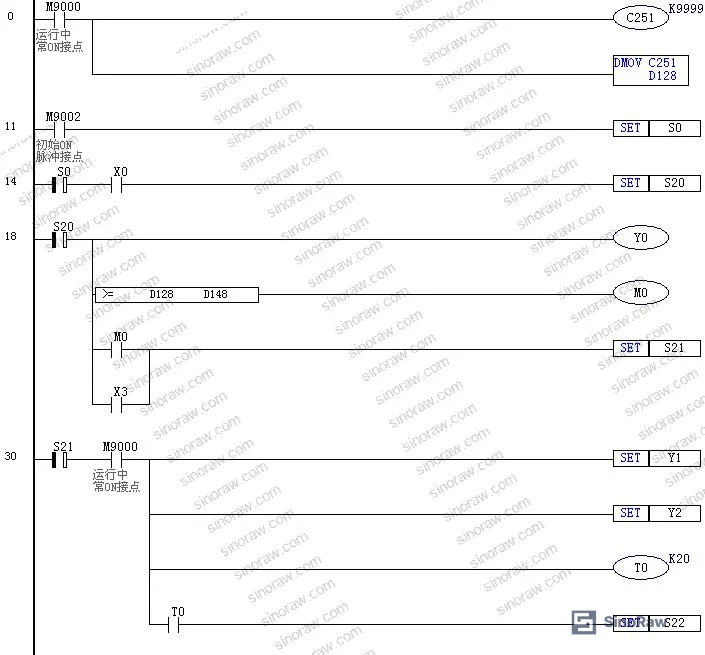
Automated Cutting System Architecture: What Qualified Suppliers Should Be Running #
The full automated cutting system integrates five functional sub-systems. Buyers auditing supplier facilities should be able to verify each one.
The pneumatic system includes three cylinders: a clamping cylinder (Y1) that immobilizes the sleeve during the cut, a push-pull cylinder (Y3) that drives the circular blade motor laterally across the sleeve cross-section, and a product ejection cylinder (Y5) that pushes finished pieces off the cutting table into a turnover bin. The cutting motor is a 370 W three-phase two-pole motor. Startup delay timer T0 is built into the PLC sequence to ensure the blade reaches full rotational speed before the lateral push cylinder activates — a detail that directly affects cut face quality.
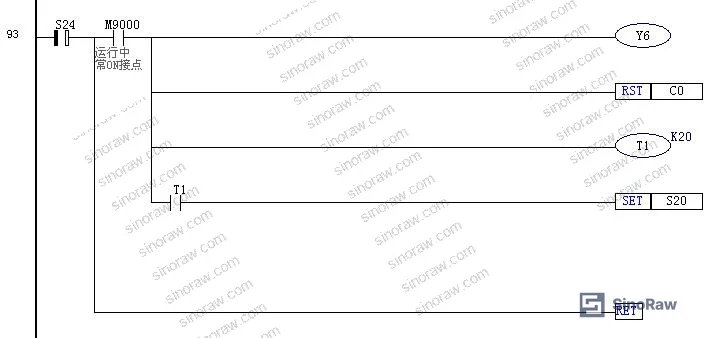
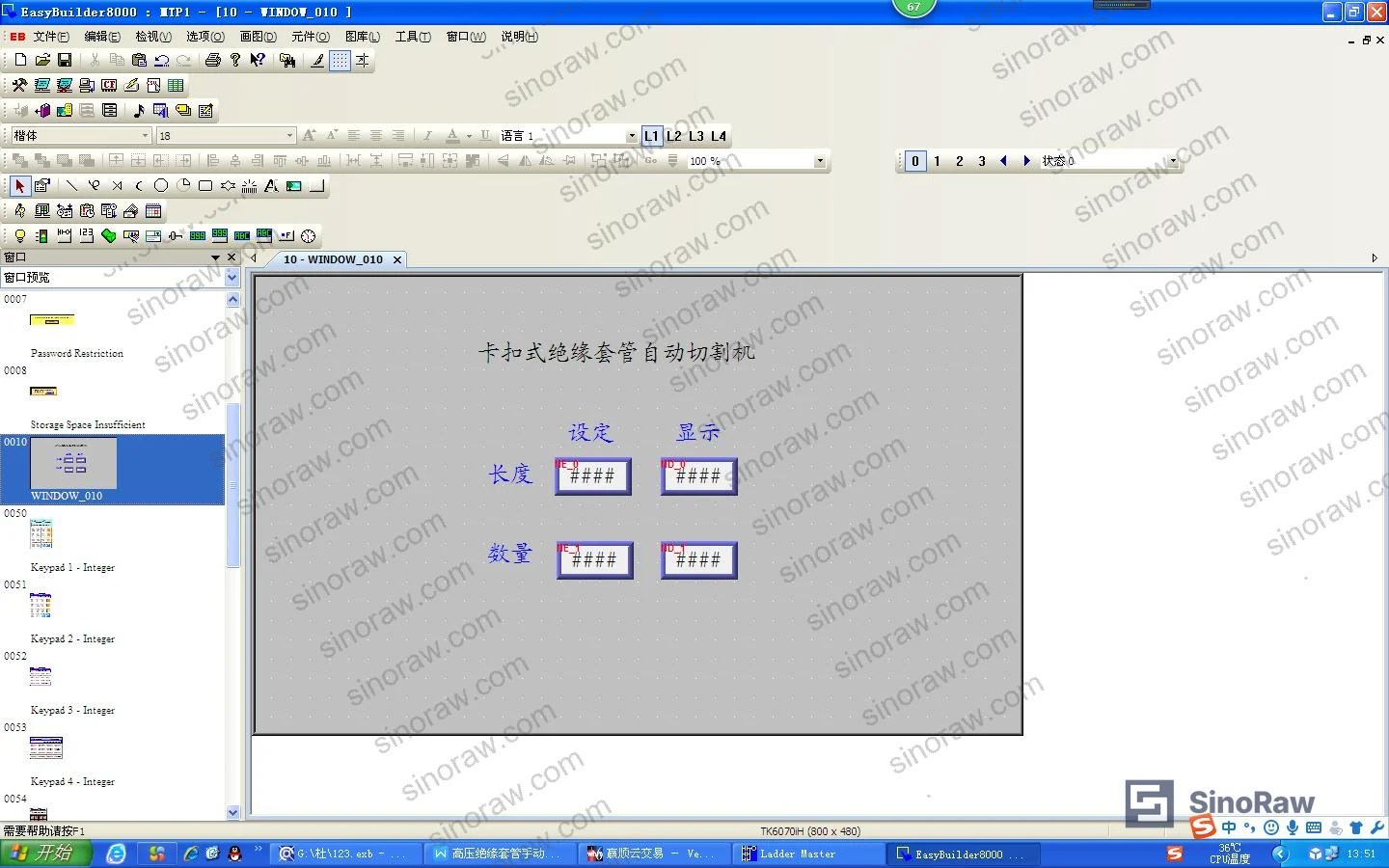
The control architecture uses a PLC (the reference design specifies a unit with programming logic equivalent to Mitsubishi ladder notation), a touchscreen HMI for setting length (D148) and batch quantity (D132), and the encoder for real-time measurement. When the batch counter C0 reaches the value stored in D132, output Y6 triggers an audible alarm — the operator’s only required interaction is then to collect and pack the completed batch.
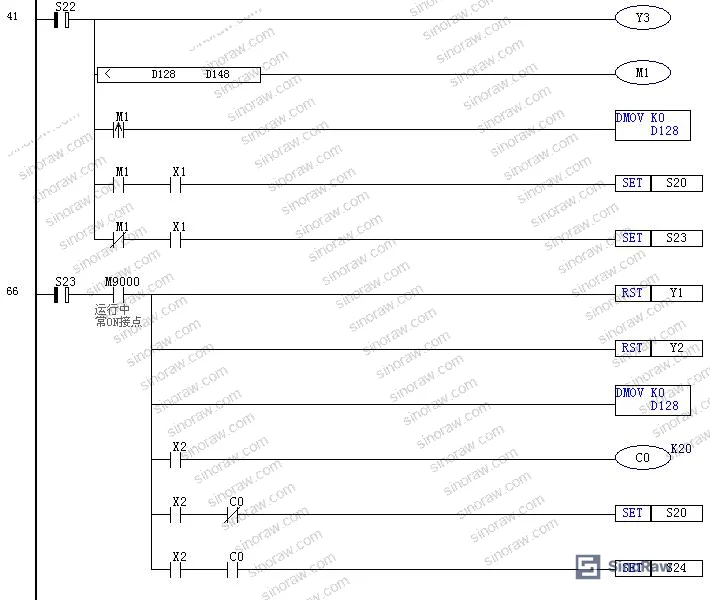
A critical sequence detail: at startup each shift, the first cut is performed manually (using switch X6) to remove the leading off-cut of extruded material. The PLC logic recognizes this — during manual trim mode, the product ejection cylinder and batch counter are suppressed (Y5 has no output, C0 does not increment) until the first full-length piece is confirmed. This prevents off-spec trim pieces from entering the counted batch. In supplier qualification, we’ve seen production lines where this startup logic was absent or bypassed — resulting in trim pieces mixed into counted cartons, which then fail incoming inspection at the buyer’s facility.
Most procurement teams don’t realize that the difference between a supplier running automated cutting and one claiming to run it is often visible in the HMI setup screen — a touchscreen display showing live length measurement (D128), set length (D148), set batch count (D132), and running count (C0 display) simultaneously. If a supplier cannot demonstrate this live during a facility audit or video walkthrough, treat that as a red flag.
Polymer Material Qualification for Extruded Insulating Sleeves #
The cutting system performance only matters if the base material is correctly specified. Snap-fit insulating sleeves for overhead high-voltage conductors are produced by continuous extrusion — typically from rubber compounds or thermoplastic elastomers formulated for outdoor UV resistance, tracking resistance, and mechanical flexibility at the snap-fit latch zone.
For buyers sourcing to electrical infrastructure standards, the material qualification questions are distinct from the process questions. The extrusion line parameters — haul-off speed, cooling bath length, draw ratio — directly affect wall thickness uniformity, which in turn affects dielectric performance. Suppliers running encoder-controlled haul-off with variable frequency drives (VFDs) on the drive motor have measurable advantages in wall thickness consistency over fixed-speed lines.
Buyers specifying these products for live-line installation work should require suppliers to demonstrate compliance with relevant electrical safety standards and verify that compound additives — plasticizers, stabilizers, flame retardants — do not include restricted substances. The RoHS Directive 2011/65/EU Restriction of Hazardous Substances is directly relevant where these products are used in electrical equipment assemblies destined for EU markets.
For incoming inspection sampling protocols on dimensional attributes, ISO 2859-1:1999 Sampling procedures for inspection by attributes provides the correct statistical framework — particularly useful when accepting large carton quantities where 100% length measurement is impractical.
Buyers sourcing related extruded polymer insulation products should also review the Specialty Polymers and Rubber & Plastic Additives categories for compound-level supplier qualification data.
Practical Guidance for Buyers #
If you’re sourcing snap-fit insulating sleeves for power distribution maintenance or overhead line insulation projects, the most important qualification step is verifying the supplier’s cutting process — not just their material certificate.
Ask directly: does the production line use encoder-based length measurement with PLC-controlled automatic cutting? Request a video of the HMI screen during active production showing D128 (real-time length) updating and the batch alarm triggering at the set count. If the supplier cannot provide this, you’re looking at a manual-cut operation regardless of what their brochure says.
Dimensional tolerance on cut length should be specified in your PO — a reasonable threshold for 2-meter sleeves is ±3 mm, which is achievable with encoder-pulse PLC control but not reliably achievable with manual shear cutting. Insist on first-article inspection reports with measured length data across at least 20 consecutive pieces from one production run.
For high-volume orders, batch counting accuracy matters. A supplier running automated PLC counting with alarm-triggered packing has a structurally lower miscounting rate than one tallying manually. This sounds minor until you’re reconciling a 500-carton shipment with your inventory system.
At sinoraw.com, our team connects overseas procurement engineers directly with verified Chinese manufacturers of polymer insulation components — we can pre-screen suppliers on process capability, not just certifications, before you invest time in samples or audits.
Need help identifying qualified suppliers for snap-fit insulating sleeves with automated PLC cutting? Talk to our sourcing team →
Supplier Qualification Questions #
- What is your production throughput for 2-meter snap-fit insulating sleeves per 8-hour shift, and is this based on automated encoder-controlled cutting or manual operation?
- Can you provide the PLC register log showing real-time measured length (D128) versus set length (D148) for a sample production run of at least 50 consecutive pieces, with demonstrated tolerance within ±3 mm?
- What is the rated power of your cutting motor, and does your system include a startup delay timer to ensure the blade reaches full rotational speed before lateral cut engagement?
- How does your production line handle startup trim suppression — specifically, does your control logic prevent off-cut trim pieces from entering the counted batch, and can you demonstrate this in the PLC program?
- What is your batch counting method, and at what count value does the system trigger an alarm — can you demonstrate the C0 counter register reaching the D132 set value and activating the alarm output during a live or recorded production run?
Sourcing Checklist #
- ☐ Supplier runs encoder-based (ABZ-type rotary encoder) automated length measurement — not manual measurement
- ☐ PLC control system logs real-time cut length and the set length is adjustable via HMI touchscreen (not hardcoded)
- ☐ Cut length tolerance demonstrated at ±3 mm or better across 20 consecutive pieces from one production run
- ☐ Cutting motor rated at minimum 370 W with startup delay timer built into cutting sequence
- ☐ Product ejection cylinder present — finished pieces are mechanically moved to turnover bin, not manually handled
- ☐ Batch alarm triggers at operator-set count value; startup trim suppression logic confirmed in PLC program
- ☐ Material compound tested for restricted substances per RoHS Directive 2011/65/EU where product is destined for EU electrical applications
- ☐ Incoming inspection sampling plan references ISO 2859-1:1999 or equivalent attribute sampling standard
Key Specifications Table #
| Parameter | Recommended Value | Verification Method |
|---|---|---|
| Cut length tolerance (2 m sleeve) | ±3 mm | First-article inspection: measure 20 consecutive pieces with calibrated tape or laser gauge |
| Cutting motor rated power | ≥370 W, three-phase | Motor nameplate + electrical panel inspection during facility audit |
| Shift throughput (2 m units) | >270 units/8 hr (manual baseline); automated line should exceed this significantly | PLC shift production log or batch counter record |
| Batch counting accuracy | 100% match to set count (D132 register) with alarm at completion | PLC counter log review; cross-check against physical carton count |
| Startup trim suppression | Off-cut pieces excluded from C0 counter and Y5 ejection during manual trim mode | PLC ladder diagram review; live demonstration at startup |
| Encoder type | ABZ three-wire rotary encoder, A and B channels active | Wiring diagram + encoder specification sheet |
Can’t find a supplier meeting these specs? Submit your requirements and we’ll match you within 48 hours.
References #
Data source: Automated Cutting System Design for Snap-Fit Insulating Sleeves in High-Voltage Power Distribution Applications, L. Gao et al., Journal of Applied Polymer Science, 2025
Frequently Asked Questions #
What is the main quality difference between manually cut and automatically cut snap-fit insulating sleeves?
Manual cutting produces length variation that depends entirely on operator consistency — in practice, this means end-face quality and cut length can vary significantly between pieces in the same batch. Automated PLC cutting using encoder pulse measurement holds length tolerance to ±3 mm or better and produces a clean, consistent cut face from a motor-driven circular blade, which directly improves field installation reliability.
Why does the startup trim suppression logic matter for buyers?
At the start of each production shift, the first few centimeters of extruded material are off-spec and must be trimmed before full-length product cutting begins. If the supplier’s PLC lacks suppression logic for this trim phase, those short off-cut pieces can be counted and ejected into the batch turnover bin alongside full-length product — meaning your received cartons may contain dimensionally non-conforming pieces with no visual indication. Verifying this logic exists in the supplier’s program is a simple but high-value audit step.
How should I specify cut length tolerance in a purchase order for these products?
State the nominal length, the tolerance band (e.g., 2000 mm ±3 mm), and require a first-article inspection report with measured values for a minimum of 20 consecutive pieces. For ongoing production, specify that the supplier’s PLC production logs are available for review on request.
Is encoder type relevant to procurement, or is this a supplier-internal detail?
It’s worth asking about, at minimum. An ABZ three-wire rotary encoder with both A and B channels active gives the PLC directional pulse counting — meaning the system can detect haul-off roller slip or reversal and avoid cumulative length measurement error. A supplier using a single-channel encoder or a simple contact-based counter has lower measurement reliability, especially at higher haul-off speeds.
What polymer materials are typically used for snap-fit insulating sleeves on overhead high-voltage lines?
These products are typically extruded from rubber compounds — often EPDM or silicone-based formulations — selected for outdoor UV resistance, electrical tracking resistance, and sufficient flexibility for the snap-fit latch mechanism to function across a wide temperature range. The specific compound formulation affects long-term dielectric performance and weather resistance, and buyers should request compound certificates alongside dimensional inspection data. For compound-level supplier data, see the Specialty Polymers category.
Published by sinoraw.com Technical Team | Request a sourcing quote


